TL;DR:
- Most e-commerce sites struggle with low conversion rates due to poor lead nurturing strategies.
- Building a conversion-optimized website with automated Klaviyo flows increases lead quality and revenue.
- Multi-channel, qualification-based lead systems outperform simple volume-focused approaches, ensuring sustainable growth.
Most e-commerce brands pour serious money into paid traffic, SEO, and social ads, only to watch visitors land, browse, and disappear forever. The average e-commerce site converts just 2 to 3 percent of its traffic, which means the other 97 percent walks out the door without leaving a name or email address. The fix is not more traffic. It is a smarter lead generation process that connects a conversion-optimized website to automated Klaviyo email flows, so every visitor who shows intent gets captured, nurtured, and eventually converted into a paying customer.
Table of Contents
- What you need before you start
- Step-by-step lead generation process for e-commerce
- Common pitfalls and how to avoid them
- How to measure and optimize your lead generation results
- What most e-commerce brands get wrong about lead generation
- Accelerate your e-commerce growth with proven automation
- Frequently asked questions
Key Takeaways
| Point | Details |
|---|---|
| Automate with Klaviyo | Automated Klaviyo flows consistently outperform manual campaigns in both engagement and revenue. |
| Segment and qualify leads | Quality matters more than quantity—score, segment, and nurture to boost conversions. |
| Optimize website forms | Use engaging quizzes and mobile-optimized forms for up to 20% higher lead capture. |
| Measure what counts | Track conversion rates and revenue per recipient rather than only new signups. |
| Avoid common pitfalls | Skip transactional pop-ups and focus on experience and personalization to avoid lead loss. |
What you need before you start
Before you build a single pop-up or write a single welcome email, you need the right foundation in place. Skipping this step is exactly why most lead generation efforts fail within the first 30 days.
Must-have tools and website elements:
| Tool or element | Must-have | Nice-to-have |
|---|---|---|
| Klaviyo account (paid plan) | Yes | |
| E-commerce platform (Shopify, BigCommerce) | Yes | |
| Conversion-optimized landing pages | Yes | |
| Embedded or pop-up sign-up forms | Yes | |
| Quiz or interactive lead capture tool | Yes | |
| CRM or customer data platform | Yes | |
| Heatmap tool (Hotjar, Microsoft Clarity) | Yes | |
| Loyalty or referral program software | Yes |
Your Klaviyo account is the engine. Your website is the intake valve. Neither works without the other. Klaviyo flows outperform campaigns in click and placed order rates, which is exactly why the goal here is to feed qualified subscribers directly into automated flows rather than relying on manual blast campaigns.
Website elements that drive signup intent:
- A clear, specific value proposition above the fold (not “Sign up for updates,” but “Get 15% off your first order plus weekly skincare tips”)
- Social proof near your forms: star ratings, customer quotes, or trust badges
- A visible privacy promise (“We never sell your data. Unsubscribe anytime.”)
- Fast page load time (under 3 seconds, tested on mobile)
- A frictionless form with no more than two fields for first-time visitors
Before you touch Klaviyo, audit your website against this list. A conversion-optimized website combined with Klaviyo is the foundation of a solid lead generation workflow that scales predictably.
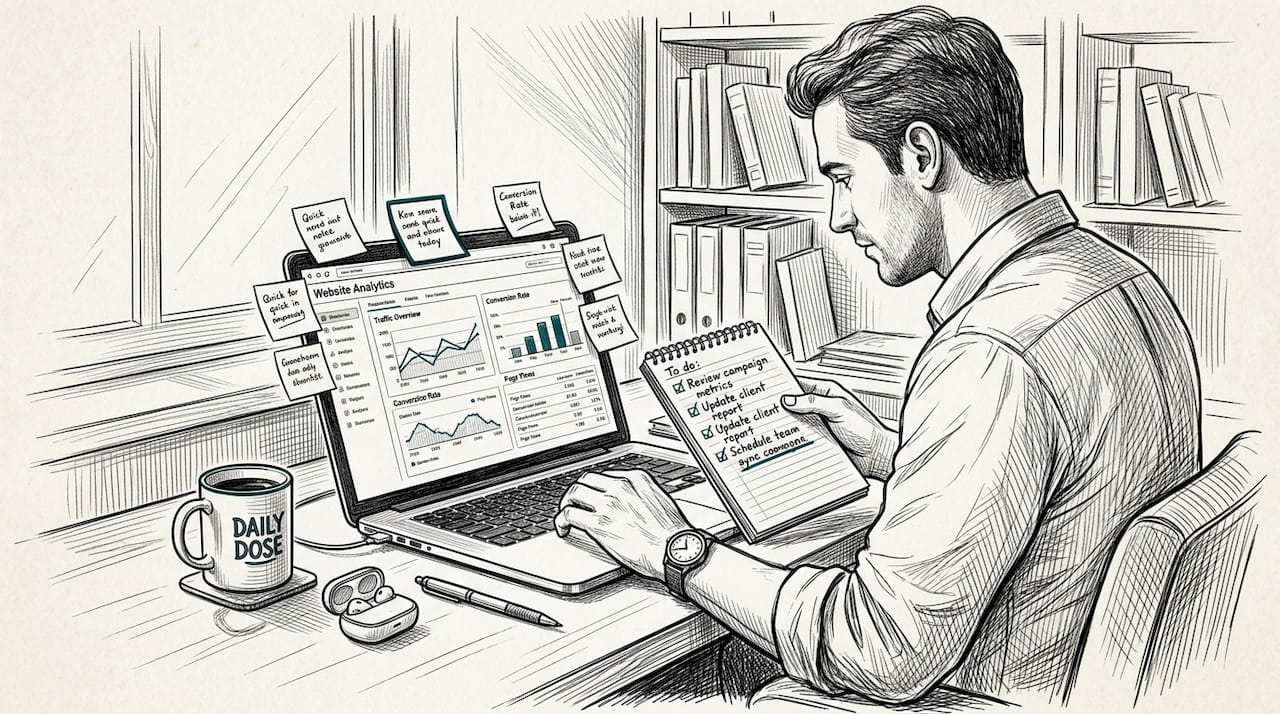
Pro Tip: Skip basic pop-ups that fire immediately on page load. Start with automation-ready embedded forms and exit-intent triggers connected to Klaviyo via native integration. This setup lets you track behavior, tag subscribers at the point of capture, and launch targeted flows from day one.
Step-by-step lead generation process for e-commerce
With your tools and website fundamentals in place, here is how to build and launch a lead generation funnel that actually converts, step by step.
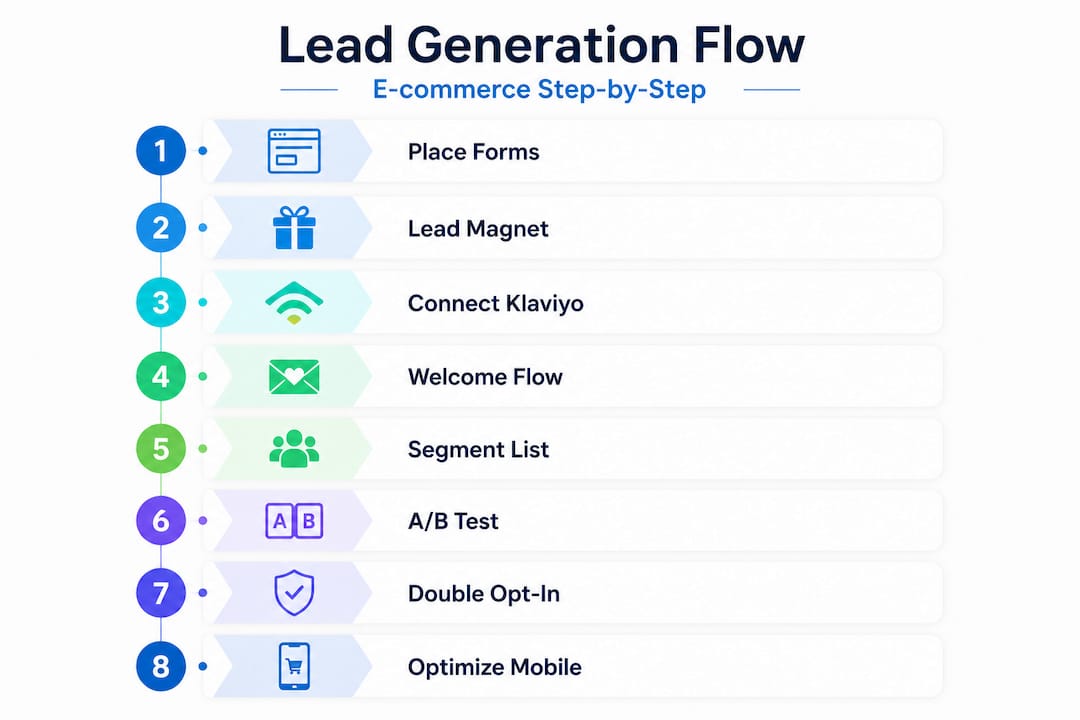
Step 1: Place forms strategically.
Stop putting your sign-up form only in the footer. Test inline forms within product description pages, embedded forms on collection pages, and exit-intent pop-ups triggered after 30 seconds or when the cursor moves toward the browser bar. Each placement targets a different level of intent.
Step 2: Offer a lead magnet with real perceived value.
A 10% discount is table stakes. High-performing brands use quizzes (“Find your perfect skincare routine”), gated guides (“The 2026 Gift Guide for Outdoor Enthusiasts”), or early-access offers to drive signups. The more specific and relevant the offer, the higher the conversion rate.
Step 3: Connect your forms directly to Klaviyo.
Use Klaviyo’s native Shopify integration or a form tool like Privy or JustUno with Klaviyo sync enabled. Tag every subscriber at the point of capture with the source, offer, and page URL so you can segment later.
Step 4: Launch a targeted welcome flow immediately.
Your welcome flow is not a single email. It is a 3 to 5 email sequence that introduces your brand story, delivers the lead magnet, showcases bestsellers, and handles objections. Automated flows drive higher click and placed order rates than manual campaigns, and your welcome flow is the highest-engagement point in the entire customer journey.
Step 5: Segment your list from day one.
Use Klaviyo’s conditional splits inside your flows to send different messages based on how someone signed up. A quiz respondent who said she has dry skin should not get the same email as someone who clicked a discount pop-up. Real segmentation is what separates stores that see revenue from flows versus stores that just see opens. Brands that invest in segmentation see results like 37% year-over-year flow revenue growth and up to 126% click rate lifts.
Step 6: A/B test every major form and flow element.
Test one variable at a time: headline copy, button color, offer type, email send delay. Give each test at least 500 recipients before drawing conclusions.
Step 7: Enable double opt-in for high-intent audiences.
Double opt-in reduces list bloat and improves deliverability. For most e-commerce stores selling to consumers in the U.S. and Europe, it also protects you against spam complaints that can tank your sender reputation.
Step 8: Optimize every step for mobile.
More than 60 percent of e-commerce traffic comes from mobile devices. If your form does not render cleanly on a 375-pixel screen, you are losing more than half your potential leads before they even see your offer. Check your step-by-step email automation setup on at least three device sizes before going live.
| Strategy | Average click rate | Average placed order rate |
|---|---|---|
| Manual blast campaigns | 1.0 to 2.5% | 0.1 to 0.3% |
| Klaviyo automated flows | 3.0 to 8.0%+ | 0.5 to 2.0%+ |
| Segmented automated flows | 8.0 to 15%+ | 1.5 to 4.0%+ |
These outcomes compound over time. You can find automation examples from real e-commerce brands that show exactly how each additional layer of segmentation and automation multiplies revenue without multiplying effort.
Pro Tip: Use Klaviyo’s predictive analytics to identify subscribers with a high likelihood to purchase within 90 days. Route them into a tighter, more aggressive flow and boost conversions with Klaviyo flows built around urgency and social proof. Predictive segmentation alone can produce 3x or more engagement compared to flat list broadcasts.
Common pitfalls and how to avoid them
Even the best-planned lead generation system can fail if you fall into these traps. We see these mistakes regularly, and they are fixable once you know what to look for.
Mistakes that quietly kill your results:
- Generic pop-ups with no targeting: A pop-up that fires for every visitor regardless of source, page, or behavior collects low-quality leads and trains your audience to dismiss your forms
- No A/B testing: Brands that never test their forms often leave 30 to 50 percent of potential leads on the table because they assume their first idea was their best idea
- Ignoring mobile visitors: A form that takes up the full screen on mobile, cannot be dismissed, or loads slowly will hurt bounce rate and hurt conversions
- Prioritizing volume over quality: Buying leads, running giveaways with no product relevance, or offering discounts to everyone who visits inflates your list while destroying your email metrics
- Skipping tracking after capture: Collecting email addresses without tracking what those subscribers do next means you can never identify what is working
“Transactional pop-ups that interrupt the browsing experience damage user trust and brand perception. Brands that replace them with interactive quizzes generate 20% more leads without the negative UX tradeoff.”
One of the most expensive mistakes we see is treating lead generation as purely a numbers game. A large list full of unengaged subscribers destroys deliverability, which hurts every email you send, even to your best customers. You need to balance quantity and quality by tracking lead-to-customer conversion rates, not just signup volume. That single metric shift changes how you evaluate every form, every offer, and every flow.
If you want to scale sustainably, learn how to increase online sales with automation by connecting lead quality signals directly to your Klaviyo segments.
Pro Tip: Score your leads by behavior inside Klaviyo. Subscribers who open every email, click product links, and visit your site multiple times are high-intent. Move them to a dedicated “hot leads” segment and trigger your most persuasive flow sequences for them specifically.
How to measure and optimize your lead generation results
Sustainable lead generation is not about a one-time setup. It is about measuring what works, cutting what does not, and iterating every 30 to 60 days.
Key metrics to track:
- Open rate: Indicates subject line quality and list health (Klaviyo benchmark varies by industry, but 30 to 45% for flows is a strong target)
- Click rate: Measures content relevance and call-to-action strength
- Placed order rate: The ultimate flow performance metric; this is what turns email marketing into revenue
- Lead-to-customer conversion rate: The percentage of new subscribers who make a purchase within 30, 60, or 90 days
- Revenue per recipient (RPR): How much revenue each email generates per subscriber sent
The top 10% of Klaviyo flows see $7.79 revenue per recipient, which is a useful benchmark for ambitious brands. If your flows are generating less than $1 RPR, your segmentation, offer, or sequence structure likely needs attention.
| Stage | What to track | Target action |
|---|---|---|
| Capture | Form conversion rate, source of signup | Optimize form placement and offer |
| Nurture | Open rate, click rate, unsubscribe rate | Refine content and sending frequency |
| Conversion | Placed order rate, RPR, lead-to-customer rate | Sharpen CTA and sequence timing |
| Retention | Repeat purchase rate, list growth rate | Add post-purchase and loyalty flows |
The benefits of email automation become clearest when you look at long-term compounding: brands using best practices have seen results like 163x ROI, tripled email revenue, and up to 77% year-over-year list growth. Those numbers are not accidents; they are the result of measuring the right things and optimizing based on data rather than gut feel.
Use progressive profiling to gather more subscriber data over time. Ask quiz questions inside your flows, use Klaviyo’s custom properties to store preferences, and use that data to personalize every subsequent message. Explore the full automation guide to map out the optimization cycle for each stage of your funnel.
What most e-commerce brands get wrong about lead generation
Here is the uncomfortable truth we have learned from working with dozens of e-commerce brands: most of them celebrate the wrong things. They see a spike in signups after launching a new pop-up and declare the campaign a success. Then, 60 days later, they wonder why revenue has not moved.
The real problem is a fixation on top-of-funnel volume without any system for qualifying, scoring, or nurturing those leads into customers. An email list of 50,000 cold, unengaged subscribers is not an asset. It is a liability that actively damages your sender reputation and skews every metric you use to make decisions.
The brands that actually grow revenue from lead generation are the ones that treat their list like a living database, not a vanity metric. They use MQL and SQL frameworks (marketing-qualified and sales-qualified lead criteria) to separate browsers from buyers. They apply qualification frameworks early, route high-intent subscribers into accelerated flows, and suppress low-intent subscribers before they drag down open rates.
“Multi-channel approaches and qualification frameworks are crucial for sustainable lead generation. Single-channel dependence is a risk, not a strategy.”
The other mistake is single-channel dependency. Brands that rely entirely on email capture miss out on the leads who are more likely to respond to SMS, push notifications, or retargeting. Multi-channel lead strategies consistently deliver up to 3x more leads and better overall ROI. Your Klaviyo flows should be one layer in a broader system, not the entire system.
If you want to build something that scales, start with a workflow for qualified leads that defines what a “good” lead looks like for your specific store, then build your capture and nurture system backward from that definition.
Accelerate your e-commerce growth with proven automation
Ready to put this framework into action? At Swyft Interactive, we specialize in building exactly the kind of integrated lead generation systems this article describes: conversion-optimized e-commerce websites paired with sophisticated Klaviyo automation that captures, qualifies, and converts.
Our clients do not just get a Klaviyo setup. They get a full-funnel growth engine, including customer journey mapping, flow architecture, form strategy, and ongoing optimization based on real revenue data. If you want to skip the trial-and-error phase and implement a proven system, start with our step-by-step automation resources, explore the Klaviyo automation advantages that drive results for growing brands, and use our email automation guide to build out your complete flow library. When you are ready for expert strategy, we are here.
Frequently asked questions
How does Klaviyo automation improve lead quality versus manual campaigns?
Klaviyo automated flows deliver behavior-triggered messages at precisely the right moment in the customer journey, which means higher relevance, more engagement, and better conversion rates. Klaviyo flows outperform campaigns in revenue, click, and open rates across every industry benchmark.
What website elements best increase lead capture for e-commerce?
Value-driven quizzes, mobile-optimized sign-up forms, and visible privacy assurances consistently outperform generic discount pop-ups. Quizzes boost capture by 20% while mobile-friendly forms are essential given that the majority of e-commerce traffic now comes from smartphones.
How should I measure the success of my lead generation process?
Go beyond raw signup counts and focus on lead-to-customer conversion rate and revenue per recipient. Benchmarking RPR and conversion data from Klaviyo gives you realistic targets to aim for and clear signals when a flow needs improvement.
How soon should I follow up with new leads captured through my e-commerce site?
Send an automated welcome email within minutes of signup, not hours. Email automation drives higher engagement when triggered by real-time behavior, and delays in your welcome sequence directly reduce open rates and first-purchase conversion.
What is the risk of using only one channel for lead generation?
Single-channel dependence creates fragility in your revenue pipeline and limits your reach to the audience segments who prefer other formats. Multi-channel lead strategies generate up to 3x more leads than single-channel approaches, with better overall ROI across the customer lifecycle.