
TL;DR:
- Post-purchase automation boosts customer retention and lifetime value through targeted follow-up emails.
- Key workflows include order confirmation, shipping updates, review requests, and personalized recommendations.
- Effective automation relies on segmentation, consistency, testing, and choosing the right tools to track performance.
Most eCommerce brands pour their energy into getting customers to click “buy,” then go quiet the moment the order is confirmed. That silence is expensive. Post-purchase automation can significantly increase repeat purchases and customer lifetime value, yet most brands treat the post-checkout experience as an afterthought. This article breaks down exactly what post-purchase automation is, why it drives real growth, and how to build workflows that turn one-time buyers into loyal, high-value customers.
Table of Contents
- What is post-purchase automation?
- Why does post-purchase automation matter for eCommerce growth?
- Core workflows in post-purchase automation
- Best practices for effective post-purchase automation
- Choosing the right tools and measuring success
- Our perspective: What most eCommerce brands miss about post-purchase automation
- Accelerate your eCommerce growth with expert automation
- Frequently asked questions
Key Takeaways
| Point | Details |
|---|---|
| Drive repeat purchases | Post-purchase automation keeps customers engaged and motivates them to buy again. |
| Boost customer loyalty | Timely, relevant follow-ups help create a loyal audience around your brand. |
| Cut manual workload | Automated workflows mean fewer repetitive tasks and more consistent customer experiences. |
| Measure and optimize | Track your post-purchase metrics to refine and maximize your automation strategy. |
What is post-purchase automation?
Post-purchase automation is the practice of using technology to trigger relevant communications and workflows the moment a customer completes an order. Instead of manually sending follow-up emails or relying on your team to remember every touchpoint, automation handles it for you, consistently and at scale.
To understand it fully, it helps to compare it to pre-purchase automation. Pre-purchase flows focus on moving shoppers toward a first sale: welcome sequences, browse abandonment emails, and cart recovery campaigns. Post-purchase automation picks up right where those leave off. As email marketing automation guides explain, post-purchase automation refers to using technology to deliver timed, relevant messages and workflows after a customer completes an order.
The post-purchase experience covers a wide range of touchpoints. Here are the most common ones:
- Order confirmation emails: Sent immediately after checkout to reassure the customer their order went through
- Shipping updates: Real-time notifications that reduce customer anxiety and support inquiries
- Product review requests: Timed to arrive after the customer has received and used the product
- Cross-sell and upsell offers: Personalized recommendations based on what the customer just bought
- Thank you emails: Simple messages that reinforce brand loyalty and make customers feel valued
- Replenishment reminders: Useful for consumable products, reminding customers when it’s time to reorder
The immediate benefits are straightforward. You reduce the manual workload on your team, eliminate the risk of missed follow-ups, and deliver a consistent customer experience every time. If you want a broader view of how this fits into your overall strategy, exploring the types of eCommerce automation available can help you see where post-purchase flows fit into the bigger picture.
“Automation doesn’t replace the human touch in eCommerce. It protects it by making sure no customer ever feels forgotten after they buy.”
That distinction matters. When customers feel cared for after the sale, they come back. When they don’t hear from you, they forget you exist.
Why does post-purchase automation matter for eCommerce growth?
Here’s a number worth sitting with: brands using post-purchase automation see a 40% higher chance of customer return. That’s not a marginal improvement. That’s a structural advantage over brands that skip this step.
The core argument for post-purchase automation comes down to economics. Acquiring a new customer costs five to seven times more than retaining an existing one. When you invest in keeping the customers you already have, every dollar works harder. Automated emails after purchase drive repeat purchases and lift customer lifetime value, which is the single most important metric for sustainable eCommerce growth.
Here’s a quick look at how retention stacks up against acquisition:
| Metric | Acquisition focus | Retention focus |
|---|---|---|
| Cost per customer | High | Low |
| Purchase likelihood | Lower | Higher |
| Revenue per customer | Single transaction | Multiple transactions |
| Brand loyalty | Minimal | Strong |
The email automation benefits go beyond just saving time. When you automate post-purchase communications, you also gather behavioral data that tells you who your best customers are, what they buy, and when they’re likely to return. That data becomes the foundation for smarter segmentation and better campaigns over time.
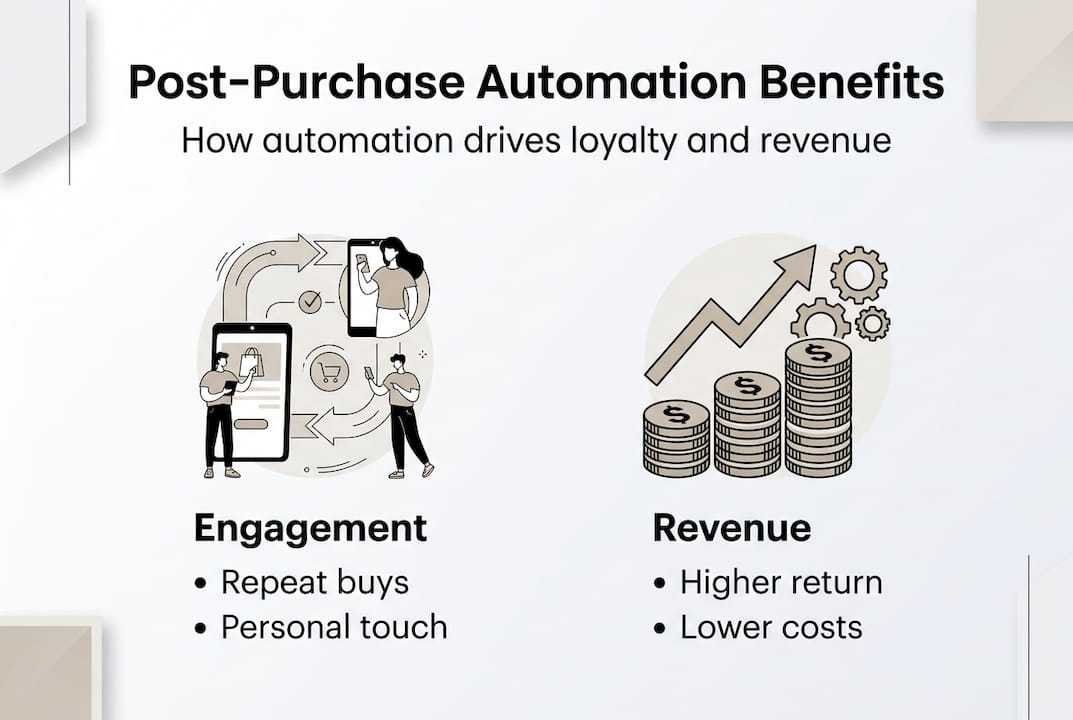
Personalization is where most brands leave money on the table. Sending the same generic “thanks for your order” email to every customer ignores the fact that a first-time buyer needs different messaging than a loyal repeat customer. Data-driven automation lets you segment your audience and tailor messaging based on purchase history, product category, and customer behavior.

Pro Tip: Segment your post-purchase flows by customer type from day one. New buyers need reassurance and education. Returning customers respond better to loyalty rewards and exclusive offers. Don’t treat them the same.
For a deeper look at what the best post-purchase email strategies look like in practice, studying high-performing brands in your niche is a great starting point.
Core workflows in post-purchase automation
Knowing that post-purchase automation works is one thing. Knowing exactly what to build is another. The most effective eCommerce brands rely on a set of foundational flows that cover the full post-purchase journey.
As outlined in step-by-step guides, order confirmation, shipping notifications, product education, and review requests are the foundational automated flows every store needs. Here’s how to think about building them:
- Order confirmation: Send within minutes of purchase. Include order details, expected delivery window, and a customer service contact. This email has the highest open rate of any message you’ll send.
- Shipping update: Trigger when the order ships. Include tracking information and set clear expectations for delivery timing.
- Product education: For complex or premium products, send a how-to guide or tips email two to three days after delivery. This reduces returns and builds confidence.
- Review request: Send five to seven days after estimated delivery. Keep it short and make leaving a review effortless.
- Cross-sell or upsell offer: Send seven to fourteen days post-purchase. Base recommendations on what the customer bought, not just what’s popular.
Here’s how manual and automated workflows compare:
| Factor | Manual workflow | Automated workflow |
|---|---|---|
| Speed | Delayed, inconsistent | Instant, reliable |
| Personalization | Limited by team capacity | Scalable with segmentation |
| Consistency | Varies by team member | Identical every time |
| Cost over time | Increases with volume | Fixed or decreasing |
For real-world inspiration, reviewing automation email examples from successful eCommerce brands can spark ideas you can adapt immediately. The Klaviyo post-purchase email guide is also a practical resource for platform-specific setup.
Pro Tip: Don’t skip post-purchase education for complex or high-ticket products. A well-timed “how to get the most from your purchase” email reduces buyer’s remorse, cuts support tickets, and makes customers feel confident in their decision.
Best practices for effective post-purchase automation
Building the workflows is step one. Making sure they perform at a high level over time is the ongoing work. Here’s what separates brands that get results from those that don’t.
Segmentation is non-negotiable. Sending the right message to the right person at the right time is the foundation of effective automation. A customer who just bought for the first time should not receive the same email as someone on their fifth purchase. Use purchase history, product category, and order value to drive your segmentation logic.
Brand consistency matters more than you think. Every post-purchase email is a brand touchpoint. Your tone, visual design, and messaging should feel seamless across every communication. Customers who experience a disjointed brand voice after purchase lose confidence in the brand overall.
As email marketing automation best practices confirm, personalized, timely content and optimization based on customer feedback distinguishes high-performing automated workflows from average ones.
Here are the most common mistakes to avoid:
- Over-automating: Sending too many emails too quickly trains customers to ignore you or unsubscribe
- Ignoring mobile: Most post-purchase emails are opened on mobile devices, so design for small screens first
- Skipping testing: Never assume your flows are working. A/B test subject lines, send times, and content regularly
- Neglecting suppression lists: Remove customers who have recently purchased from acquisition campaigns to avoid tone-deaf messaging
For automation efficiency tips specific to Klaviyo, there are detailed guides that walk through flow logic, suppression settings, and performance benchmarks.
“The brands that win long-term are the ones that treat post-purchase automation as a living system, not a set-and-forget task.”
Pro Tip: Use the data your automation generates to run quarterly reviews. Look at open rates, click rates, and repeat purchase rates by flow. Then adjust timing, content, or segmentation based on what the numbers tell you. This is how you compound results over time.
For a broader view of email marketing automation best practices, industry resources can help you benchmark your performance against other eCommerce brands.
Choosing the right tools and measuring success
The best post-purchase automation strategy in the world won’t deliver results if it’s built on the wrong platform. Choosing the right tool matters, and so does knowing which numbers to watch.
As leading resources confirm, selecting the right platform and consistently measuring key metrics are essential for lasting eCommerce success. When evaluating tools, look for these core features:
- Native eCommerce integrations: Your platform should connect seamlessly with Shopify, WooCommerce, or your store’s backend
- Visual flow builder: Drag-and-drop workflow editors make it easier to build and adjust sequences without developer help
- Advanced segmentation: The ability to filter audiences by purchase history, behavior, and product category
- Analytics and reporting: Built-in dashboards that show revenue per recipient, flow performance, and engagement trends
- A/B testing capabilities: The ability to test variations within flows without breaking the entire sequence
Popular platforms worth evaluating include Klaviyo, Omnisend, and Mailchimp. Klaviyo is widely regarded as the strongest option for data-driven eCommerce brands. For a broader comparison, reviewing top eCommerce automation tools can help you weigh your options.
Once your flows are live, track these key performance indicators:
| KPI | What it tells you |
|---|---|
| Repeat purchase rate | How well your flows drive second and third purchases |
| Revenue per recipient | The direct revenue impact of each automated email |
| Email open rate | Whether your subject lines and send times are working |
| Unsubscribe rate | Whether you’re sending too frequently or missing relevance |
| Click-through rate | Whether your content and offers are compelling enough |
For a deeper look at how to structure your automation stack, the automation platform comparison guide walks through the decision-making process in detail.
Our perspective: What most eCommerce brands miss about post-purchase automation
After working with dozens of eCommerce brands, we’ve noticed a consistent pattern. Brands invest heavily in pre-purchase marketing, fine-tuning their ads, optimizing their product pages, and perfecting their cart recovery flows. Then the customer buys, and the experience falls apart.
Post-purchase emails become generic transactional messages with zero personality. Or worse, they stop entirely after the shipping confirmation. The brands that grow sustainably are the ones that treat the post-purchase window as the most important part of the customer relationship, not the least.
The uncomfortable truth is that a single thoughtful post-purchase sequence can do more for your long-term revenue than months of acquisition spending. It’s not about sending more emails. It’s about sending the right ones, at the right moment, with a message that makes the customer feel like you actually know them.
The brands we see winning consistently are those that build automation growth strategies with the post-purchase journey at the center, not as an afterthought bolted on at the end.
Accelerate your eCommerce growth with expert automation
If you’re ready to build post-purchase flows that actually move the needle, the right guidance makes all the difference. At Swyft Interactive, we specialize in building and refining Klaviyo automation strategies for eCommerce brands that want measurable results, not just more emails in the queue.
Our automation guide is a strong starting point if you want to understand the full picture before diving in. If you’re ready to map out your specific flows, the automation workflow steps guide walks you through the process from segmentation to send. And if you want a custom strategy built for your store, we’re here to help you get it right from the start.
Frequently asked questions
What is post-purchase automation in eCommerce?
Post-purchase automation uses technology to automatically send emails and trigger workflows after a customer buys, keeping them engaged and informed without manual effort from your team.
How can post-purchase automation increase revenue?
Automated follow-ups encourage repeat purchases, build loyalty, and surface additional offers at the right moment. Automated post-purchase campaigns can boost loyalty by up to 40%, which directly translates to more revenue from your existing customer base.
Which post-purchase emails should every online store use?
Every store needs order confirmation, shipping notifications, review requests, and tailored cross-sell or upsell offers. These core post-purchase flows form the foundation of an effective retention strategy.
What tools are best for post-purchase automation?
Top platforms like Klaviyo, Omnisend, and Mailchimp offer strong post-purchase automation features built for eCommerce. Selecting top automation tools that integrate natively with your store is the most important first step.
What metrics should I track to measure post-purchase automation success?
Focus on repeat purchase rate, revenue per recipient, and email engagement to gauge performance. Tracking KPIs like repeat purchase rate gives you the clearest picture of whether your flows are driving real business results.