
Managing ecommerce marketing can feel like juggling a hundred moving parts when every message needs to reach the right customer at the right moment. Facing competition from other American brands, the pressure to deliver personalized, timely emails is higher than ever. Using Klaviyo’s powerful automation and real-time data integration lets you create campaigns that follow each customer’s journey, turning touchpoints into true engagement opportunities and driving steady sales growth.
Table of Contents
- Step 1: Define Ecommerce Goals And Map Customer Journeys
- Step 2: Integrate Klaviyo With Your Ecommerce Platform
- Step 3: Segment Audiences And Set Up Targeted Lists
- Step 4: Create Automated Workflows For Key Customer Actions
- Step 5: Test, Optimize, And Monitor Automation Performance
Quick Summary
| Key Insight | Explanation |
|---|---|
| 1. Define clear ecommerce goals | Establish measurable goals like increasing average order value and reducing cart abandonment to guide your marketing. |
| 2. Map customer journeys meticulously | Understand customer stages and touchpoints to create personalized experiences that enhance engagement and conversion. |
| 3. Integrate Klaviyo effectively | Connect Klaviyo to your ecommerce platform for seamless data syncing, enabling targeted marketing automation campaigns. |
| 4. Segment audiences for targeting | Organize customers into meaningful segments like demographics and behaviors to personalize email communications. |
| 5. Continuously test and optimize | Monitor email marketing metrics and conduct A/B tests to refine workflows and improve overall campaign performance. |
Step 1: Define ecommerce goals and map customer journeys
Defining clear goals and mapping your customer journey is the strategic foundation for successful email marketing automation. By understanding your customer’s path from initial awareness to purchase and beyond, you’ll create targeted experiences that drive growth and engagement.
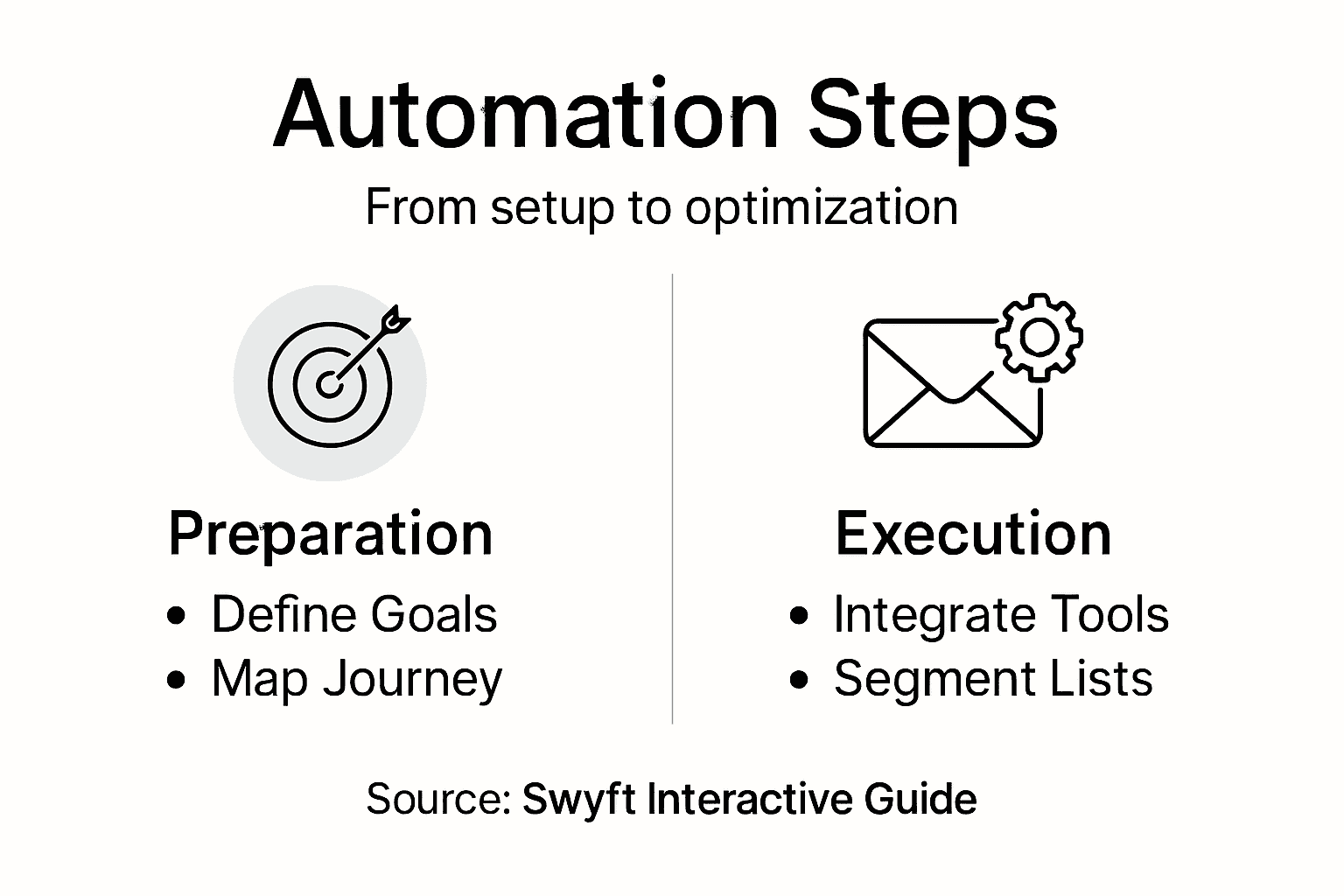
Start by establishing precise, measurable ecommerce goals that align with your business objectives. These might include increasing average order value, reducing cart abandonment, improving customer retention, or generating more repeat purchases. To create an effective customer journey map, consider these key elements:
- Customer stages: Awareness, consideration, purchase, post-purchase
- Touchpoints: Website visits, email interactions, social media engagement
- Customer emotions: Identify potential pain points and moments of delight
- Conversion opportunities: Pinpoint where customers might need additional motivation
Break down your customer journey into specific segments, tracking how different customer groups interact with your brand. This involves analyzing behavioral data, purchase history, and engagement metrics to understand unique paths to conversion. Pay special attention to:
Here’s a quick reference to customer journey mapping elements and their impact:
| Mapping Element | Description | Marketing Impact |
|---|---|---|
| Customer Stages | Phases from awareness to loyalty | Refines messaging for each phase |
| Touchpoints | All customer-brand interaction points | Identifies opportunities to engage |
| Customer Emotions | Pain points and moments of delight | Guides empathetic communication |
| Conversion Opportunities | Decision points needing extra motivation | Boosts conversion and retention |
- Identifying critical decision-making moments
- Mapping potential friction points in the purchasing process
- Understanding which interactions drive the most value
A comprehensive customer journey map provides a 360-degree view of how customers engage with your brand across multiple channels and touchpoints.
By meticulously defining your goals and mapping customer journeys, you’ll create a foundation for personalized, automated email marketing strategies that speak directly to customer needs and motivations.
Pro tip: Use analytics tools to continuously refine your customer journey map, tracking real-world interactions and adjusting your automation strategies based on actual customer behavior.
Step 2: Integrate Klaviyo with your ecommerce platform
Connecting Klaviyo to your ecommerce platform is a critical step in creating a powerful email marketing automation system. This integration enables seamless data synchronization and sets the foundation for targeted, personalized marketing campaigns.
Klaviyo offers native integrations with major ecommerce platforms like Shopify, BigCommerce, Magento, and WooCommerce, making the connection process straightforward. To get started, follow these key steps:
- Locate the integration: Find Klaviyo in your platform’s app store or plugin directory
- Connect account credentials: Use API keys or OAuth for secure connection
- Authorize data sync: Confirm permissions for customer and order data transfer
- Verify connection: Check that data is flowing correctly between platforms
During the integration process, you’ll want to ensure that critical data points are being synchronized:
- Customer contact information
- Purchase history
- Product details
- Browsing behaviors
- Engagement metrics
Seamless integration allows real-time tracking of customer interactions, enabling more precise and timely marketing automation.
The integration process typically takes 15-30 minutes and provides immediate access to historical and real-time store data. This allows you to build sophisticated email and SMS campaigns without manual data management.

Pro tip: Double-check your data mapping to ensure all critical customer attributes are correctly transferred during the initial platform integration.
Step 3: Segment audiences and set up targeted lists
Audience segmentation is the strategic cornerstone of effective email marketing, transforming generic campaigns into precision-targeted communications that resonate with specific customer groups. By dividing your customer base into meaningful segments, you’ll create more personalized and engaging marketing experiences.
To develop powerful audience segments, consider these critical categorization dimensions:
Use this table to compare popular segmentation types in Klaviyo:
| Segmentation Type | What It Focuses On | Example Use Case |
|---|---|---|
| Demographic | Age, income, education | Target new product by age group |
| Behavioral | Purchase and engagement history | Re-engage past buyers |
| Geographic | Customer location or shipping | Offer local promotions |
| Psychographic | Lifestyles and values | Promote relevant brand stories |
- Demographic segmentation: Age, income, occupation, education level
- Behavioral segmentation: Purchase history, website interactions, engagement frequency
- Geographic segmentation: Location, shipping regions, local preferences
- Psychographic segmentation: Lifestyle, interests, values, purchasing motivations
In Klaviyo, you can create segments using combinations of these attributes to build highly targeted lists:
- Navigate to the Audiences section
- Select “Create New Segment”
- Choose your filtering criteria
- Name your segment descriptively
- Save and activate the segment
Effective segmentation allows you to craft messages that feel personally crafted for each customer group, dramatically improving engagement and conversion rates.
By implementing sophisticated segmentation strategies, you transform generic email blasts into personalized conversations that speak directly to each customer’s unique needs and preferences.
Pro tip: Regularly review and refresh your audience segments to ensure they remain accurate and reflect evolving customer behaviors and preferences.
Step 4: Create automated workflows for key customer actions
Automated email workflows transform how ecommerce brands interact with customers, enabling personalized, timely communications triggered by specific customer behaviors. Designing strategic marketing automation workflows allows you to create intelligent, responsive email sequences that engage customers precisely when they’re most receptive.
Klaviyo offers powerful workflow creation tools to help you build sophisticated automation sequences. Key customer action workflows to consider include:
- Welcome series: Engage new subscribers immediately after signup
- Abandoned cart: Remind customers about unpurchased items
- Post-purchase: Thank customers and encourage repeat buying
- Browse abandonment: Re-engage customers who viewed products
- Winback campaigns: Reconnect with inactive customers
To create an effective automated workflow in Klaviyo:
- Select the trigger event
- Define audience conditions
- Build email sequence
- Set time delays between messages
- Configure branching logic
- Test and activate workflow
Successful automation transforms generic marketing into personalized, contextually relevant customer experiences that feel individually crafted.
By implementing these targeted workflows, you’ll create a dynamic marketing system that responds intelligently to customer actions, driving engagement and revenue without constant manual intervention.
Pro tip: Always include an exit criteria in your workflows to prevent customers from receiving redundant or irrelevant communications.
Step 5: Test, optimize, and monitor automation performance
Continuous performance monitoring is crucial for maintaining the effectiveness of your email marketing automation strategy. Email marketing optimization requires systematic performance analysis to ensure your campaigns deliver maximum engagement and return on investment.
In Klaviyo, track these critical performance metrics to gauge your automation effectiveness:
- Open rates: Measure initial email engagement
- Click-through rates: Evaluate content relevance
- Conversion rates: Track final purchase outcomes
- Revenue per recipient: Calculate direct campaign impact
- Unsubscribe rates: Monitor audience satisfaction
To optimize your automated workflows:
- Establish baseline performance metrics
- Run A/B tests on subject lines and content
- Analyze segment-specific performance
- Adjust triggers and timing
- Refine email content based on insights
- Implement continuous improvement cycles
Successful email marketing automation is an iterative process that demands constant refinement and data-driven decision making.
By systematically testing and optimizing your workflows, you’ll create increasingly sophisticated automation sequences that adapt to your customers’ evolving behaviors and preferences.
Pro tip: Schedule monthly performance reviews to identify trends and make incremental improvements to your email marketing automation strategy.
Unlock Your Ecommerce Growth With Expert Email Automation
Struggling to turn customer data into meaningful engagement? This guide highlights the crucial steps of defining goals, mapping journeys, segmenting audiences, and crafting targeted Klaviyo workflows to boost ecommerce performance. If increasing conversions, reducing cart abandonment, and personalizing customer experiences are your goals these challenges can feel overwhelming. Swyft Interactive specializes in solving these issues by integrating sophisticated email automation with high-converting ecommerce websites to deliver measurable results.
Explore our Email Marketing Archives – Swyft Interactive to discover proven strategies tailored for ecommerce brands. Ready to transform your marketing funnel with expert guidance and data-driven campaigns? Visit Swyft Interactive to learn how we combine full-funnel digital strategy with Klaviyo automation. Dive deeper into tactics that avoid common pitfalls in You Suck At Klaviyo Archives – Swyft Interactive and start building your scalable sales engine today.
Frequently Asked Questions
What are the key goals for email marketing automation in ecommerce?
Establish precise and measurable goals such as increasing average order value, reducing cart abandonment, and improving customer retention. Start by defining what success looks like for your business and set specific targets to track progress.
How do I map the customer journey for email marketing?
Break down the customer journey into stages like awareness, consideration, purchase, and post-purchase. Identify touchpoints, customer emotions, and potential conversion opportunities to understand how customers interact with your brand.
What steps are involved in integrating Klaviyo with my ecommerce platform?
To integrate Klaviyo, locate it in your platform’s app store, connect account credentials using API keys or OAuth, authorize data synchronization, and verify that data is flowing correctly. Complete this process within 15-30 minutes to start leveraging your customer data for targeted campaigns.
How can I segment my audience effectively in Klaviyo?
Create meaningful segments by considering demographics, behaviors, geographic locations, and psychographics. Use the audience settings in Klaviyo to filter and categorize customers, making your campaigns more personalized and relevant.
What types of automated workflows should I create for ecommerce marketing?
Develop key automated workflows such as welcome series, abandoned cart reminders, post-purchase follow-ups, and winback campaigns for inactive customers. Identify the trigger events for each workflow to ensure timely and relevant communication.
How do I monitor and optimize my email marketing automation performance?
Regularly track performance metrics like open rates, click-through rates, and conversion rates to gauge effectiveness. Run A/B tests on different elements of your emails and adjust your strategies based on the insights gained to improve engagement within each campaign.