
TL;DR:
- Email marketing yields a higher return on investment than other channels, with top programs exceeding $70 per $1 spent. Segmentation, automation, personalization, and testing significantly boost revenue, while technical setup and analytics ensure effective delivery and accurate measurement. Building lifecycle-driven email flows and focusing on revenue-connected metrics drive sustainable ecommerce growth.
Email marketing ROI is defined as the revenue generated per dollar spent on email campaigns, and no digital channel comes close to matching it. Industry averages run $36–$42 per $1 spent, with top-performing programs exceeding $70 per $1 invested. By comparison, Google Ads returns roughly $8 per $1. This guide to increasing email ROI covers the four core levers that separate average programs from high-performing ones: segmentation, automation, campaign execution, and analytics. Apply all four together, and the compounding effect on returns is significant.
Which email marketing strategies most impact ROI?
Segmentation is the single highest-impact starting point for any ROI improvement effort. Segmented campaigns produce 14% higher open rates and 100% higher click-through rates compared to unsegmented blasts. That doubling of click-through rate alone can transform a mediocre campaign into a revenue driver without changing a single word of copy.

Automation amplifies segmentation results by delivering the right message at the right moment without manual effort. Automated lifecycle flows generate 41% of email revenue while accounting for only 5.3% of total emails sent. That ratio is striking. It means a well-built welcome series, abandoned cart sequence, or post-purchase flow produces more revenue per send than any broadcast campaign you schedule manually.
Personalization goes beyond inserting a first name. Aligning email content to a subscriber’s purchase history, browsing behavior, or lifecycle stage produces relevance that generic blasts cannot replicate. An ecommerce brand sending a replenishment reminder to customers who bought a consumable product 30 days ago will consistently outperform a brand sending the same promotional email to its entire list.
A/B testing provides the feedback loop that keeps all of the above improving. Rigorous A/B testing can achieve up to a 48:1 ROI when marketers test one variable at a time and act on results. Subject lines, send times, CTA button text, and offer framing are all testable elements. Test one per campaign, record the winner, and apply it forward.
- Segmentation: Divide your list by purchase history, engagement level, and lifecycle stage.
- Automation: Build welcome, abandoned cart, and post-purchase flows before scaling broadcast volume.
- Personalization: Match content to subscriber behavior, not just demographic data.
- A/B testing: Test one element per send and document every result.
Pro Tip: Set SMART goals (Specific, Measurable, Achievable, Relevant, Time-bound) for every campaign before you build it. Campaigns aligned to clear goals — revenue, retention, or reactivation — consistently outperform campaigns sent without a defined objective.
What tools and technical prerequisites maximize email ROI?
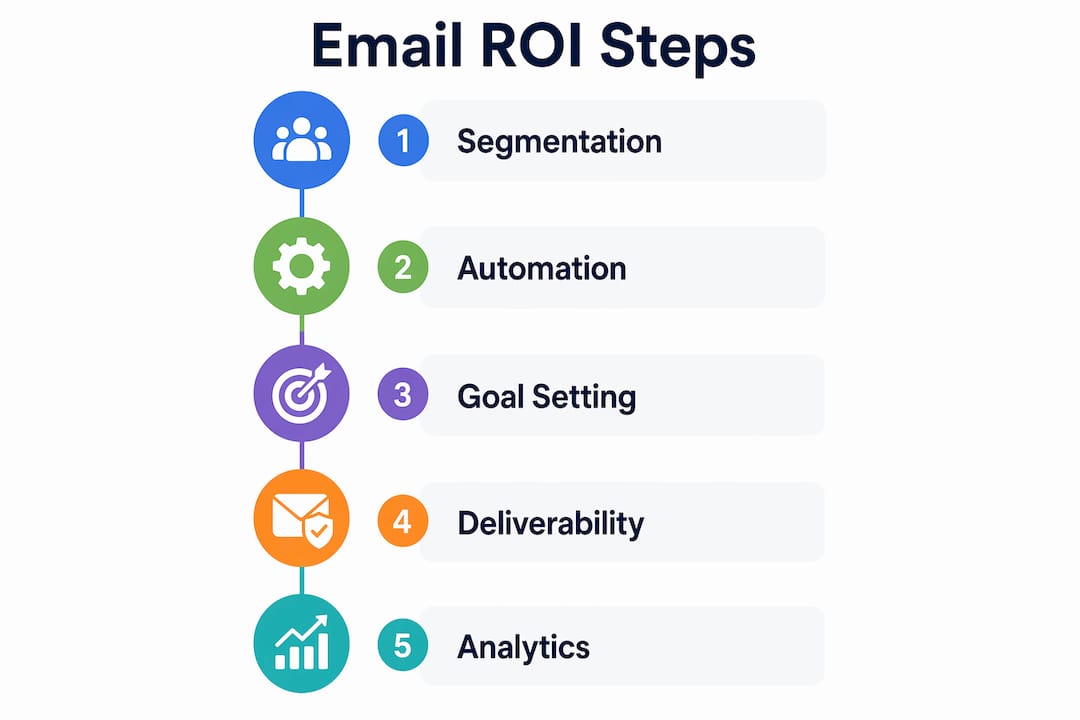
Deliverability is the foundation of every email ROI strategy. A perfectly written email that lands in spam generates zero revenue. Failing to meet technical authentication standards results in campaigns being filtered regardless of content quality. Gmail, Yahoo, and Microsoft all enforce SPF, DKIM, and DMARC authentication requirements, and maintaining a spam complaint rate below 0.3% is the threshold that keeps your sender reputation intact.
Your email service provider (ESP) and CRM integration determine how well you can act on subscriber data. An ESP that connects directly to your ecommerce platform lets you trigger flows based on real purchase events, not just form submissions. Klaviyo, for example, is built specifically for ecommerce data integration, which is why Swyftinteractive uses it as the core automation platform for client programs.
| Feature category | What to look for | Why it matters |
|---|---|---|
| Authentication | SPF, DKIM, DMARC setup | Protects sender reputation and inbox placement |
| Automation | Trigger-based flows, behavioral rules | Enables lifecycle revenue without manual sends |
| Analytics | Revenue per email, conversion tracking | Connects email activity to actual sales data |
| Segmentation | Dynamic lists, purchase-based filters | Powers relevant targeting at scale |
| CRM integration | Real-time ecommerce data sync | Keeps subscriber profiles accurate and current |
Analytics tools that connect email clicks to downstream purchases are not optional at a serious program level. Without revenue attribution, you are optimizing for open rates and missing the actual goal. Platforms with native ecommerce integrations make this connection automatic.
How to design and execute email campaigns for higher conversions
Campaign execution is where strategy either pays off or falls apart. The best segmentation and automation setup produces nothing if the emails themselves fail to convert. Every high-converting campaign shares four qualities: a subject line that earns the open, an offer worth clicking, a clear call to action, and a send time that matches audience behavior.
Subject lines and preview text together determine whether your email gets opened. Short, specific subject lines (under 50 characters) consistently outperform vague or clever ones. Preview text should extend the subject line’s promise, not repeat it. Testing subject line formats (question vs. statement, urgency vs. curiosity) gives you data on what your specific audience responds to.
- Define the campaign goal. Choose one: revenue, retention, reactivation, or activation. Every element of the email should serve that goal.
- Select the audience segment. Match the offer to the segment’s behavior or lifecycle stage.
- Write the subject line and preview text. Keep the subject under 50 characters. Make the preview text add new information.
- Build the offer and CTA. One primary offer per email. One primary CTA button. Remove competing links that dilute click intent.
- Set send time based on data. Review past campaign performance by day and hour. Send when your list has historically engaged most.
- Run an A/B test. Test one variable: subject line, CTA text, or send time. Never test multiple variables simultaneously.
- Review results within 48 hours. Record the winner and apply the learning to the next send.
Frequency is a common execution failure point. Over-emailing a list increases unsubscribes and spam complaints, which damages deliverability for every future send. Under-emailing leaves revenue on the table and allows list engagement to decay. Most ecommerce brands perform best with two to four broadcast emails per month, supplemented by automated flows that trigger based on behavior.
Pro Tip: The email campaign strategy guide framework recommends mapping every campaign to a specific customer journey stage before writing a single line of copy. This one habit eliminates the most common execution mistake: sending the right message to the wrong audience.
How to monitor email performance and continuously improve ROI
Revenue per email is the metric that matters most, and most marketers ignore it. Advanced analytics connecting email activity to downstream revenue correlates with up to 43% higher ROI among organizations that track it. Open rates and click rates tell you about engagement. Revenue per email tells you whether your program is actually working.
Vanity metrics like open rates can actively mislead you. Apple’s Mail Privacy Protection inflates open rate data for a significant portion of email clients, making open rate an unreliable signal for optimization decisions. Click-through rate, conversion rate, revenue per email, unsubscribe rate, and spam complaint rate are the metrics that reflect real performance.
- Click-through rate (CTR): Measures how compelling your offer and CTA are. A low CTR with a high open rate signals a weak offer or unclear CTA.
- Conversion rate: Tracks how many clickers complete the desired action. Low conversion often points to a landing page problem, not an email problem.
- Revenue per email: Divides total campaign revenue by total emails sent. This is your true ROI signal.
- Unsubscribe rate: A rising unsubscribe rate signals frequency or relevance problems.
- Spam complaint rate: Keep this below 0.3% to protect deliverability.
Running controlled tests and interpreting results correctly requires discipline. Change one variable, wait for statistical significance, and record the outcome before moving to the next test. Marketers who test multiple variables simultaneously cannot attribute results to any single change, which makes the data useless for future decisions. The email segmentation tutorial approach of isolating one audience variable at a time applies the same logic to list management.
Effective ROI improvement requires coordinated optimization of offers, targeting, email flows, and conversion paths together. Increasing send volume without improving these underlying factors does not increase ROI. It typically decreases it.
Key Takeaways
Maximizing email marketing ROI requires coordinated execution across segmentation, automation, campaign design, and revenue-connected analytics working together.
| Point | Details |
|---|---|
| Segmentation doubles click-through rates | Segmented campaigns produce 100% higher CTR than unsegmented blasts. |
| Automation drives disproportionate revenue | Lifecycle flows generate 41% of email revenue from only 5.3% of sends. |
| Deliverability is non-negotiable | SPF, DKIM, DMARC setup and sub-0.3% spam complaints protect inbox placement. |
| Revenue per email beats vanity metrics | Connecting email activity to actual sales data correlates with 43% higher ROI. |
| Test one variable at a time | Isolating single elements in A/B tests produces clear, actionable performance data. |
What I’ve learned about email ROI after years of ecommerce programs
The most common mistake I see marketing professionals make is treating email as a broadcast channel rather than a behavioral one. They build a list, send a weekly newsletter, and wonder why returns are flat. The answer is almost always the same: no segmentation, no automation, and no connection between email activity and revenue outcomes.
The second mistake is skipping infrastructure. I have watched well-funded brands launch sophisticated campaigns that landed in spam because SPF and DKIM were never configured. Automation workflows are the highest-leverage tactic available after you establish solid deliverability. But deliverability has to come first. No amount of creative or offer quality recovers a damaged sender reputation quickly.
What actually works is treating email as infrastructure, not a campaign channel. Every send should connect to a business objective. Every flow should map to a customer lifecycle stage. The lifecycle email strategy framework I return to most often is simple: welcome new subscribers, recover abandoned carts, and follow up after purchase. Those three flows alone, built correctly, will outperform most broadcast programs.
Technology and tactics are enablers. Strategic clarity is what drives results. Know what you want each email to do, build the infrastructure to support it, and test relentlessly. That is the entire playbook.
— Leon
Swyftinteractive’s email automation services for ecommerce ROI
Swyftinteractive builds email automation programs specifically for ecommerce brands that want measurable revenue growth, not just higher open rates.
The agency designs and implements welcome sequences, abandoned cart flows, and post-purchase campaigns using Klaviyo, with full segmentation and behavioral targeting built in from day one. Every program is tied to revenue metrics, not vanity numbers. Brands working with Swyftinteractive have seen documented improvements in conversion rates, list engagement, and email-attributed revenue. If you want a program built on the same principles covered in this guide, the Klaviyo email marketing services page is the right starting point. For a broader look at how automation fits into ecommerce growth, the ecommerce growth strategy resource covers the full picture.
FAQ
What is a good email marketing ROI benchmark?
Email marketing averages $36–$42 per $1 spent across industries, with top programs exceeding $70 per $1. Anything above $36 per $1 is considered strong performance.
How does segmentation increase email ROI?
Segmented campaigns produce 14% higher open rates and 100% higher click-through rates than unsegmented blasts. Higher engagement rates translate directly into more revenue per send.
What technical setup is required before running email campaigns?
SPF, DKIM, and DMARC authentication must be configured on your sending domain. Your spam complaint rate must stay below 0.3% to maintain inbox placement with major providers like Gmail and Yahoo.
Which email flows generate the most revenue?
Welcome, abandoned cart, and post-purchase flows are the highest-revenue automation sequences for ecommerce brands. These lifecycle email flows collectively account for a disproportionate share of email-attributed revenue relative to their send volume.
What metric should I prioritize to measure email ROI accurately?
Revenue per email is the most reliable ROI metric. Open rates are unreliable due to tracking limitations, and click rates measure engagement rather than business outcomes. Connect email clicks to actual purchase data for accurate measurement.