TL;DR:
- Lead nurturing is a systematic process of building trust with potential customers through personalized, multi-touch content until they are ready to buy.
- Effective programs align marketing and sales by using behavior-driven automation and segmentation across the buyer’s journey stages to convert leads into revenue.
Lead nurturing is defined as the systematic process of building relationships with potential customers by delivering relevant, personalized content at each stage of the buyer’s journey until they are ready to purchase. IBM defines lead nurturing as a multistep workflow where sales and marketing work together to educate and guide leads toward becoming paying customers. Without a structured nurturing program, most leads go cold. HubSpot reports that nurtured leads produce 50% more sales-ready prospects at 33% lower cost than non-nurtured leads. That gap is the business case for every tactic covered in this guide.
What is lead nurturing and how does it fit in the buyer’s journey?
Lead nurturing is not the same as lead generation. Generation captures attention. Nurturing converts that attention into trust, and trust into revenue. HubSpot describes lead nurturing as a purposeful process that engages a defined group with relevant information across every stage of the buyer’s journey, positioning your company as the obvious choice when the prospect is finally ready to buy.
The buyer’s journey maps neatly onto three funnel zones that every nurturing program must address:
- Top of funnel (TOFU): Prospects recognize a problem but have no solution in mind. Content here is educational: blog posts, explainer videos, and awareness-stage email sequences that introduce your brand without pushing a sale.
- Middle of funnel (MOFU): Prospects are actively evaluating options. Webinars, case studies, comparison guides, and product-specific email drips work best here because they address specific objections.
- Bottom of funnel (BOFU): Prospects are close to a decision. Free trials, personalized demos, and limited-time offers close the gap between interest and purchase.
The critical distinction between nurturing and a one-time email blast is sequence and intent. A single email does not convert a cold lead. A multi-touch sequence with aligned sales and marketing efforts is what moves a prospect from awareness to a signed contract. Marketing owns the early stages. Sales takes over once a lead crosses a defined readiness threshold, which is where lead scoring becomes the handoff mechanism.
Pro Tip: Define your sales-qualified lead (SQL) criteria in writing before you build any nurturing sequence. If marketing and sales disagree on what “ready” means, your best-nurtured leads will still fall through the cracks.
What are the common lead nurturing strategies and examples?
Effective nurturing programs are not monolithic. They split into three program types, each serving a different purpose:
- Engagement programs: Keep leads warm between active buying signals. Welcome sequences, re-engagement campaigns, and newsletter flows belong here.
- Education programs: Build authority and trust by teaching prospects something useful. Drip email courses, downloadable guides, and webinar series are the standard formats.
- Active funnel programs: Accelerate leads who have shown buying intent. Retargeting ads, personalized product recommendations, and direct sales outreach are the primary tools.
The tactics within each program type overlap significantly. Email sequences remain the backbone of most nurturing programs because they are measurable, scalable, and easy to personalize. Relevant emails drive 18x more revenue than broadcast emails sent to an undifferentiated list. That multiplier explains why segmentation is not optional.
Retargeting ads on platforms like Meta and Google extend nurturing beyond the inbox. A prospect who downloaded a product comparison guide but did not request a demo is a strong candidate for a retargeting sequence showing social proof and a low-friction next step. Webinars serve a dual purpose: they educate mid-funnel prospects while generating behavioral data (attendance, questions asked, drop-off points) that feeds back into your CRM for smarter follow-up.

Zendesk notes that CRM software automates email sending and lead segmentation within nurturing workflows, reducing the manual overhead that kills most programs before they gain momentum.
Pro Tip: Map each content asset to a specific funnel stage before you build your sequences. Sending a pricing page to a TOFU lead is the fastest way to lose them. Sending a thought leadership article to a BOFU lead wastes their time and yours.
| Strategy type | Best formats | Primary goal |
|---|---|---|
| Engagement | Welcome emails, newsletters, re-engagement flows | Keep leads warm and brand top of mind |
| Education | Drip courses, webinars, downloadable guides | Build trust and demonstrate expertise |
| Active funnel | Retargeting ads, demos, personalized offers | Accelerate purchase decisions |
How to use marketing automation and CRM tools in lead nurturing
Marketing automation is what separates a scalable nurturing program from a manual process that breaks under volume. Salesforce describes automated lead nurturing as using integrated CRM and sales tools to personalize sequences, build unified customer profiles, and scale engagement without proportional increases in headcount. That last point matters most for growing ecommerce brands where the lead volume outpaces team capacity quickly.
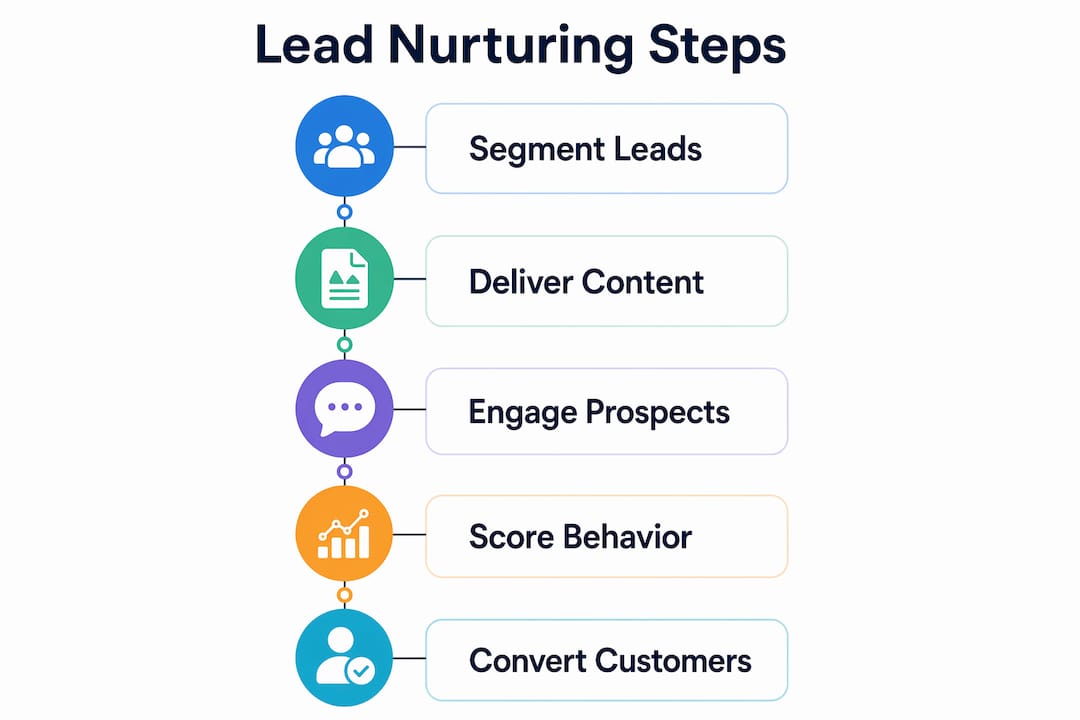
The core workflow in any automation-powered nurturing program follows this structure:
- A lead takes an action (downloads a guide, abandons a cart, attends a webinar).
- The CRM logs the behavior and updates the lead’s profile in real time.
- A trigger fires the next content asset in the appropriate sequence.
- Lead scoring adjusts based on cumulative behavior.
- Sales receives a notification when a lead crosses the SQL threshold.
Automation platforms score leads based on behavior and notify sales reps when leads are sales-ready, which prioritizes follow-up and optimizes conversion rates. Without this mechanism, sales teams waste time on cold leads while warm ones go uncontacted.
Tools like Klaviyo, HubSpot Marketing Hub, and Salesforce Marketing Cloud each handle the trigger-based sequencing differently, but the underlying logic is identical. The differentiator is data quality. Scaling lead nurturing is easiest when CRM and marketing automation systems consistently update lead context based on evolving engagement, rather than relying on stale drip sequences built once and never revised.
For ecommerce brands specifically, behavior-triggered automation tied to purchase history, browse data, and email engagement creates the kind of personalized marketing that generic drip campaigns cannot replicate. A returning visitor who viewed a product three times but did not buy is a fundamentally different lead than a first-time subscriber, and your automation should treat them that way.
What are the key metrics and how to measure lead nurturing effectiveness?
Measuring lead nurturing requires tracking metrics at each funnel stage rather than relying on a single conversion number. A program can look healthy at the top while leaking badly in the middle.
The metrics that matter most, organized by funnel stage:
- TOFU metrics: Email open rates, click-through rates, content download counts, and webinar registration numbers. These measure whether your nurturing content is relevant enough to earn attention.
- MOFU metrics: Webinar attendance rates, time-on-page for case studies, email sequence completion rates, and lead score progression. These measure whether prospects are moving forward or stalling.
- BOFU metrics: Demo request rates, free trial activations, and sales-qualified lead counts. These measure whether nurturing is producing leads that sales can actually close.
- Revenue metrics: Average deal size from nurtured versus non-nurtured leads, customer lifetime value, and retention rates. HubSpot data shows that nurtured leads make purchases 47% larger than non-nurtured leads, which means the revenue impact extends well beyond the initial conversion.
Reviewing these metrics monthly and adjusting sequence content, timing, and segmentation criteria keeps programs from going stale. Most nurturing programs underperform not because the strategy is wrong but because the content stops being updated after the initial build.
Common challenges and best practices in lead nurturing programs
The most common failure mode in lead nurturing is treating it like a broadcast channel. Segmented targeting and personalization keep leads engaged and build trust. Generic communications do the opposite. A prospect who receives an email clearly written for a different industry or funnel stage will unsubscribe faster than one who receives nothing at all.
The five best practices that separate high-performing programs from average ones:
- Segment by behavior, not just demographics. A lead who attended a webinar is fundamentally different from one who only opened a welcome email. Treat them differently in your sequences.
- Align sales and marketing on handoff criteria. Sales and marketing alignment is critical. If sales lacks updates on nurture engagement and intent, lead nurturing loses its effectiveness entirely.
- Refresh content quarterly. Stale sequences with outdated statistics or irrelevant offers erode trust. Set a calendar reminder to audit every active sequence every 90 days.
- Test timing and frequency. The optimal send cadence varies by industry and audience. A B2B SaaS prospect may tolerate weekly emails. An ecommerce shopper may disengage after three emails in a week.
- Use explicit handoff triggers, not gut feel. Effective nurturing programs use stage-appropriate education and explicit criteria for handing leads off to sales, avoiding premature exposure to sales-focused content that kills trust before it is built.
Pro Tip: Build a “cooling off” branch into every active funnel sequence. If a lead stops engaging after three emails, move them to a low-frequency re-engagement track rather than continuing to push. Persistence without relevance is just spam.
For ecommerce brands, the lead generation workflow that feeds your nurturing program is as important as the nurturing sequences themselves. Garbage in, garbage out applies to lead quality as much as data quality.
Key takeaways
Effective lead nurturing requires a structured, multi-touch sequence that combines behavioral segmentation, marketing automation, and tight sales alignment to convert prospects into buyers at scale.
| Point | Details |
|---|---|
| Definition is precise | Lead nurturing is a multistep workflow, not a single email or campaign. |
| Funnel alignment is mandatory | TOFU, MOFU, and BOFU each require different content formats and goals. |
| Automation scales what humans cannot | CRM-integrated tools like Klaviyo and Salesforce handle trigger-based sequencing at volume. |
| Metrics must span the full funnel | Track engagement, conversion, and revenue metrics together for an accurate picture. |
| Personalization beats volume | Segmented, behavior-triggered sequences consistently outperform generic broadcast emails. |
Why most lead nurturing programs fail before they start
I have reviewed dozens of ecommerce marketing setups, and the pattern is almost always the same. The brand builds a welcome sequence, maybe a post-purchase flow, and calls it a nurturing program. It is not. A welcome sequence is table stakes. Real nurturing is what happens between the first email and the moment a prospect is ready to buy, and that middle section is where most programs have nothing.
The second mistake I see constantly is building nurturing sequences in isolation from sales. Marketing builds the emails. Sales never sees them. When a lead finally converts and calls in, the sales rep has no idea what content the prospect consumed, what objections they raised in a webinar Q&A, or how long they have been in the funnel. That context is the difference between a 20-minute close and a 90-minute call that goes nowhere.
NetSuite’s framework of combining personas, automation workflows, and CRM data for proper sales-ready lead handoff is the right model. The brands that execute it consistently are the ones where marketing and sales share a single dashboard, not separate reports. If your CRM and your email platform are not talking to each other in real time, you are nurturing in the dark.
The counterintuitive truth about lead nurturing is that slowing down the process often speeds up revenue. Pushing a lead to a sales call before they have consumed enough educational content produces lower close rates and smaller deals. Patience, backed by good automation, is the actual competitive advantage.
— Leon
How Swyftinteractive accelerates your lead nurturing results
Swyftinteractive builds ecommerce email automation systems that do exactly what this article describes: behavior-triggered sequences, CRM-integrated lead scoring, and Klaviyo-powered workflows that move prospects through the funnel without manual intervention. If you have read this far and recognized gaps in your current nurturing setup, the email marketing automation guide is the right next step. For brands ready to implement a full sequence from opt-in to purchase, the step-by-step email automation walkthrough covers the exact workflow Swyftinteractive uses with ecommerce clients to produce measurable revenue lifts.
FAQ
What is lead nurturing in simple terms?
Lead nurturing is the process of sending the right content to the right prospect at the right time to build trust and move them toward a purchase. It is a multi-touch, ongoing effort rather than a single email or campaign.
How is lead nurturing different from lead generation?
Lead generation captures new contacts. Lead nurturing converts those contacts into buyers by educating and engaging them over time until they are ready to purchase.
What tools are used for lead nurturing?
Marketing automation platforms like Klaviyo, HubSpot Marketing Hub, and Salesforce Marketing Cloud are the primary tools. They handle trigger-based sequencing, lead scoring, and CRM integration at scale.
How do you measure lead nurturing success?
Track open rates and click-through rates at the top of the funnel, lead score progression and sequence completion in the middle, and sales-qualified lead counts and deal size at the bottom. Nurtured leads close at 47% higher average deal values than non-nurtured leads.
How often should lead nurturing emails be sent?
Send frequency depends on your audience and funnel stage. Most ecommerce nurturing sequences perform best with two to three emails per week at the top of the funnel, tapering to one per week as leads move deeper into consideration.