

Understanding email deliverability is crucial for ecommerce success. Many marketers believe that sent emails automatically reach customer inboxes, but roughly 10-15% of marketing emails never make it there. This gap costs brands substantial revenue through lost engagement opportunities. This guide explains what email deliverability truly means and how to optimize it using Klaviyo to boost customer engagement and drive sales growth.
Table of Contents
- Understanding Email Deliverability And Why It Matters
- The Core Factors Influencing Email Deliverability In 2026
- Navigating New Bulk Email Rules From Google And Microsoft
- Maximizing Your Klaviyo Deliverability Score For Ecommerce Success
- Boost Email Deliverability And Ecommerce Growth With Expert Automation
- Frequently Asked Questions
Key takeaways
| Point | Details |
|---|---|
| Deliverability differs from delivery | Delivery confirms emails reached servers; deliverability determines inbox versus spam placement |
| Authentication protocols are critical | SPF, DKIM, and DMARC verify sender identity and dramatically improve inbox placement rates |
| Sender reputation impacts placement | Clean lists, low bounce rates under 5%, and minimal spam complaints build strong reputation scores |
| New bulk sender rules matter | Google and Microsoft enforce strict compliance for senders exceeding 5,000 daily emails since 2024 |
| Klaviyo metrics guide optimization | Monitoring open rates, click rates, bounce rates, unsubscribes, and spam complaints maintains deliverability |
Understanding email deliverability and why it matters
Email delivery and email deliverability represent two distinct concepts that directly affect your revenue. Delivery simply confirms your message reached the recipient’s mail server. Deliverability determines whether that email actually lands in the inbox where customers see it.
The difference matters enormously. Average inbox placement hovers around 83-85%, meaning many delivered emails end up in spam folders invisible to recipients. For ecommerce brands sending thousands of promotional campaigns, this gap translates to significant lost sales opportunities.
Poor deliverability creates multiple problems:
- Lost revenue from customers who never see promotional offers or abandoned cart reminders
- Decreased customer trust when important transactional emails go missing
- Wasted marketing spend on campaigns that reach spam folders instead of engaged buyers
- Reduced lifetime value as relationship-building messages fail to arrive
Understanding the role of email deliverability helps you focus on strategies that genuinely increase customer visibility. When your emails consistently reach inboxes, engagement rates climb, conversion opportunities multiply, and customer relationships strengthen through reliable communication.
Email deliverability represents the foundation of successful ecommerce email marketing. Without strong inbox placement, even the most compelling campaigns and sophisticated automation sequences fail to generate returns.
Improving deliverability requires understanding what mailbox providers evaluate when deciding inbox versus spam placement. These factors span technical authentication, sender reputation, content quality, and recipient engagement patterns that signal whether your emails deserve priority inbox positioning.
The core factors influencing email deliverability in 2026
Mailbox providers use sophisticated algorithms to determine email placement. Understanding these factors empowers you to optimize your Klaviyo campaigns for maximum inbox visibility and engagement.
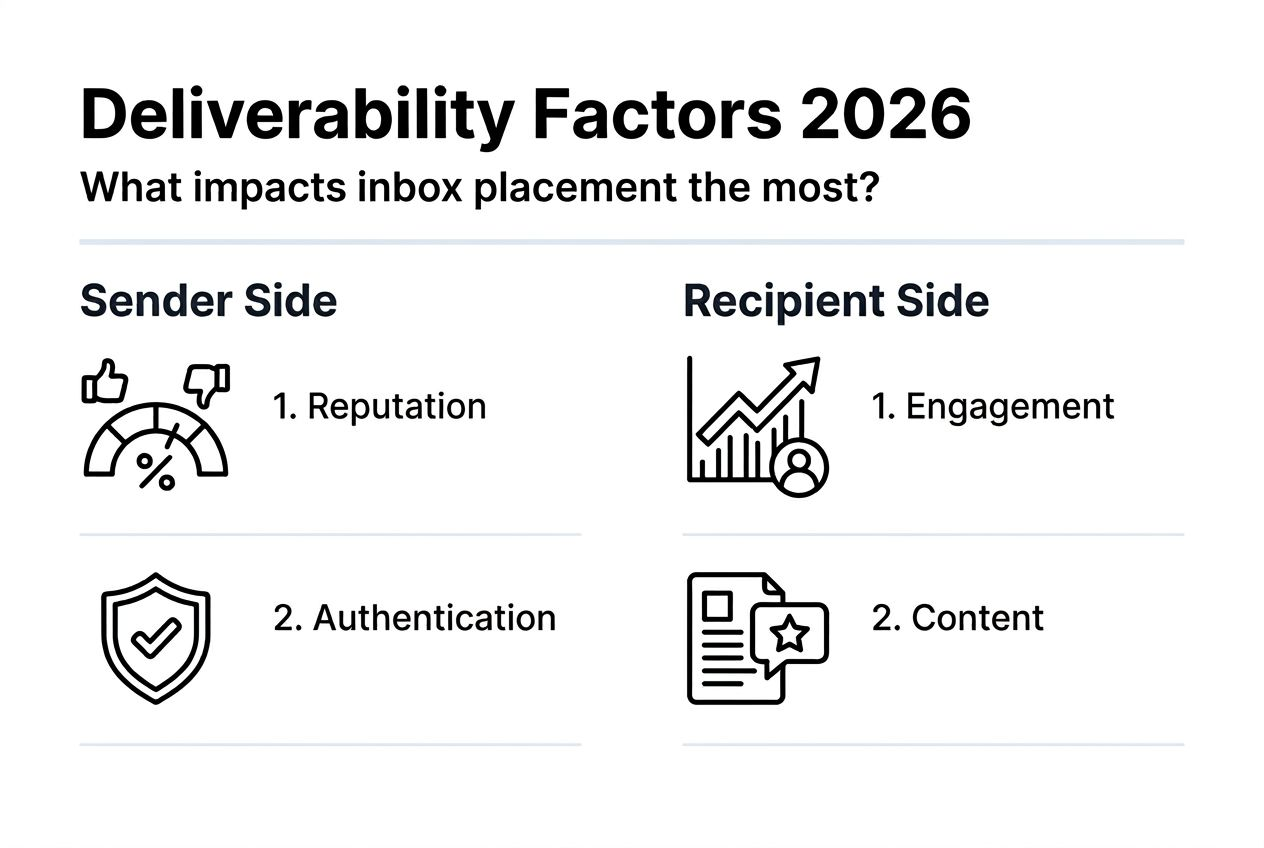
Sender reputation acts like a credit score for email sending. Internet service providers assign reputation scores based on your sending behavior across multiple dimensions. Clean email lists, bounce rates consistently under 5%, minimal spam complaints, and strong engagement signals build positive reputation over time.

Authentication protocols validate your identity as a legitimate sender. SPF, DKIM, and DMARC are essential methods for verifying sender identity and preventing spoofing. Failing these authentication checks significantly reduces deliverability because providers cannot confirm you are who you claim to be.
Content quality influences placement through both automated filters and recipient behavior. Spam trigger words, excessive capitalization, misleading subject lines, and poor HTML formatting raise red flags. Meanwhile, compelling content that generates opens, clicks, and positive engagement signals inbox worthiness.
Recipient engagement provides powerful behavioral signals. When subscribers consistently open your emails, click through to your store, and avoid marking messages as spam, providers interpret this as evidence of wanted communication. Conversely, ignored emails or spam complaints damage your sender reputation rapidly.
Bulk sender regulations have intensified since 2024. Google and Microsoft enforce strict rules on domains sending over 5,000 emails daily, rejecting non-compliant traffic entirely. This threshold affects most ecommerce brands running regular promotional campaigns and automated flows.
| Factor | Impact on Deliverability | Optimization Priority |
|---|---|---|
| Sender Reputation | Determines initial inbox placement probability | High – foundational to all campaigns |
| Authentication (SPF/DKIM/DMARC) | Validates sender identity and prevents rejection | Critical – must be configured correctly |
| List Quality | Affects bounce rates and engagement metrics | High – requires ongoing maintenance |
| Content Relevance | Influences engagement and spam filter scoring | Medium – varies by audience |
| Recipient Engagement | Signals wanted communication to providers | High – drives long-term reputation |
Pro Tip: Regularly monitor your Klaviyo deliverability metrics including open rates and bounce rates to spot issues early. Catching reputation problems before they escalate prevents costly campaign failures and protects your sender standing.
Implementing email marketing best practices for ecommerce growth ensures you address all key factors systematically. This holistic approach builds sustainable deliverability that supports long-term customer relationships and revenue growth.
Navigating new bulk email rules from Google and Microsoft
Major inbox providers implemented sweeping changes between 2023 and 2025 that fundamentally altered bulk email requirements. These regulations directly impact ecommerce brands sending high volumes through platforms like Klaviyo.
Google defines bulk senders as domains sending over 5,000 emails to Gmail addresses daily. Beginning in February 2024, Google began warning non-compliant senders, then progressively rejecting emails from April 2024 onward. Microsoft enforces similar restrictions, rejecting non-compliant bulk emails since May 5, 2025, for domains exceeding 5,000 daily messages to Outlook addresses.
Non-compliance creates immediate operational problems. Initial violations trigger temporary error messages and delayed delivery. Continued violations result in full rejection where emails never reach recipients at all, or automatic routing to junk folders. For ecommerce brands, this means lost sales from promotional campaigns and critical transactional messages that customers never receive.
Compliance requires systematic implementation of authentication and best practices:
- Configure SPF records authorizing your sending domains and Klaviyo’s infrastructure
- Implement DKIM signing for all outbound messages to verify message integrity
- Set up DMARC policies with monitoring to prevent domain spoofing attempts
- Maintain list hygiene by removing invalid addresses and non-engaged subscribers promptly
- Provide clear unsubscribe mechanisms in every marketing message
- Monitor spam complaint rates and address sources of subscriber dissatisfaction immediately
- Segment audiences to send relevant content that drives engagement rather than complaints
Microsoft’s May 2025 deadline represents a hard cutoff where non-compliant bulk senders face immediate rejection. Ecommerce marketers must prioritize authentication implementation to maintain customer communication channels.
These regulations reflect provider commitments to protecting users from unwanted bulk mail. For legitimate ecommerce brands, compliance actually benefits deliverability by establishing trust signals that distinguish your messages from spam. Your email campaign strategy guide should incorporate these requirements as foundational elements rather than optional enhancements.
The 5,000 daily email threshold encompasses all messages from your domain, including transactional emails, automated flows, and promotional campaigns. Most growing ecommerce brands cross this threshold quickly, making compliance essential rather than optional for sustained email marketing success.
Maximizing your Klaviyo deliverability score for ecommerce success
Klaviyo calculates deliverability through five critical metrics that reflect your sender reputation and email program health. Understanding and optimizing these metrics ensures your campaigns consistently reach customer inboxes.
Klaviyo’s deliverability score depends on open rate, click rate, bounce rate, unsubscribe rate, and spam complaint rate. Each metric provides specific signals about subscriber engagement and list quality that mailbox providers use to determine inbox placement.
Target benchmarks for strong deliverability:
- Open Rate: Above 33% indicates compelling subject lines and engaged subscribers
- Click Rate: Above 1.2% demonstrates relevant content driving action
- Bounce Rate: Below 1% confirms clean lists and valid email addresses
- Unsubscribe Rate: Below 0.3% shows appropriate frequency and relevant targeting
- Spam Complaint Rate: Below 0.01% proves subscribers want your messages
| Metric | Good Performance | Poor Performance | Impact on Deliverability |
|---|---|---|---|
| Open Rate | >33% | <15% | Major – signals engagement and relevance |
| Click Rate | >1.2% | <0.5% | Significant – demonstrates content value |
| Bounce Rate | <1% | >5% | Critical – indicates list quality issues |
| Unsubscribe Rate | <0.3% | >1% | Moderate – reflects frequency and fit |
| Spam Complaints | <0.01% | >0.1% | Severe – immediate reputation damage |
Improving each metric requires specific tactical approaches:
- Segment your audience based on engagement history, purchase behavior, and preferences to send hyper-relevant content
- Craft compelling subject lines that promise genuine value without misleading or using spam triggers
- Implement regular list cleaning by removing hard bounces immediately and suppressing chronically non-engaged subscribers
- Test send times and frequencies to identify optimal windows when your audience engages most
- Personalize content beyond first names using purchase history, browsing behavior, and lifecycle stage
- Monitor metrics weekly to detect downward trends before they significantly impact deliverability
Pro Tip: Segment your audience to boost engagement and reduce complaints, improving your score effectively. Sending relevant messages to interested subscribers always outperforms high-volume blasts to your entire list.
The benefits of email automation for ecommerce success include built-in opportunities to optimize these metrics. Automated flows like welcome series, browse abandonment, and post-purchase sequences typically achieve higher engagement than promotional blasts because they deliver timely, contextually relevant messages.
Studying examples of email marketing strategies ecommerce reveals how top brands maintain strong deliverability while scaling email volume. They prioritize engagement over list size, ruthlessly clean non-responsive subscribers, and continuously test content to maximize relevance.
Monitoring these metrics through Klaviyo’s analytics dashboard enables proactive management. When bounce rates spike or open rates decline, you can investigate root causes and implement corrections before deliverability deteriorates significantly. This vigilance protects your sender reputation and ensures consistent campaign performance.
Boost email deliverability and ecommerce growth with expert automation
Achieving exceptional email deliverability requires technical expertise and strategic execution across authentication, content optimization, and audience management. While this guide provides foundational knowledge, implementing these strategies at scale demands specialized skills.
Swyft Klaviyo email marketing services help ecommerce brands transform deliverability challenges into competitive advantages. Expert implementation of authentication protocols, sophisticated segmentation strategies, and proven engagement tactics boost inbox placement while driving measurable revenue growth.
Our email marketing automation guide ecommerce approach integrates deliverability optimization throughout your entire email program. From technical setup ensuring compliance with bulk sender rules to advanced segmentation that maximizes engagement metrics, we build email systems that consistently reach customers and generate returns.
Partner with specialists who understand both the technical requirements of modern email deliverability and the strategic imperatives of ecommerce growth. Discover how tailored ecommerce growth strategy automation can elevate your email marketing performance and unlock revenue trapped in spam folders.
Frequently asked questions
What is the difference between email delivery and email deliverability?
Email delivery confirms your message reached the recipient’s mail server successfully. Deliverability determines whether that email actually lands in the inbox where customers see it, rather than spam or junk folders. This distinction matters because delivered emails frequently end up invisible to recipients, resulting in lost engagement and revenue opportunities.
How do sender reputation and authentication impact email deliverability?
Sender reputation scores guide mailbox providers in deciding whether to trust your emails with inbox placement. Authentication methods like SPF, DKIM, and DMARC verify your sender identity and prevent spoofing attempts. Together, these factors create the foundation for consistent inbox placement, as providers prioritize authenticated senders with strong reputations while filtering questionable sources.
What are the new bulk email sending rules from major providers?
Google and Microsoft classify bulk senders as domains sending over 5,000 emails daily to their respective services. Non-compliance with authentication requirements and best practices results in progressive enforcement, starting with warnings and escalating to full email rejection. These rules became strictly enforced in 2024 for Google and May 2025 for Microsoft, making compliance essential for ecommerce email programs.
How can I improve my Klaviyo deliverability score effectively?
Focus on reducing bounce rates below 1% through regular list cleaning and removing invalid addresses immediately. Keep spam complaints under 0.01% by sending relevant, valuable content to engaged subscribers only. Segment your audience based on behavior and preferences to boost open and click rates while implementing email marketing best practices for ecommerce growth including appropriate send frequencies and clear unsubscribe options.