Abandoned cart recovery is an automated system that re-engages shoppers who added items to their cart but left without buying. It works by capturing the shopper’s identity before they leave, tracking cart state, and triggering a coordinated sequence across email, SMS, push notifications, and paid retargeting to bring them back to checkout.
- Identity capture: email-on-add, early checkout capture, or pixel-based resolution for anonymous visitors
- Cart state tracking: real-time sync between your store and automation platform
- Automation engine: timed, conditional triggers that fire messages based on behavior
- Messaging channels: email (baseline), SMS (high-engagement), push (quick reminders), retargeting ads (ad-based recapture)
Table of Contents
- What is abandoned cart recovery and why does it matter?
- Why do shoppers abandon their carts?
- Which recovery channels should you use, and when?
- What does a high-performing recovery sequence look like?
- How do you reduce abandonment before recovery is needed?
- How do you measure recovery performance?
- What tools and platforms power cart recovery?
- What are the U.S. legal requirements for recovery messages?
- Key Takeaways
- The part most stores get backwards
- Swyftinteractive builds recovery systems that actually pay for themselves
- Useful sources
- FAQ
What is abandoned cart recovery and why does it matter?
Cart abandonment is the norm, not the exception. Statista reports the worldwide cart abandonment rate reached roughly 70.22% in 2026. That means roughly seven out of ten shoppers who show genuine purchase intent leave without buying.
A significant majority of online shopping carts are abandoned globally — making recovery one of the highest-ROI automations any ecommerce store can run.
An abandoned cart is typically defined by an inactivity threshold of 30–60 minutes after a shopper adds an item but does not complete checkout. That window is your trigger point. Recovery rates vary by store, category, and channel mix, but realistic expectations sit in the single-digit to low-double-digit range as a percentage of enrolled carts. Small percentages on high-intent sessions still translate to meaningful incremental revenue.
The key distinction: prevention is the larger lever (it benefits every visitor), while recovery is the smaller but still high-ROI lever (it targets the segment you’ve already lost). Both matter, and the best programs run them in parallel.
Why do shoppers abandon their carts?
Not all abandonment is equal, and diagnosing your mix determines where to spend your time.
- Surprise costs at checkout (shipping, taxes, fees): the top fixable reason, accounting for roughly 39% of non-browsing abandonments
- Browsing intent only: shoppers who were never close to buying (~43% of abandonment); recovery messages rarely convert this segment
- Forced account creation: a major friction point, especially on mobile
- Slow or broken mobile checkout: device data shows higher abandonment rates on mobile and tablet than desktop
- Limited payment options: missing Apple Pay, Google Pay, or buy-now-pay-later options
- Trust and security concerns: no visible trust badges, unfamiliar brand, or unclear return policy
- Long or uncertain shipping times: especially for time-sensitive purchases
Pro Tip: Run session replays (tools like Hotjar or Microsoft Clarity) on your checkout funnel. Identify the single step where the most users drop off — that one fix usually outperforms any recovery email you can write.
The browsing-intent bucket is largely unrecoverable through messaging. Focus recovery spend on the shoppers who reached the cart or checkout page and hit a friction point.

Which recovery channels should you use, and when?
Each channel has a distinct role. The most effective programs in 2026 combine email, SMS, and retargeting into a coordinated sequence rather than relying on a single email.
- Email: content-rich, cost-effective, and the baseline of any recovery flow. Supports dynamic product blocks, social proof, and multi-step sequences.
- SMS: high open rates, interruption-level urgency. Use it selectively — it works best as a follow-up after email, not as the first touch.
- Browser/push notifications: low-friction reminders for opted-in users. Best for quick, early nudges.
- Paid retargeting: dynamic product ads on Meta and Google that re-engage anonymous visitors or reinforce email sequences. Higher cost per touch but reaches users you cannot email.
Conditional logic is what separates a professional stack from a spray-and-pray approach. Suppress SMS if the shopper already clicked the email. Stop all messages the moment a purchase is recorded. The identity and cart-state capture must happen before the user leaves — without it, none of the downstream automation fires.
U.S. legal note: SMS requires documented prior express written consent under TCPA. Email requires a clear unsubscribe mechanism under CAN-SPAM. Both require immediate opt-out honoring.

| Channel | Strengths | Limitations | Best for |
|---|---|---|---|
| Rich content, low cost, sequences | Requires identity capture | All stores; baseline channel | |
| SMS | High open rates, urgency | TCPA consent required, interruption risk | Mid-to-late sequence, high-AOV carts |
| Push/browser | Fast delivery, no email needed | Low opt-in rates | Early reminders, opted-in users |
| Paid retargeting | Reaches anonymous visitors | Higher cost per touch | Anonymous traffic, reinforcement |
What does a high-performing recovery sequence look like?
About 45% of recoveries happen within the first two hours of abandonment. Speed matters, but so does sequence design.
A proven structure:
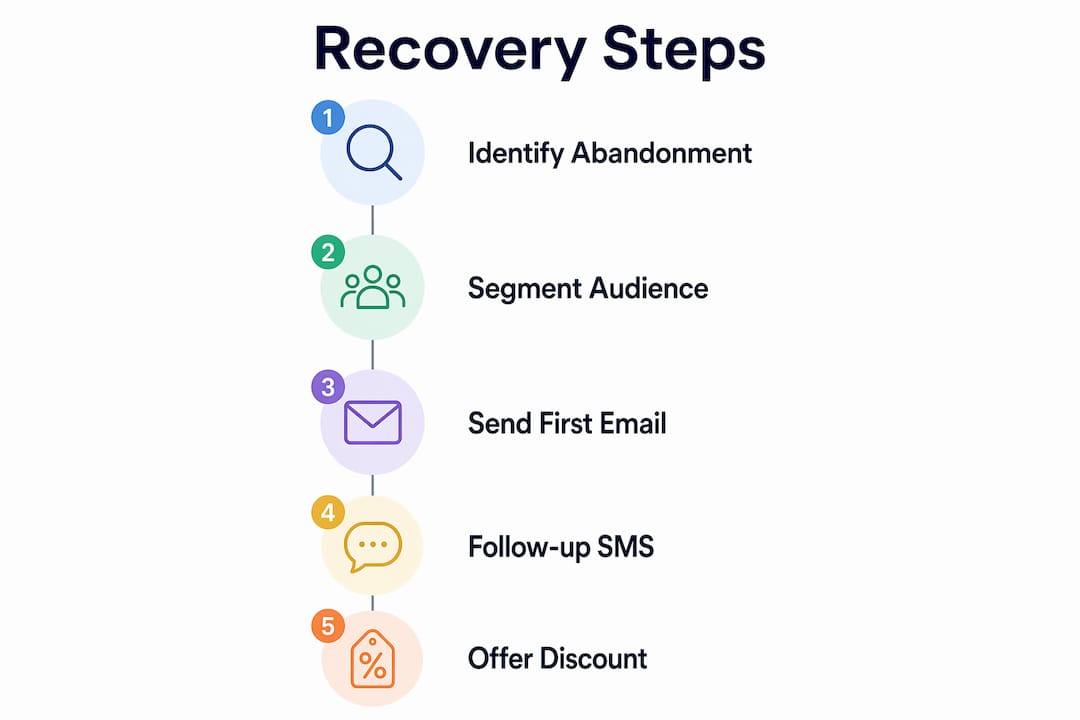
- Trigger qualification (0–30 min): confirm the cart is still active, the item is in stock, and the shopper has not purchased
- First email (45–60 min): product-specific reminder, clear checkout link, no discount yet
- First SMS (2–3 hours): short, direct, links straight to cart
- Second email (22–24 hours): add social proof (reviews, ratings), address common objections
- Discount email (48 hours): first incentive offer — percentage off or free shipping
- Final SMS + retargeting (72 hours): last push, reinforce the offer
Subject lines referencing the exact abandoned product outperform generic “You left something behind” lines by roughly 22% in open rates. Dynamic product blocks that show the actual item, price, and image are non-negotiable.
Example email subject: “Your [Product Name] is still waiting — here’s 10% off to make it yours”
Example SMS: “Hey [First Name], you left [Product Name] in your cart. Grab it before it sells out: [link]”
Pro Tip: Reserve your discount for the 48-hour message, not the first email. Sending a coupon immediately trains shoppers to abandon on purpose and wait for the offer. Protect your margin by making them wait.
On scarcity: only use “only X left” messaging if your platform can pull real-time inventory. Fake urgency erodes long-term trust more than it helps short-term conversion.
Segment your flows by abandonment type. A shopper who reached the payment page needs a different message than one who only added to cart. Separate flows for browse, cart, and checkout abandonment consistently outperform a single generic sequence. Pair this with personalization tactics like loyalty status, past purchase history, and price sensitivity to sharpen relevance.
How do you reduce abandonment before recovery is needed?
Prevention compounds. Every checkout improvement benefits 100% of your visitors; recovery only touches the fraction you can identify and re-engage.
- Show full costs earlier: display estimated shipping and taxes on the product page or cart, not just at checkout
- Enable guest checkout: removing forced account creation is one of the fastest conversion wins available
- Reduce form fields: ask only for what you need to complete the order
- Optimize mobile UX: test your checkout on actual devices, not just a desktop browser resized smaller
- Offer expected payment methods: Apple Pay, Google Pay, and at least one buy-now-pay-later option
- Use free-shipping thresholds: “Spend $X more for free shipping” nudges average order value and reduces abandonment simultaneously
Pro Tip: Start with the surprise-cost fix. Display shipping costs on the cart page before checkout. It takes a developer an afternoon and it addresses the single largest fixable abandonment driver.
Good website design that surfaces costs early and removes checkout friction pays dividends on every session, not just the ones you can recover.
How do you measure recovery performance?
Track these five metrics to understand whether your program is working and where to improve it.
| Metric | Definition | Sample calculation |
|---|---|---|
| Recovery rate | Share of abandoned carts that convert | Placed orders from flow ÷ enrolled carts |
| Placed-order rate | Orders per email/SMS sent | Orders ÷ messages sent |
| Revenue per recipient | Revenue generated per message delivered | Total flow revenue ÷ recipients |
| Discount dependency rate | Share of recoveries using a coupon | Coupon-assisted orders ÷ total recovered orders |
| Incremental lift | Revenue attributable to recovery vs. organic return | Recovery revenue minus estimated organic return rate |
Attribution in multi-channel stacks is messy. A shopper who clicks an email and then converts after seeing a retargeting ad will show up in both reports. Use a single last-click attribution window (typically 5–7 days) and de-duplicate across channels. Without de-duplication, you will overcount recovery revenue and underestimate your organic return rate.
- Set a consistent attribution window across all channels
- Use UTM parameters on every link in every message
- Pull a unified report from your analytics platform, not channel-by-channel dashboards
What tools and platforms power cart recovery?
A working recovery stack has five layers:
- Email automation platform (campaigns + flows): Klaviyo is the dominant choice for Shopify and BigCommerce stores; it handles dynamic product blocks, segmentation, and suppression logic natively
- SMS provider: integrated directly into Klaviyo or via a dedicated SMS tool
- Web push: a lightweight addition for opted-in users; many email platforms include it
- Analytics and attribution: Google Analytics 4, your platform’s native reporting, or a dedicated attribution tool
- Identity resolution: pixel-based tools that match anonymous visitors to known profiles, expanding the recoverable audience
Shopify’s built-in abandoned checkout recovery sends a single automated email and is a useful starting point, but it lacks multi-step sequencing and SMS. BigCommerce offers similar native functionality with documented API hooks for deeper integrations. Rebuy adds personalization and upsell logic on top of cart recovery flows, particularly for Shopify merchants. For serious volume, Klaviyo’s email automation capabilities give you the conditional logic, segmentation, and dynamic content that single-channel tools cannot match.
The prerequisite for all of it: accurate cart-state sync between your store and your automation platform, real-time inventory signals for scarcity messaging, and a coupon generation system that issues unique codes (not a single reusable code that gets shared publicly).
What are the U.S. legal requirements for recovery messages?
Compliance is not optional, and the penalties for TCPA violations in particular are significant.
- SMS: requires prior express written consent before sending any marketing text. Document the opt-in method, timestamp, and source for every subscriber
- Email: CAN-SPAM requires a clear sender identity, a physical address, and a functional unsubscribe link. Honor opt-outs within 10 business days (best practice: immediately)
- Suppression lists: maintain a unified suppression list across all channels and sync it in real time
- Double opt-in for SMS: reduces complaint rates and provides stronger consent documentation
- Purchase-triggered suppression: stop all remaining messages the moment an order is placed
Pro Tip: Log consent timestamps directly in the customer profile in your CRM or email platform. If a compliance question ever arises, you need to show exactly when and how the subscriber opted in — not just that they did.
This article is general information, not legal advice. Confirm current TCPA and CAN-SPAM requirements with a qualified attorney for your specific situation.
Key Takeaways
Abandoned cart recovery works best as a system: prevention reduces the pool of abandoners, and a multi-channel sequence converts the high-intent segment you can identify.
| Point | Details |
|---|---|
| Prevention first | Fix surprise costs and guest checkout before building recovery flows — it benefits every visitor. |
| Identity capture is the prerequisite | Without email or phone capture before exit, no automation can fire. |
| Sequence timing matters | Roughly 45% of recoveries happen within two hours; send the first message within 45–60 minutes. |
| Reserve discounts | Hold incentives until the 48-hour message to protect margin and avoid training abandoners. |
| Swyftinteractive for implementation | Swyftinteractive audits checkout UX, builds Klaviyo flows, and implements multi-channel recovery for ecommerce brands. |
The part most stores get backwards
Most ecommerce teams build the recovery email first and treat checkout UX as a future project. That’s the wrong order. A single checkout page improvement — displaying shipping costs before the payment step, for example — will outperform your entire recovery stack on a per-visitor basis, every time. Recovery is a tax on a broken checkout experience.
The second mistake is treating the discount as the recovery mechanism. Discounts recover orders. They also teach your best customers to abandon on purpose. The stores that run the most profitable recovery programs are the ones that reserve incentives for the final message and invest the first two touches in removing friction and reinforcing value instead.
Multi-channel stacks that combine email, SMS, and retargeting do lift aggregate recovery rates into the mid-to-high teens. But the sequence only works when suppression logic is tight, attribution is de-duplicated, and the discount is the last resort rather than the opening move.
Swyftinteractive builds recovery systems that actually pay for themselves
Most stores leave the same revenue on the table month after month because their recovery setup is a single native email and no suppression logic. Swyftinteractive builds the full stack: checkout UX audit, identity capture setup, Klaviyo flow architecture, SMS integration, and attribution reporting so you know exactly what the program is worth.
The fit is stores doing more than $5,000 per month in revenue that want a working system without hiring an in-house developer or spending months testing sequences from scratch. Swyftinteractive’s Klaviyo lifecycle audit covers the full recovery flow from trigger to final message, with suppression logic and discount timing built in from day one. If you want the complete automation blueprint, the ecommerce growth strategy guide walks through how recovery fits into a full-funnel program. Book a strategy call to see what your current abandonment rate is actually costing you.
Useful sources
- Statista: Online shopping cart abandonment rate worldwide — global benchmark data used throughout this article
- Ecommerce Times: How to Build a High-Converting Abandoned Cart Recovery System in 2026 — multi-channel sequence strategy, incentive timing, and scarcity guidance
- Klaviyo Blog: Abandoned cart email best practices — personalization benchmarks and subject line data
- BigCommerce: Abandoned Cart Emails — platform documentation and email sequence best practices
- Dotdigital: 7 strategies to boost ecommerce sales with abandoned cart recovery — timing data on recovery windows
- Deelo Blog: What Is Abandoned Cart Recovery? — segmentation by abandonment type (browse, cart, checkout)
- CartWhisper: What Is Abandoned Cart Recovery? — extra costs data and prevention framing
- Propel Commerce: Average cart abandonment rate 2026 — device-level abandonment data
- Swyftinteractive: The Ultimate Guide to Abandoned Cart Emails — templates and Klaviyo implementation workflows
FAQ
What is abandoned cart recovery in ecommerce?
Abandoned cart recovery is an automated system that sends follow-up messages (email, SMS, push, or retargeting ads) to shoppers who added items to their cart but did not complete checkout, with the goal of bringing them back to purchase.
How long should you wait before sending the first recovery email?
Send the first email within 45–60 minutes of abandonment. Roughly 45% of recoveries happen in the first two hours, so early follow-up captures shoppers while purchase intent is still high.
Should you offer a discount in every recovery message?
No. Reserve discounts for the final message in your sequence, typically around the 48-hour mark. Sending a coupon immediately trains shoppers to abandon intentionally and wait for the offer, which erodes margin over time.
Which platform is best for abandoned cart recovery flows?
Klaviyo is the most widely used automation platform for Shopify and BigCommerce stores, offering native cart-state sync, dynamic product blocks, SMS integration, and suppression logic in a single tool.
Is it legal to send abandoned cart SMS messages in the U.S.?
Yes, but only to subscribers who provided prior express written consent under TCPA. Document the opt-in method and timestamp for every SMS subscriber, and honor opt-out requests immediately.