

One ecommerce brand spent just $2,000 per month on Connected TV ads and saw a 41% year-over-year revenue increase while cutting customer acquisition costs in half. That kind of result feels almost impossible until you understand the mechanics behind it. Most marketing managers aren’t confused about whether paid ads work. They’re confused about which ads to run, where to run them, and how to measure what actually matters. This guide cuts through the noise and gives you a practical, evidence-based framework for turning paid advertising into a real growth engine for your ecommerce brand.
Table of Contents
- Why paid ads matter for ecommerce brands
- Types of paid ads and where they fit in the funnel
- Benchmarks that matter: Setting goals and measuring success
- Automation, AI, and control: Striking the right balance
- Case studies: How campaigns drive real performance gains
- Practical steps: Building a scalable paid ads strategy
- Supercharge growth: Partner with experts for paid ads
- Frequently asked questions
Key Takeaways
| Point | Details |
|---|---|
| Paid ads fuel growth | Strategic ad spending is essential for scaling ecommerce and capturing new customers. |
| Choose the right mix | Different ad types work best at specific funnel stages—combine for maximum impact. |
| Benchmark and measure | Set goals with clear metrics like CAC and ROAS, and regularly compare performance to keep improving. |
| Embrace automation wisely | AI and manual control both have a role—testing and ongoing optimization are key. |
| Real results need smart strategy | Case studies prove that layering campaigns and leveraging expert tactics yield outsized gains. |
Why paid ads matter for ecommerce brands
Paid advertising is the fastest lever you can pull to drive qualified traffic to your store. Unlike SEO or organic social, paid ads deliver results on a timeline you control. When managed with intention, they don’t just generate clicks. They build brand awareness, accelerate conversions, and create a measurable feedback loop that improves over time.
Scalability is what makes paid ads uniquely powerful for growth-focused brands. You can start small, prove a concept, and then increase spend as your data confirms what’s working. That’s a fundamentally different model than most other marketing channels, which require long lead times before you see meaningful results.
Here’s what paid ads can do for your ecommerce brand when managed well:
- Drive immediate, targeted traffic to product pages and landing pages
- Retarget warm audiences who’ve already visited your site or engaged with your content
- Test creative and messaging at scale before committing to larger campaigns
- Build brand recognition across multiple channels simultaneously
- Generate measurable revenue with clear attribution back to ad spend
The brands seeing outsized results are the ones pairing their ad spend with analytics for ecommerce growth to understand what’s actually driving performance. Without that layer, you’re spending blind. Data-driven marketing transforms paid ads from a cost center into a predictable revenue machine.
Pro Tip: Before scaling any paid ad campaign, connect your ad platform data to a centralized analytics dashboard. Seeing CAC, ROAS, and revenue lift in one place changes how you make decisions.
Types of paid ads and where they fit in the funnel
Not all paid ads are created equal, and using the wrong format at the wrong funnel stage is one of the most common and expensive mistakes ecommerce brands make. Here’s a breakdown of the major ad types and where each one belongs.
| Ad type | Funnel stage | Key KPIs | Budget guidance |
|---|---|---|---|
| Search (Google) | Consideration, conversion | CTR, CPC, ROAS | Mid to high; high intent |
| Shopping (Google) | Consideration, conversion | ROAS, revenue | High; product-focused |
| Social (Meta, TikTok) | Awareness, consideration | CPM, CTR, CPA | Flexible; great for testing |
| Display | Awareness, retargeting | CPM, view rate | Low to mid; broad reach |
| Connected TV (CTV) | Awareness, consideration | Reach, revenue lift | Mid; growing fast |
| Remarketing | Conversion, retention | CPA, ROAS | Low to mid; high efficiency |
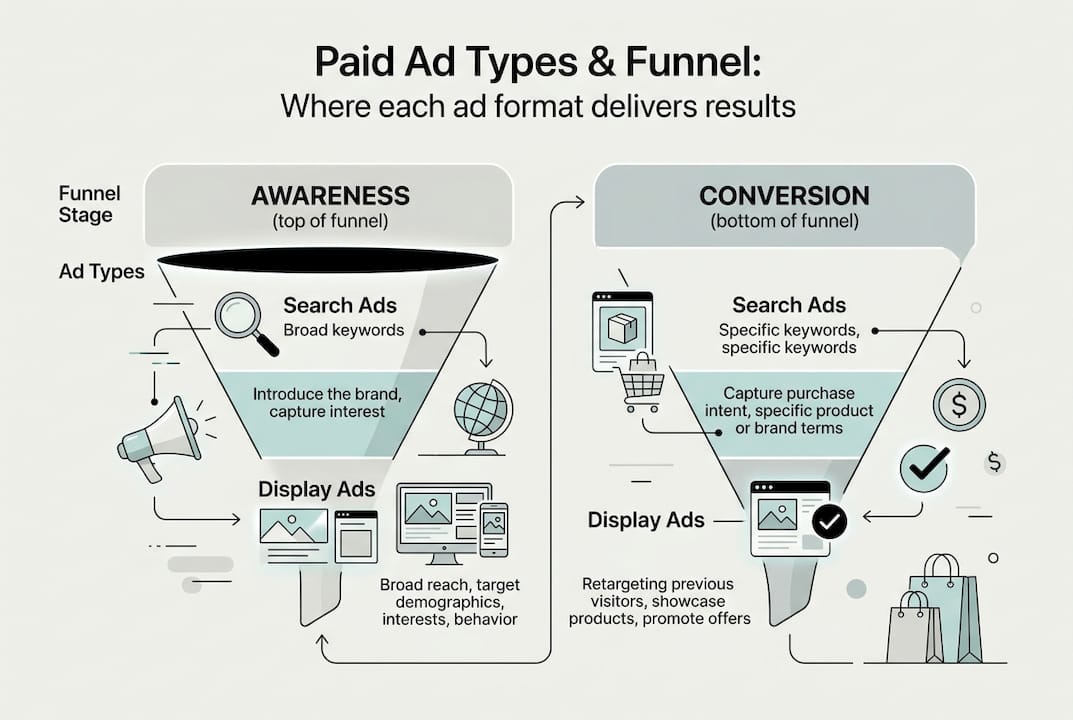
CTV is worth calling out specifically. It’s not just a brand awareness play anymore. CTV ads can boost reach and revenue while actually improving Meta campaign efficiency when the two channels run together. That kind of platform synergy is something most brands haven’t fully explored yet.
A few quick pros and cons to keep in mind as you plan:
- Search ads: High purchase intent, but competitive and expensive in crowded categories
- Social ads: Massive reach and strong creative testing environment, but rising CPMs
- Shopping ads: Highly visual and conversion-focused, but require clean product feed management
- CTV ads: Premium reach and brand lift, but harder to attribute directly without the right tools
- Remarketing: Extremely efficient for warm audiences, but limited scale on its own
Choosing the right mix starts with understanding your funnel. Review the marketing platforms for online retailers that align with your audience and goals, then track performance using the right ecommerce engagement metrics for each channel.
Benchmarks that matter: Setting goals and measuring success
Running paid ads without clear benchmarks is like driving without a destination. You might be moving fast, but you have no idea if you’re heading the right direction. Setting evidence-based goals is what separates brands that scale from brands that just spend.
The four metrics every ecommerce paid ads manager should know cold:
- Customer Acquisition Cost (CAC): Total ad spend divided by new customers acquired. Lower is better, but context matters.
- Return on Ad Spend (ROAS): Revenue generated per dollar spent on ads. A 3x to 5x ROAS is a common target, but varies by margin.
- Click-Through Rate (CTR): Percentage of people who click your ad after seeing it. Signals creative and audience relevance.
- Revenue lift: The incremental revenue directly attributed to your paid campaigns.
Here’s how average benchmarks compare across the top ad types:
| Ad type | Average CTR | Average ROAS | Typical CAC range |
|---|---|---|---|
| Google Search | 3.5% to 6% | 4x to 8x | $15 to $50 |
| Google Shopping | 0.8% to 2% | 5x to 10x | $10 to $40 |
| Meta Social | 0.9% to 1.5% | 2x to 5x | $20 to $80 |
| CTV | 0.1% to 0.3% | Varies (brand lift) | Indirect |
One finding that surprises most managers: Meta CTR increased 28% when campaigns ran alongside CTV. Cross-channel lift is real, and it’s often invisible if you’re measuring each platform in isolation.
Here’s a numbered process for aligning your goals with the right KPIs:
- Define your primary objective (awareness, conversions, or retention) before choosing a platform.
- Set a baseline using your last 90 days of campaign data or industry averages if you’re starting fresh.
- Choose two to three core KPIs per campaign and resist the urge to track everything.
- Set a realistic ROAS target based on your product margins, not just industry averages.
- Review performance weekly and adjust bids, creative, or targeting before scaling spend.
To track ecommerce metrics effectively, you need a system that connects ad platform data to actual revenue outcomes. Attribution is the hardest part, but it’s also where the biggest insights live.
Automation, AI, and control: Striking the right balance
AI-powered ad tools have changed the game. Meta Advantage+ and Google Performance Max promise to optimize your campaigns automatically, finding the best audiences, placements, and bids without constant manual input. The efficiency gains are real. But so are the tradeoffs.

When you hand full control to an AI system, you often lose visibility into why something is working. You can’t always see which audience segment is converting, which creative is driving results, or whether the algorithm is prioritizing your best customers or just the easiest ones to reach. That lack of transparency can be costly at scale.
Manual optimization gives you strategic control. You can test specific hypotheses, isolate variables, and build institutional knowledge about your audience. The downside is time. Manual management doesn’t scale the way AI does, especially across multiple campaigns and platforms.
Here’s a practical guide for choosing your approach:
- Use AI automation when you have large budgets, broad audiences, and enough conversion data for the algorithm to learn from
- Use manual control when you’re testing new creative, entering a new market, or troubleshooting underperformance
- Use a hybrid approach when you want AI efficiency on proven campaigns while manually testing new strategies in parallel
“Neither AI nor manual optimization is always superior. The smartest approach is to split-test both methods and let your own data tell you which works better for your specific account.”
Pro Tip: Run a manual campaign and an AI-optimized campaign simultaneously with the same budget and creative. After 30 days, compare CAC and ROAS. The results will tell you more than any industry report.
Case studies: How campaigns drive real performance gains
Theory is useful. Real numbers are better. Here’s what a strategic, multi-channel paid ads approach actually produced for one ecommerce brand.
The brand added CTV advertising to their existing Meta campaigns. The CTV budget was modest, just $2k monthly driving a 41% YoY revenue jump. Customer acquisition costs dropped significantly. And Meta campaign performance improved at the same time, not in spite of the CTV spend, but because of it.
Three key lessons from this result:
- Platform synergy is real: CTV warmed up audiences who then converted through Meta. The channels amplified each other.
- Small budgets can move big numbers: You don’t need a massive media budget to see meaningful lift. Strategic placement matters more than raw spend.
- Measurement unlocks everything: The brand only discovered the CTV-to-Meta lift because they were tracking cross-channel attribution carefully.
“A $2,000 monthly CTV investment drove a 41% year-over-year revenue increase and cut customer acquisition costs in half. The lesson isn’t just about CTV. It’s about what happens when you combine channels intentionally and measure the right things.”
Using ecommerce analytics for campaign success is what made these insights visible. Without that infrastructure, the brand would have seen good results but never understood what caused them. Pair that with essential ecommerce strategies and you have a repeatable growth system.
Practical steps: Building a scalable paid ads strategy
Evidence and case studies are only useful if you can act on them. Here’s a step-by-step process for building a paid ads program that scales without falling apart.
- Audit your current state. Review existing campaigns, identify your top-performing audiences, and document your current CAC and ROAS baselines.
- Define your funnel gaps. Are you losing people at awareness, consideration, or conversion? Your ad mix should address the weakest stage first.
- Choose two to three platforms based on where your audience spends time and which funnel stages need the most support.
- Build creative in batches. Test at least three to five ad variations per campaign. Let data decide what scales, not gut instinct.
- Set up cross-channel tracking before you spend a dollar. Attribution gaps will cost you more than any ad budget mistake.
- Launch with controlled budgets. Start small, prove performance, then scale spend on what’s working.
- Review weekly, optimize monthly. Weekly reviews catch problems early. Monthly optimizations make strategic adjustments based on trends.
- Layer in new channels gradually. Campaign layering and precise measurement are what drive outsized growth. Add one new channel at a time so you can isolate its impact.
Cross-channel analysis is non-negotiable at scale. Brands that look at each platform in isolation miss the compounding effects that drive the biggest wins. Review your ecommerce marketing strategies regularly to make sure your paid ads are working in sync with your broader growth plan.
Pro Tip: Don’t set and forget. Review campaigns every week and test only one new element at a time, whether that’s a new audience, creative format, or bidding strategy. Changing multiple variables at once makes it impossible to know what actually moved the needle.
Supercharge growth: Partner with experts for paid ads
Building a high-performing paid ads program takes more than a good strategy document. It takes consistent execution, sharp analytics, and the ability to adapt fast when the data changes. That’s where having the right partner makes a real difference.
At Swyft Interactive, we build and manage full-funnel growth systems for ecommerce brands, combining paid ads management with the analytics infrastructure and automation that make campaigns actually scale. Whether you’re starting from scratch or optimizing an existing program, our team brings proven playbooks and hands-on experience to every engagement. Explore our growth strategy with automation approach, check out our website growth checklist to make sure your store is ready to convert the traffic you’re paying for, and use our framework to track ecommerce growth metrics that actually matter.
Frequently asked questions
How much should ecommerce brands budget for paid ads?
A common starting point is 10 to 20% of gross revenue, but aggressive growth goals often require higher spend and constant re-evaluation. One brand saw a 41% revenue boost with just $2,000 per month in CTV spend, proving that strategic allocation often matters more than total budget size.
Are AI-powered ads better than manual optimization?
Neither AI nor manual approaches are always superior. Split-testing both methods is the most reliable way to find what works for your specific account and audience.
Which paid ad platform performs best for ecommerce?
Performance depends on your goals, products, and audience. Meta, Google, and CTV are all strong options, but the CTV and Meta synergy seen in recent case studies shows that combining platforms often outperforms any single channel.
How do you measure success with paid ads?
Success is measured through ROAS, CAC, CTR, and attributed revenue. Set your targets based on industry benchmarks and your own historical data, then review performance weekly to stay ahead of underperforming campaigns.