

Increasing online sales feels like pushing a boulder uphill when customer acquisition costs keep rising and conversion rates plateau. Many eCommerce brands pour budget into ads only to watch profit margins shrink as new customers become more expensive to attract. The smarter path forward lies in retention strategies that cost 5-7x less than acquisition while generating substantially higher returns. This guide walks you through data-driven email automation strategies using Klaviyo that transform existing customers into repeat buyers, optimize personalization at scale, and create sustainable revenue growth without constantly expanding your ad spend.
Table of Contents
- Key takeaways
- Understanding customer acquisition versus retention economics
- Preparing your eCommerce store for email automation success
- Executing Klaviyo email automation to boost online sales
- Verifying results and optimizing your sales strategy continuously
- Boost your online sales with expert ecommerce automation
- Frequently asked questions
Key Takeaways
| Point | Details |
|---|---|
| Retention is cheaper | Retention costs five to seven times less than acquisition and repeat customers spend sixty seven percent more per transaction. |
| Segmented emails boost revenue | Segmentation transforms blasts into targeted conversations that increase relevance and revenue per recipient. |
| Klaviyo integration matters | Integrating Klaviyo with your store unlocks real time behavioral triggers that power personalized automation. |
| Define key KPIs | Define clear performance indicators before campaigns so you can measure revenue per email sent, conversion rate by flow type, and overall list health. |
Understanding customer acquisition versus retention economics
Customer acquisition involves every dollar spent attracting someone who has never purchased from your store, including paid ads, influencer partnerships, and content marketing. Retention focuses on keeping existing customers engaged and encouraging repeat purchases through email campaigns, loyalty programs, and personalized experiences. The financial difference between these approaches is dramatic and often misunderstood by growing brands.
Retention strategies consistently outperform acquisition on profitability metrics. Retention costs 5-7x less than acquisition and repeat customers spend 67% more per transaction compared to first-time buyers. Even more compelling, research shows that increasing retention by just 5% can boost profits between 25% and 95%, making it one of the highest-leverage activities for eCommerce growth. These numbers reflect the compounding value of customer relationships over time.
| Metric | New Customers | Repeat Customers |
|---|---|---|
| Average order value | Baseline | 67% higher |
| Conversion rate | 1-3% | 60-70% |
| Marketing cost per sale | $45-80 | $8-15 |
| Profit margin impact | Lower | 25-95% higher |
Repeat customers convert at dramatically higher rates because they already trust your brand, understand your products, and have experienced your service quality. They require less convincing, respond better to personalized recommendations, and generate word-of-mouth referrals that reduce your overall acquisition burden. Their familiarity with your checkout process reduces friction and cart abandonment.
Pro Tip: Track your customer lifetime value to acquisition cost ratio monthly. If this ratio drops below 3:1, you are spending too much on acquisition relative to the long-term value customers provide, signaling an urgent need to shift resources toward retention strategies.
Preparing your eCommerce store for email automation success
Successful email automation starts long before you build your first flow. Your customer data quality determines whether personalization works or falls flat. Clean your email list by removing inactive subscribers, correcting formatting errors, and verifying that customer profiles sync accurately between your eCommerce platform and Klaviyo. Dirty data produces irrelevant messages that damage sender reputation and waste automation potential.
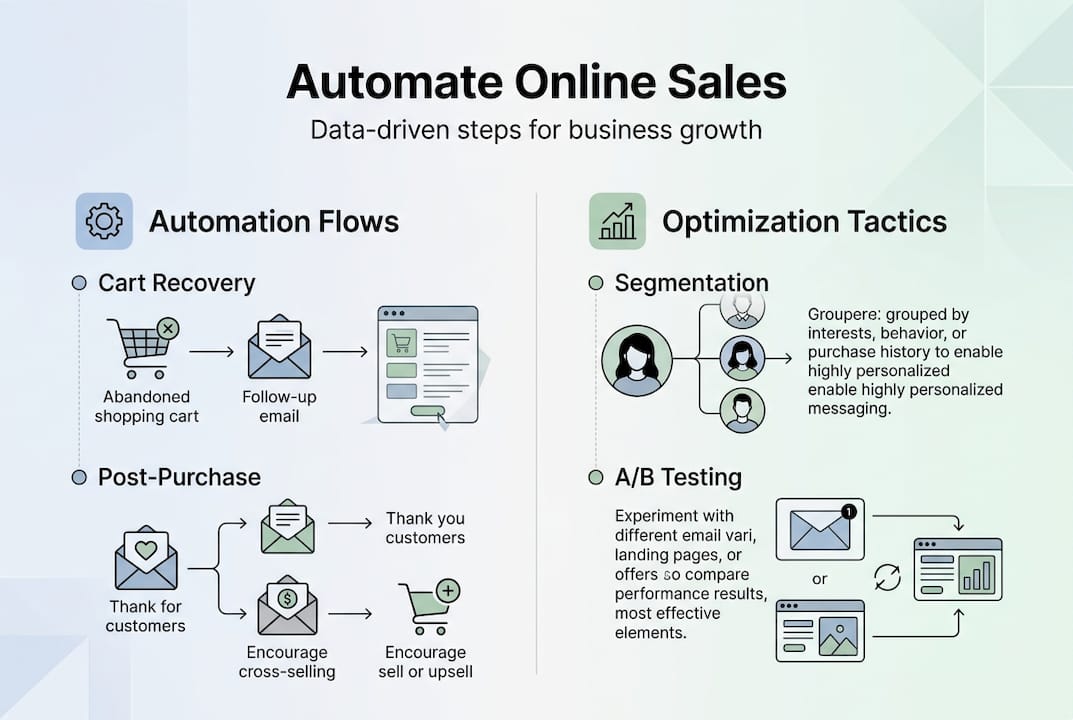
Segmentation transforms generic email blasts into targeted conversations that drive action. Create segments for prospects who browsed but never purchased, first-time buyers ready for their second order, cart abandoners who need a nudge, VIP customers who deserve exclusive offers, and win-back targets who have not purchased in 90 days. Each segment requires different messaging, timing, and offers. Email segmentation based on behavior increases relevance and directly impacts revenue per recipient.
Integrating Klaviyo with your eCommerce platform unlocks the behavioral triggers that make automation powerful. This connection allows Klaviyo to track product views, cart additions, purchases, and browsing patterns in real time. Verify that your integration captures all relevant events including product categories viewed, items added to wishlists, and checkout abandonment stages. These data points fuel the personalization engine that separates effective automation from spam.
Define clear key performance indicators before launching campaigns so you can measure what matters. Track revenue per email sent, conversion rate by flow type, list growth rate, unsubscribe percentage, and customer retention rate over 90-day periods. Email marketing automation success depends on connecting these metrics to actual sales outcomes rather than vanity metrics like open rates alone.
Pro Tip: Prioritize abandoned cart and post-purchase flows first because they target high-intent moments when customers are already engaged with your brand. These time-sensitive automations generate quick wins that fund more sophisticated segmentation strategies later.
Executing Klaviyo email automation to boost online sales
Abandoned cart flows recover revenue from customers who demonstrated clear purchase intent but did not complete checkout. Build a three-email sequence triggered when someone adds products to cart but does not purchase within one hour. The first email reminds them of items left behind with product images and a direct cart link. The second email, sent 24 hours later, addresses common objections like shipping costs or return policies. The third email, sent 48 hours after abandonment, can include a small discount or free shipping offer to overcome final hesitation.
Post-purchase flows transform one-time buyers into repeat customers by delivering value immediately after purchase. Send a thank-you email with order confirmation, followed by shipping updates, product care instructions, and complementary product recommendations based on what they bought. This sequence builds trust during the critical post-purchase window when customer satisfaction is highest and receptivity to additional offers peaks. Klaviyo automation flows that nurture this relationship systematically increase lifetime value.

Win-back campaigns re-engage customers who have not purchased in 60-90 days by acknowledging their absence and offering compelling reasons to return. Segment these customers by their previous purchase behavior to personalize the message. Someone who bought seasonal items might respond to new arrivals in that category, while a customer who purchased gifts might appreciate a reminder about upcoming occasions. Test different incentive levels to find the minimum discount that reactivates dormant buyers without training them to wait for deals.
Browse abandonment flows target visitors who viewed specific products but did not add anything to cart. These flows work best when personalized with the exact products browsed and sent within 4-8 hours while interest remains fresh. Include social proof like reviews, highlight key product benefits, and address potential concerns that might have prevented the initial add-to-cart action. This flow captures demand at an earlier stage than cart abandonment and expands your conversion opportunities.
| Flow Type | Trigger | Timing | Average Conversion Rate |
|---|---|---|---|
| Abandoned cart | Cart addition without purchase | 1 hour, 24 hours, 48 hours | 15-25% |
| Post-purchase | Order confirmation | Immediate, 3 days, 14 days | 8-15% |
| Win-back | No purchase in 60-90 days | 60 days, 75 days, 90 days | 5-12% |
| Browse abandonment | Product view without cart addition | 4-8 hours, 24 hours | 3-8% |
Behavior-triggered personalization dramatically outperforms batch-and-blast campaigns. Personalizing based on behavior and reducing email volume while increasing relevance drove +14.5% revenue and -43.8% sends for brands that implemented sophisticated segmentation. This data proves that strategic automation focused on relevance beats high-frequency generic messaging every time.
- Map your customer journey stages from awareness through advocacy to identify automation opportunities at each transition point.
- Build your core flows starting with abandoned cart, welcome series, and post-purchase sequences that address universal customer behaviors.
- Set up dynamic product recommendations within emails based on browsing history, past purchases, and trending items in relevant categories.
- Test send times by analyzing when your segments typically engage with emails, then schedule flows to match those peak windows.
- Create seasonal and limited-time variations of your core flows to inject urgency around product launches and promotions without rebuilding entire sequences.
- Monitor flow performance weekly during the first month, then bi-weekly once patterns stabilize, adjusting subject lines, content, and timing based on data.
Pro Tip: Use countdown timers in limited-time offer emails to create visual urgency that drives faster decision-making. This tactic works especially well in cart abandonment and flash sale campaigns where time sensitivity naturally exists.
Verifying results and optimizing your sales strategy continuously
Tracking the right metrics separates guesswork from data-driven optimization. Revenue per email sent tells you whether your automation actually drives sales or just generates activity. Click-through rate reveals whether your content and offers resonate with recipients. Conversion rate by flow type identifies which automations deserve more investment and which need reworking. Customer retention rate over 90-day periods shows whether your email strategy builds lasting relationships or just captures one-time transactions. Analyzing email metrics in Klaviyo provides the insights needed to refine your approach systematically.
Common issues have recognizable patterns and proven solutions. Low open rates below 20% typically indicate subject line problems, poor send time optimization, or list fatigue from over-mailing. High unsubscribe rates above 0.5% per campaign suggest irrelevant content, excessive frequency, or misaligned audience expectations. Poor click-through rates below 2% point to weak calls-to-action, uncompelling offers, or content that does not match the subject line promise. Cart abandonment flows with conversion rates below 10% often suffer from timing issues, weak urgency creation, or insufficient incentive clarity.
- Review your automation flows monthly to identify performance trends and opportunities for A/B testing subject lines, content blocks, and offer structures.
- Segment underperforming flows by customer characteristics to discover whether specific groups respond differently and need tailored variations.
- Adjust email cadence based on engagement data, reducing frequency for less engaged segments while maintaining or increasing it for highly responsive customers.
- Refresh creative elements quarterly to prevent creative fatigue, testing new imagery, copy angles, and layout formats that might improve performance.
- Benchmark your metrics against industry standards and your own historical performance to set realistic improvement targets that drive continuous gains.
Budget allocation between acquisition and retention should evolve as your business matures. Acquisition should be balanced by retention to avoid rising CAC and revenue loss that traps growing brands in unsustainable spending patterns. New stores with limited customer bases naturally weight acquisition higher, but mature businesses achieve better returns by prioritizing retention.
| Business Stage | Acquisition Budget | Retention Budget | Primary Focus |
|---|---|---|---|
| Launch (0-6 months) | 80% | 20% | Building initial customer base |
| Growth (6-24 months) | 70% | 30% | Scaling while establishing retention |
| Mature (24+ months) | 40% | 60% | Maximizing customer lifetime value |
| Optimized | 35% | 65% | Sustainable profitable growth |
Data-driven optimization never stops because customer behavior, competitive dynamics, and platform algorithms constantly evolve. Schedule quarterly strategy reviews where you analyze cohort retention rates, segment performance trends, and flow contribution to total revenue. Essential eCommerce marketing strategies require ongoing refinement based on what your data reveals about changing customer preferences and market conditions.
Boost your online sales with expert ecommerce automation
Implementing sophisticated email automation while running your eCommerce business demands expertise, time, and constant optimization that stretches internal teams thin. Swyft Interactive specializes in ecommerce growth strategy automation that combines high-converting website development with proven Klaviyo email marketing systems designed specifically for online retailers seeking scalable revenue growth.
Our team builds complete email automation ecosystems tailored to your customer journey, integrating abandoned cart recovery, post-purchase nurturing, win-back campaigns, and segmentation strategies that drive measurable results. We have helped eCommerce brands achieve revenue increases exceeding 14% while reducing email volume through smarter targeting and personalization. Klaviyo email marketing services from Swyft deliver the technical implementation and strategic guidance needed to transform your email channel into a consistent revenue engine. Ready to implement a proven ecommerce marketing checklist that systematically grows your online sales? Contact Swyft Interactive to discover how data-driven automation can unlock your store’s full potential.
Frequently asked questions
How quickly can I expect to see results from Klaviyo email automation?
Most stores see initial improvements in open rates and click-through rates within 2-3 weeks of launching core automation flows like abandoned cart and welcome series. Revenue growth typically becomes measurable within 4-6 weeks as flows accumulate enough data and optimization cycles refine targeting and messaging. Stores with larger email lists and higher traffic volumes see results faster because more customers enter automation flows daily, generating statistically significant performance data sooner.
What is the ideal balance between acquisition and retention spending for online stores?
New eCommerce stores typically allocate 80% of marketing budget to acquisition and 20% to retention because building an initial customer base takes priority. As stores mature beyond 24 months, the optimal split shifts to approximately 40% acquisition and 60% retention to maximize profitability and customer lifetime value. Focusing exclusively on acquisition creates unsustainable cost increases as customer acquisition costs rise while repeat purchase rates stagnate, trapping brands in an expensive growth cycle that erodes margins.
How does segmentation improve email marketing performance?
Segmentation tailors messages to specific customer behaviors, preferences, and purchase history, making every email more relevant to its recipient. This relevance reduces unsubscribe rates because customers receive content that matches their interests rather than generic promotions that feel like spam. Segmented campaigns consistently achieve 2-3x higher conversion rates and revenue per email compared to batch sends because they address individual customer needs at the right moment in their journey.
Can reducing email frequency really increase revenue?
Reducing sends while increasing email relevance resulted in +14.5% revenue and -43.8% sends for brands that shifted from high-volume batch campaigns to behavior-triggered automation. Sending fewer emails prevents subscriber fatigue and improves inbox placement rates, which means more of your emails actually reach customers. Quality beats quantity in email marketing because highly relevant messages at optimal moments drive more action than constant promotional noise that trains customers to ignore your brand.