

Finding ways to engage customers while driving revenue often feels like a constant challenge for American ecommerce marketing managers. Email automation systems, such as Klaviyo, offer a practical solution by delivering personalized communication triggered by real-time customer actions with minimal manual effort. Understanding the core principles and types of automated emails can help your online retail brand maximize operational efficiency and deepen customer relationships, setting the stage for measurable growth through data-driven strategies.
Table of Contents
- Defining Ecommerce Email Automation: Core Principles
- Main Types of Automated Ecommerce Emails
- How Klaviyo Powers Ecommerce Automation
- Driving Revenue and Retention With Automation
- Avoiding Common Pitfalls and Managing Costs
Key Takeaways
| Point | Details |
|---|---|
| Email Automation Principles | Focus on trigger-based communication, personalization, and segmentation for effective engagement. |
| Types of Automated Emails | Utilize welcome emails, abandoned cart reminders, and re-engagement campaigns strategically. |
| Integration & Infrastructure | Leverage behavioral tracking and customer data platforms for seamless communication flows. |
| Avoiding Pitfalls | Design workflows effectively and monitor costs to enhance automation success and efficiency. |
Defining Ecommerce Email Automation: Core Principles
Ecommerce email automation transforms digital marketing by systematically delivering personalized communications triggered by specific customer behaviors and interactions. At its core, this technology enables online businesses to send targeted messages without manual intervention, creating a seamless and responsive customer engagement strategy.
The fundamental principles of ecommerce email automation center around three critical components:
- Trigger-Based Communication: Automated emails that launch in response to specific customer actions
- Personalization: Dynamic content tailored to individual customer preferences and history
- Segmentation: Precise audience grouping based on behavioral and demographic characteristics
Understanding email automation requires recognizing its capacity to streamline electronic commerce processes. By handling repetitive marketing tasks, these systems dramatically improve operational efficiency while maintaining a high level of customer engagement.
Here’s a quick summary of core email automation principles and their business benefits:
| Principle | Description | Business Impact |
|---|---|---|
| Trigger-Based Communication | Automated emails based on user actions | Increases timely engagement |
| Personalization | Custom content using customer data | Enhances conversion and loyalty |
| Segmentation | Groups audiences by profile/behavior | Improves targeting and relevance |
The technical infrastructure supporting email automation involves complex integration between customer data platforms, email service providers, and behavioral tracking systems. These interconnected technologies enable real-time response mechanisms that can instantly recognize and react to customer interactions across multiple digital touchpoints.
Pro tip: Start by mapping your customer journey and identifying key interaction points where automated emails can provide maximum value and relevance.
Main Types of Automated Ecommerce Emails
Ecommerce email automation encompasses a diverse range of strategic communication types designed to engage customers throughout their purchasing journey. Successful email marketing campaigns leverage multiple automated email strategies to nurture customer relationships and drive conversions.
The primary types of automated ecommerce emails include:
- Welcome Emails: Initial communication sent immediately after customer signup
- Abandoned Cart Reminders: Targeted messages encouraging customers to complete interrupted purchases
- Post-Purchase Confirmations: Transactional emails providing order details and shipping information
- Re-engagement Campaigns: Emails designed to reconnect with inactive customers
- Personalized Product Recommendations: Dynamic emails featuring tailored product suggestions
Each email type serves a specific strategic purpose in the customer lifecycle. Welcome emails establish initial brand connection, while abandoned cart emails directly address potential lost revenue. Post-purchase confirmations build trust through transparent communication, and re-engagement campaigns prevent customer churn by reigniting interest.
Compare how key automated email types serve different purposes in the ecommerce customer journey:
| Email Type | Primary Purpose | Impact on Customer Experience |
|---|---|---|
| Welcome Email | Brand introduction | Builds trust from first interaction |
| Abandoned Cart Reminder | Recover lost sales | Reduces purchase drop-off risk |
| Post-Purchase Confirmation | Order and shipping details | Reassures and informs customers |
| Re-engagement Campaign | Restore inactive relationships | Prevents customer churn |
The most effective automated email strategies combine sophisticated segmentation with personalized content. By analyzing customer behavior, purchase history, and interaction patterns, businesses can create highly targeted communications that feel individually crafted and relevant.

Pro tip: Implement progressive profiling in your email automation to continuously refine customer segments and improve personalization accuracy.
How Klaviyo Powers Ecommerce Automation
Email automation workflows represent the technological backbone of modern ecommerce marketing strategies. Klaviyo transforms digital marketing by creating sophisticated, data-driven communication systems that respond dynamically to customer behaviors and interactions.
The platform’s key automation capabilities include:
- Behavioral Triggering: Automatically launching emails based on specific customer actions
- Advanced Segmentation: Categorizing customers using granular demographic and behavioral data
- Multi-Channel Integration: Connecting email, SMS, and push notification communications
- Real-Time Personalization: Generating individualized content at massive scale
- Performance Tracking: Providing comprehensive analytics for continuous optimization
Klaviyo’s sophisticated system goes beyond simple email sending. By leveraging real-time customer data, the platform creates intricate automated flows that adapt to individual customer journeys. These flows can detect complex interaction patterns, triggering precisely timed and personalized communications that feel individually crafted.
The platform’s power lies in its ability to combine technological sophistication with marketing intuition. By analyzing purchase history, browsing behavior, and engagement metrics, Klaviyo enables businesses to create highly targeted communication strategies that feel personal and relevant.
Pro tip: Map out your customer journey touchpoints before building Klaviyo automation flows to ensure maximum relevance and engagement.
Driving Revenue and Retention With Automation
Machine learning customer analytics frameworks are transforming how ecommerce businesses approach customer retention and revenue generation. Automated email strategies enable businesses to predict customer behavior, create personalized experiences, and systematically reduce potential revenue loss.
The key revenue and retention strategies powered by email automation include:
- Predictive Churn Prevention: Identifying at-risk customers before they disengage
- Personalized Product Recommendations: Generating targeted suggestions based on individual purchase history
- Lifecycle Stage Marketing: Delivering precisely timed communications aligned with customer journey
- Abandoned Cart Recovery: Strategically reminding customers about incomplete purchases
- Loyalty Program Engagement: Automated rewards and recognition communications
By implementing sophisticated automation, businesses can create dynamic communication ecosystems that adapt in real-time to customer interactions. The most successful approaches combine data-driven insights with emotionally intelligent messaging that feels personal and relevant.
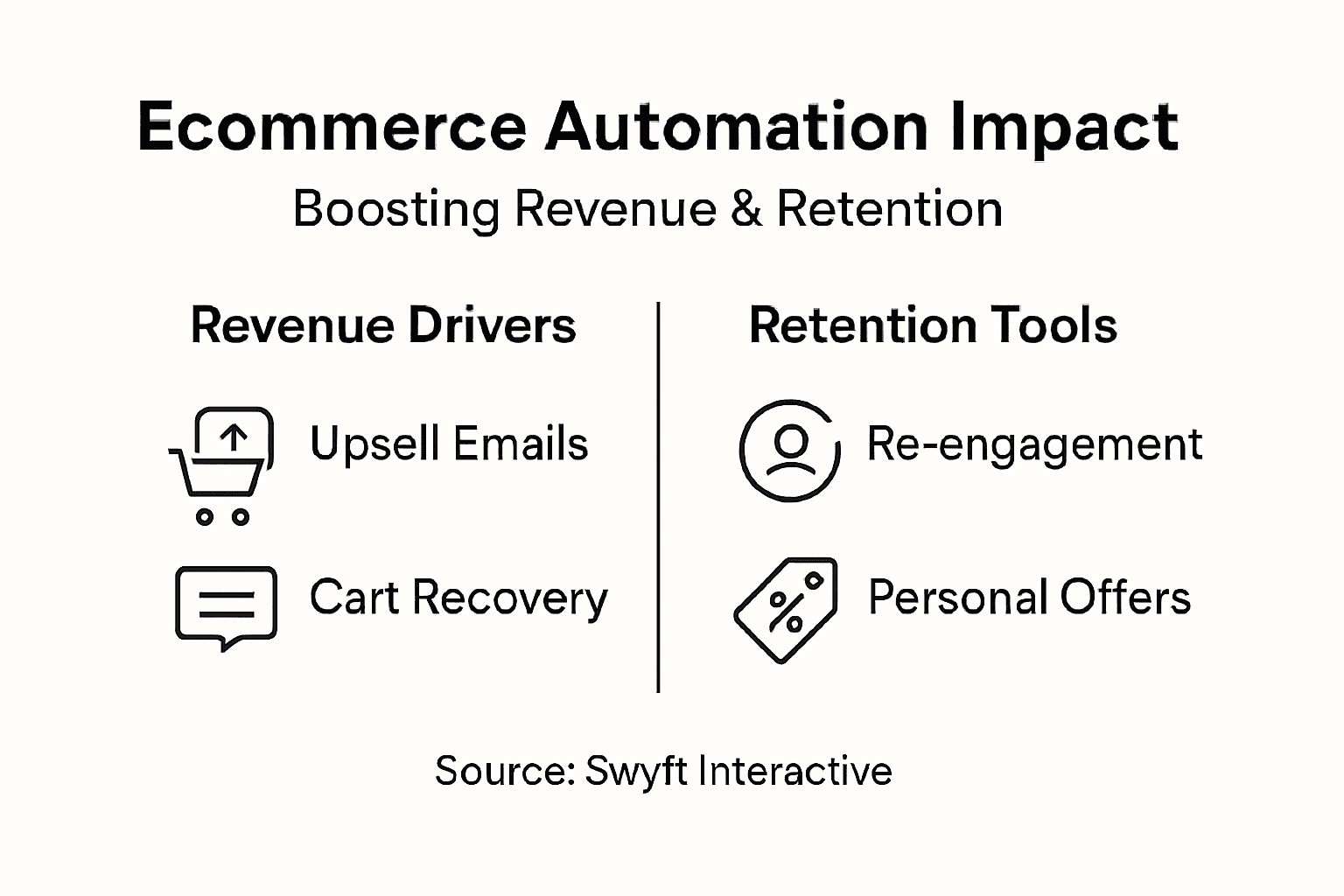
Advanced email automation goes beyond simple messaging. It represents a comprehensive strategy for understanding customer behavior, predicting future actions, and creating meaningful engagement that drives both immediate sales and long-term customer loyalty.
Pro tip: Develop segmentation strategies that consider multiple customer attributes to create truly personalized automation workflows.
Avoiding Common Pitfalls and Managing Costs
E-commerce automation pitfalls can significantly undermine the potential benefits of digital marketing strategies. Successful implementation requires a strategic approach that anticipates potential challenges and proactively develops mitigation strategies.
The most critical pitfalls to avoid include:
- Ineffective Workflow Design: Automating processes without proper strategy
- Integration Challenges: Using disconnected systems that prevent seamless data flow
- Manual Intervention Bottlenecks: Overreliance on human checks that slow automation
- Data Visibility Limitations: Lack of real-time insights and tracking
- Cost Control Failures: Insufficient monitoring of operational expenses
Successful cost management in email automation requires a multifaceted approach. Businesses must balance technological investment with measurable returns, continuously evaluating the performance of their automated systems and adjusting strategies to optimize efficiency.
Technological sophistication alone cannot guarantee success. The most effective automation strategies combine advanced tools with human insight, creating flexible systems that can adapt to changing customer behaviors and market dynamics.
Pro tip: Conduct monthly audits of your automation workflows to identify inefficiencies and potential cost-saving opportunities.
Unlock the Full Potential of Ecommerce Email Automation with Expert Support
The challenge of crafting trigger-based, personalized, and segmented email automation that truly engages customers can feel overwhelming. This article highlights key obstacles like designing effective workflows, managing integrations, and delivering timely communications that drive conversions while avoiding common pitfalls. Swyft Interactive understands these pain points and offers tailored solutions that combine high-performance website development with strategic email marketing automation using Klaviyo. Our approach ensures your ecommerce business does not just send emails but builds dynamic customer journeys that increase revenue and retention.
Take control of your ecommerce growth today with Swyft Interactive. Whether you are looking to refine your automation flows, leverage advanced segmentation, or align your website and email strategies for full-funnel success, our expert team is ready to help you navigate the complexities of digital marketing. Start maximizing your marketing impact by exploring our proven strategies and see why top brands trust us for scalable, data-driven ecommerce solutions that deliver measurable results. Visit Swyft Interactive now to unlock your store’s potential and access insightful content like our You Suck At Klaviyo Archives and Digital Strategy Archives.
Frequently Asked Questions
What is ecommerce email automation?
Ecommerce email automation refers to the systematic delivery of personalized email communications triggered by specific customer behaviors and interactions, allowing businesses to engage customers without manual intervention.
How does trigger-based communication work in email automation?
Trigger-based communication automatically sends emails based on specific customer actions, such as making a purchase or abandoning a cart, which increases engagement and helps recover lost sales.
What are the key principles of personalization in ecommerce email automation?
Personalization in ecommerce email automation involves tailoring dynamic content to individual customer preferences and history, which enhances conversion rates and builds customer loyalty.
What types of automated ecommerce emails should businesses consider?
Businesses should consider various automated email types, including welcome emails, abandoned cart reminders, post-purchase confirmations, re-engagement campaigns, and personalized product recommendations to effectively nurture customer relationships.