
TL;DR:
- In 2026, ecommerce SEO is heavily influenced by AI Overviews suppressing organic CTRs on informational queries and stricter Google Merchant Center image requirements.
- Core Web Vitals’ INP threshold of 150ms now directly impacts search rankings, emphasizing the need for fast, responsive user interactions.
- Agentic commerce tools like Google’s Universal Commerce Protocol are transforming the buyer journey, requiring brands to optimize for natural language attributes and rich product data to stay competitive.
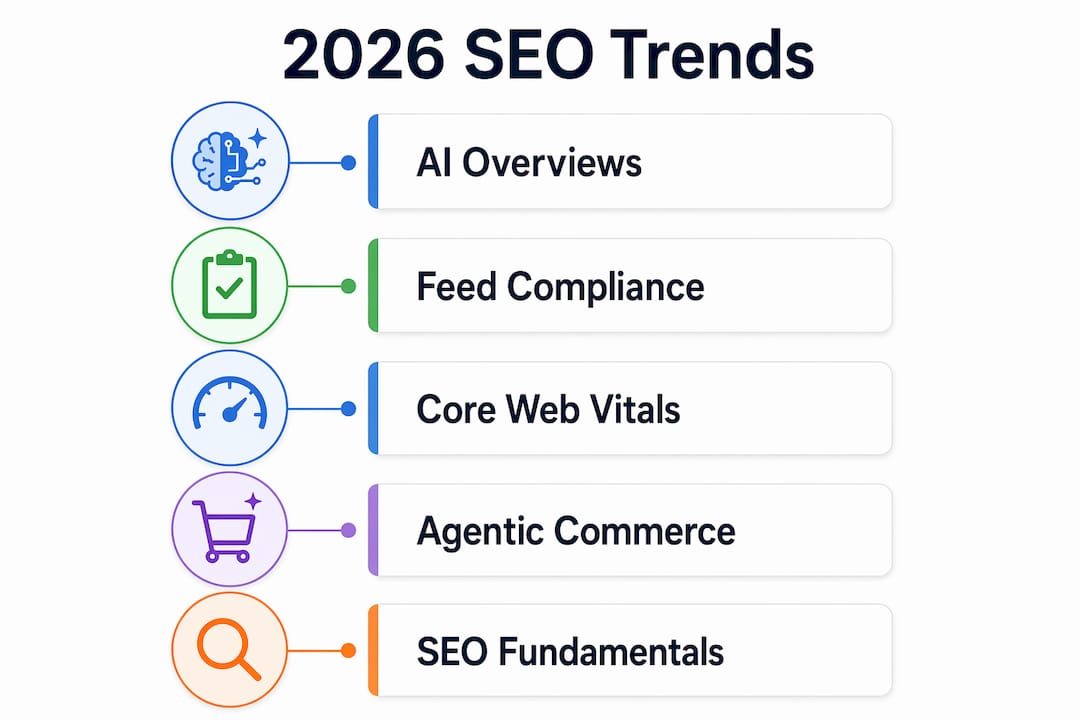
SEO trends in 2026 for online stores are defined by four structural shifts: AI-powered search features that suppress organic click-through rates, stricter Google Merchant Center feed and image requirements, tightened Core Web Vitals thresholds centered on Interaction to Next Paint (INP), and the emergence of agentic commerce tools like Google’s Universal Commerce Protocol. These are not incremental updates. Each one changes how products get discovered, ranked, and purchased. Ecommerce professionals who treat these as optional upgrades will lose ground to brands that have already adapted their 2026 ecommerce SEO strategies to match Google’s new ecosystem. The following sections break down each shift with specific data, named tools, and practical steps you can act on now.
How AI Overviews are reshaping ecommerce SEO in 2026
AI Overviews now appear on roughly 65% of commercial queries in the US, and the traffic impact is uneven in ways that matter for how you allocate SEO resources. Informational and category-level queries are absorbing the hardest hits, with organic click-through rates down 28 to 34% on informational queries and 12 to 19% on mid-funnel category pages. That is a significant portion of the traffic that once fed top-of-funnel discovery. Product detail pages, by contrast, show less than 5% CTR change, and Google Shopping clicks are holding steady or growing slightly.
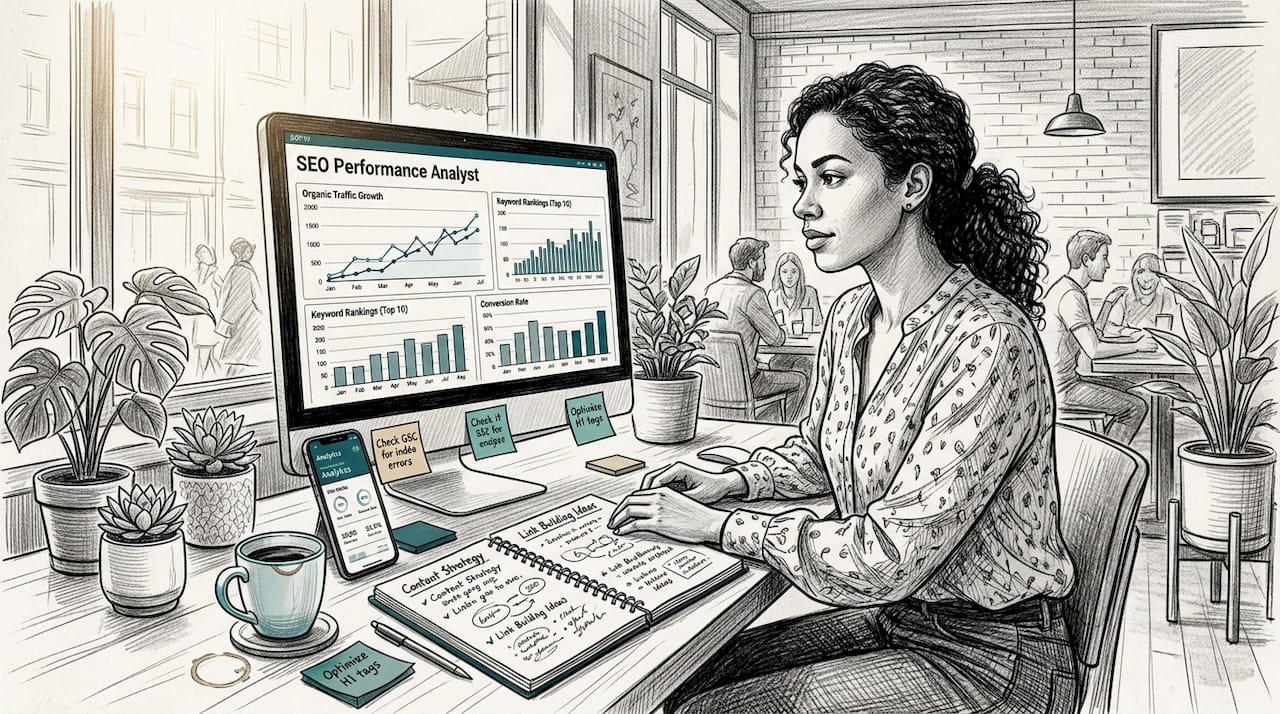
The practical implication is clear: your SEO reporting must separate organic clicks from AI-surfaced discovery. Brands that measure both in the same bucket will misread their performance and cut investment in channels that are actually working. Google’s AI Mode in Search and Gemini are pulling users toward Shopping surfaces faster than before, which means product feed quality now functions as an SEO asset, not just a paid ads requirement.
To adapt, focus your content investment on product pages and structured data rather than broad informational blog content. Category pages still matter for mid-funnel capture, but they need tighter alignment with transactional intent and richer Schema markup to remain visible in AI-generated results.
- Audit which query types drive your current organic traffic and flag those most exposed to AI Overview suppression
- Shift content resources toward product-level pages with detailed specifications, reviews, and structured attributes
- Use Google Search Console to track CTR by page type and identify where AI Overviews are intercepting clicks
- Monitor Google Shopping performance separately from organic, since Shopping clicks are not declining at the same rate
Pro Tip: Set up a custom Search Console segment that isolates informational query traffic from transactional query traffic. If informational CTR drops while Shopping impressions hold, your strategy is working even if total organic clicks look flat.
Google’s AI Performance Insights tool inside Merchant Center gives brands data on their share-of-voice across AI-driven Search and Gemini, broken down by shopper journey stage. This is the measurement layer that connects feed optimization to actual discovery outcomes, and most brands are not using it yet.
What Google Merchant Center’s new specs mean for product visibility
Google Merchant Center raised its minimum image resolution requirement to 500×500 pixels, with warnings starting April 14, 2026 and enforcement beginning January 31, 2027. Products with sub-standard images will be flagged first, then disapproved. Disapprovals silently remove products from Shopping surfaces without any ranking signal or error message in your analytics. That makes feed hygiene a revenue issue, not just a technical one.
The same update introduced a new optional video link attribute. Video validations started April 14, 2026, with videos eligible to serve from June 30, 2026. Policy errors prevent video serving but do not affect the product offer itself, so adding video links carries no downside risk and meaningful upside for product display quality.
Here is a practical compliance sequence to work through before the January 2027 enforcement deadline:
- Export your full product feed and filter for images below 500×500 pixels
- Use AI upscaling tools (Google explicitly permits this) to bring sub-standard images up to spec without reshooting
- Audit near-duplicate images across product variants and consolidate where possible to reduce disapproval risk
- Add video link attributes to your top 20% of products by revenue, starting with items that have existing product videos
- Schedule a quarterly feed review as a standing operational task, not a one-time fix
Pro Tip: Do not wait for Merchant Center warnings to appear before acting. The warning period starting April 14, 2026 gives you a window to fix issues before enforcement. Brands that treat this as a Q4 2026 project will face disapprovals during peak shopping season.
| Feed element | Current requirement | Enforcement date |
|---|---|---|
| Image resolution | 500×500 pixels minimum | January 31, 2027 |
| Video link attribute | Optional, policy validation active | Serving eligible June 30, 2026 |
| Near-duplicate images | AI optimization permitted | Ongoing |
Why INP thresholds are now a direct ranking factor for online stores
Interaction to Next Paint replaced First Input Delay as Google’s responsiveness metric, and the INP threshold for “Good” is now 150ms or under. Scores between 150ms and 500ms fall into “needs improvement,” and anything above 500ms is classified as poor. The ranking consequences are concrete: sites in the “needs improvement” range lose approximately 0.8 positions, while poor INP triggers drops of 2 to 4 positions. Those are not rounding errors on a competitive SERP.
What makes INP particularly challenging for ecommerce sites is how Google aggregates Core Web Vitals scores. Domain-level CWV scoring uses traffic-weighted averages, so a handful of high-traffic pages with poor INP pull down your entire domain’s score. Fixing your homepage and top 20 traffic pages delivers more ranking recovery than optimizing 200 low-traffic pages. Prioritize by traffic share, not by page count.
| INP score | Classification | Estimated ranking impact |
|---|---|---|
| ≤150ms | Good | No penalty |
| 150ms to 500ms | Needs improvement | ~0.8 position loss |
| >500ms | Poor | 2 to 4 position drops |
The most common causes of poor INP on ecommerce sites are third-party JavaScript, heavy event handlers on product pages, and synchronously loaded review carousels or chat widgets. Sites that lazy-load review carousels and chat widgets have brought INP scores from 280ms down to 110ms, recovering lost ranking positions after recent Google core updates. That is a specific, repeatable fix.
Treat INP as a session worst-case problem, not an initial load metric. A user who clicks “Add to Cart” 30 seconds after page load triggers an interaction that counts toward your INP score. JavaScript that runs fine on load can create latency spikes during user interactions, which is why lab testing alone misses real-world INP issues. Use Chrome User Experience Report data alongside PageSpeed Insights to capture actual user sessions.
Pro Tip: Run a JavaScript audit on your product pages using Chrome DevTools’ Performance panel. Look for long tasks triggered by click or input events. Third-party scripts from loyalty programs, live chat, and review platforms are the most common offenders on ecommerce sites.
Good UX design and Core Web Vitals are now inseparable. A product page that loads fast but freezes during cart interactions fails both the user and the ranking algorithm.
What agentic commerce tools mean for your SEO strategy
Google’s Universal Commerce Protocol (UCP), Agent Payments Protocol (AP2), and Universal Cart represent the clearest signal yet that AI is moving from search assistant to purchase agent. UCP features include a Google Pay-enabled universal cart that works across brands including Nike, Sephora, and Walmart, allowing shoppers to add products from multiple retailers and check out in a single session. For ecommerce SEO, this changes the buyer journey in a fundamental way: discovery, evaluation, and purchase can now happen entirely within Google’s ecosystem.
The SEO implication is that product descriptions optimized for keyword matching are no longer sufficient. Conversational queries fed into AI agents require attributes like “easy setup,” “ships in two days,” or “works with existing hardware.” Google’s AI Performance Insights tool surfaces exactly which product attributes drive discovery at each stage of the shopper journey, from awareness through purchase. Brands using this data can prioritize which feed attributes to enrich rather than guessing.
- Optimize product titles and descriptions for natural language queries, not just keyword-dense phrases
- Add structured attributes to your feed that reflect how buyers describe products in conversation
- Monitor your share-of-voice in AI-driven Search using Merchant Center’s AI Performance Insights
- Integrate new payment options like Affirm and Klarna where UCP supports them, since payment flexibility influences conversion signals Google tracks
The AI-driven discovery tools inside Merchant Center now give brands a breakdown of visibility by discovery, evaluation, and purchase stage. Most ecommerce teams only optimize for purchase-stage visibility. Brands that fill gaps at the discovery and evaluation stages will capture buyers before competitors even appear in the results.
Balancing classic SEO fundamentals with 2026 ecommerce innovations
Technical SEO fundamentals have not been replaced by AI trends. They have become the foundation that makes AI-driven discovery possible. Proper pagination, faceted navigation handling, canonical tags, and Schema markup help both search engines and AI systems interpret ecommerce content accurately. Without these in place, even a perfectly optimized product feed will underperform.
Template-level SEO is where most ecommerce brands leave ranking potential on the table. A single fix to a category page template propagates across thousands of pages simultaneously. Aligning title tag structures, meta descriptions, and heading hierarchies at the template level delivers more consistent results than page-by-page optimization. Schema markup for products, reviews, and breadcrumbs feeds directly into how AI Overviews and Shopping surfaces display your products.
E-E-A-T (Experience, Expertise, Authoritativeness, and Trustworthiness) has grown more relevant as AI systems evaluate content quality. User-generated content including verified reviews, Q&A sections, and customer photos adds the experience signals that editorial content alone cannot provide. For ecommerce, this means your product pages should carry authentic social proof that Google’s systems can parse and surface.
- Audit your site’s canonical tag implementation across faceted navigation and filtered category pages
- Implement Product, Review, and BreadcrumbList Schema on all product and category templates
- Add meta robots directives to paginated and filtered URLs that should not consume crawl budget
- Integrate verified review platforms that output structured data Google can read
Pro Tip: Use Google’s Rich Results Test on your top product page templates before deploying Schema changes site-wide. A single markup error in a template can suppress rich results across your entire catalog.
Connecting ecommerce analytics to your SEO program is what separates brands that react to ranking changes from those that predict them. Tracking organic traffic by page type, conversion rate by landing page, and INP scores by template gives you the data to prioritize fixes before they become ranking penalties.
Key takeaways
Winning ecommerce SEO in 2026 requires simultaneous execution across AI search adaptation, feed compliance, Core Web Vitals performance, and agentic commerce readiness.
| Point | Details |
|---|---|
| AI Overviews suppress informational CTR | Organic clicks on informational queries are down 28 to 34%; shift investment to product pages and Shopping feeds. |
| Feed compliance is a revenue issue | Sub-500×500 images face disapproval from January 2027; audit and fix your feed before peak season. |
| INP is now a direct ranking factor | Scores above 150ms cost ranking positions; fix high-traffic pages first using real user data. |
| Agentic commerce requires conversational attributes | Optimize product descriptions for natural language queries and use AI Performance Insights to prioritize feed enrichment. |
| Technical SEO enables AI discovery | Canonical tags, Schema markup, and template-level optimization remain the foundation for AI-driven product visibility. |
What I’ve learned watching ecommerce SEO shift under AI search
I have watched ecommerce brands lose 20% of their organic traffic in a single quarter and spend months trying to recover it through content production, when the actual problem was a product feed full of low-resolution images and missing Schema markup. The AI Overviews rollout accelerated something that was already happening: Google is becoming a shopping interface, not just a search engine. Brands that optimize for that reality will grow. Brands that keep optimizing for the 2022 version of SEO will keep losing ground.
The INP metric is the one I see most consistently underestimated. Teams fix their Largest Contentful Paint scores, declare their Core Web Vitals work done, and then wonder why rankings did not recover. INP is a session-level metric that fires on every user interaction, and third-party scripts from loyalty programs, chat tools, and review widgets are almost always the culprit. The fix is not complicated. It requires someone to actually run the performance audit and make the call to lazy-load or defer those scripts.
Universal Commerce Protocol is the trend I would watch most closely for 2026 and beyond. When Google can complete a purchase across multiple retailers in a single session, the brands with the richest, most structured product data will dominate AI-driven recommendations. That is not a future state. It is already live for Nike, Sephora, and Walmart. The question is how quickly your brand gets its feed and product attributes ready to compete in that environment.
— Leon
How Swyftinteractive helps ecommerce brands stay ahead of 2026 SEO shifts
Adapting to 2026’s SEO demands requires more than a checklist. It requires a connected system where your website performance, product feed quality, and marketing automation work together.
Swyftinteractive builds high-converting ecommerce websites engineered to meet Core Web Vitals thresholds and structured for AI-driven discovery from day one. Their ecommerce website checklist covers feed compliance, Schema implementation, and Klaviyo automation integration so your store captures traffic at every stage of the buyer journey. If you want a site that performs under 2026’s stricter ranking standards and converts the traffic it earns, Swyftinteractive’s ecommerce growth strategy services are built for exactly that outcome.
FAQ
What are the biggest SEO trends in 2026 for online stores?
The top trends are AI Overviews suppressing organic CTR on informational queries, stricter Google Merchant Center image requirements (500×500 pixels minimum), tighter Core Web Vitals INP thresholds (≤150ms for “Good”), and the rollout of Google’s Universal Commerce Protocol for agentic shopping experiences.
How do AI Overviews affect ecommerce organic traffic?
AI Overviews appear on roughly 65% of commercial queries and reduce organic CTR by 28 to 34% on informational queries and 12 to 19% on category pages. Product detail pages and Google Shopping clicks are far less affected.
What is INP and why does it matter for ecommerce rankings?
INP (Interaction to Next Paint) measures how quickly a page responds to user interactions like clicks and taps. Google’s 2026 threshold sets “Good” at 150ms or under, with poor scores triggering ranking drops of 2 to 4 positions across the entire domain.
How should I prepare my product feed for Google Merchant Center in 2026?
Audit all product images for the 500×500 pixel minimum, use AI upscaling where needed, and add the new optional video link attribute to high-revenue products. Treat feed hygiene as a quarterly task since disapprovals remove products from Shopping surfaces without visible alerts.
What is Universal Commerce Protocol and how does it affect SEO?
Google’s Universal Commerce Protocol enables AI agents to manage cross-retailer shopping carts and complete purchases within Google’s ecosystem. Brands with structured, conversational product attributes and rich feed data will receive preferential visibility in AI-driven recommendations.