

Every checkout that feels confusing or slow is a missed revenue opportunity. For American ecommerce managers, understanding why shoppers hesitate at the final step is key to reducing abandoned carts and driving more conversions. This guide clarifies the principles behind ecommerce checkout optimization and offers practical ways to make the path from cart to purchase smoother, helping your brand turn more potential buyers into loyal customers.
Table of Contents
- Defining Ecommerce Checkout Optimization
- Common Barriers To Conversion At Checkout
- Key Features Of High-Converting Checkouts
- Impacts On Revenue And Customer Loyalty
- Avoiding Mistakes And Maximizing Results
Key Takeaways
| Point | Details |
|---|---|
| Ecommerce Checkout Optimization | Focus on minimizing friction to enhance conversion rates and customer satisfaction during the checkout stage. |
| Common Barriers to Conversion | Address issues like forced account creation and hidden fees to prevent cart abandonment. |
| High-Converting Checkout Features | Incorporate features such as one-click purchasing and transparent pricing to improve user experience. |
| Impacts on Revenue and Loyalty | An optimized checkout process can significantly boost customer spending and repeat purchase likelihood. |
Defining Ecommerce Checkout Optimization
Ecommerce checkout optimization represents a strategic approach to improving the final stage of online purchasing, where potential customers transform into actual buyers. By systematically reducing friction and complexity in the transaction process, businesses can significantly enhance conversion rates and customer satisfaction.
According to academic research, checkout optimization focuses on identifying and eliminating consumer pain points during the purchase journey. This process involves carefully analyzing each step customers navigate between selecting products and completing payment. Key objectives include:
- Minimizing required form fields
- Streamlining navigation between cart and payment screens
- Providing multiple payment method options
- Displaying clear pricing and total costs
- Ensuring mobile-responsive design
- Creating trust signals like security badges
The primary goal of ecommerce checkout optimization goes beyond simply reducing abandoned shopping carts. It aims to improve overall user experience and transaction reliability by creating a smooth, intuitive pathway from product selection to successful purchase completion.
Successful checkout optimization requires continuous testing, data analysis, and user experience refinement. Businesses must regularly evaluate their checkout process, identifying potential barriers that might discourage customers from finalizing their purchases.
Pro tip: Implement A/B testing on your checkout pages to systematically identify and remove potential conversion obstacles.
Common Barriers to Conversion at Checkout
Ecommerce businesses face significant challenges in maintaining customer momentum during the final purchasing stage. Checkout abandonment remains a critical issue, with multiple friction points potentially derailing a customer’s intent to complete a transaction.
Research reveals several prominent barriers that consistently interrupt the checkout process:
- Forced account creation
- Unexpected or hidden fees
- Complex, multi-step checkout flows
- Limited payment method options
- Poor mobile user experience
- Slow page loading times
- Lack of transparent pricing information
- Insufficient security signals
Forced Account Creation represents one of the most significant deterrents. Checkout UX mistakes can dramatically impact conversion rates, with approximately 24% of shoppers abandoning purchases when required to create a mandatory account. Customers increasingly value quick, frictionless transactions and view extensive registration processes as unnecessary obstacles.

Additionally, pricing transparency plays a crucial role in maintaining customer trust. Surprising customers with unexpected costs, shipping fees, or additional charges during the final checkout stage can instantly erode their purchasing confidence and lead to cart abandonment.
Pro tip: Implement a guest checkout option and display all potential costs upfront to minimize customer friction and improve conversion rates.
Key Features of High-Converting Checkouts
Successful ecommerce websites understand that the checkout process is more than a transaction – it’s a critical moment of customer engagement. One-click checkout technologies dramatically improve purchasing experiences, transforming how customers interact with online stores.
Key features of high-converting checkout experiences include:
- Simplified, minimal form fields
- Multiple secure payment options
- Clear, upfront pricing display
- Mobile-responsive design
- Instant form validation
- Persistent cart functionality
- Quick loading times
- Trust and security badges
- Guest checkout capability
The most effective checkouts prioritize customer convenience and psychological comfort. Successful checkout experiences emphasize efficiency and user control, reducing friction that might prevent customers from completing their purchase.
Technological innovations like saved payment methods, address autofill, and integrated digital wallets can significantly streamline the checkout process. By minimizing steps and providing multiple payment alternatives, businesses can create a seamless purchasing journey that feels effortless and trustworthy.
Pro tip: Conduct regular user testing to identify and eliminate checkout process bottlenecks that might discourage potential customers.
Here’s a summary of how specific checkout features influence ecommerce performance:
| Checkout Feature | Business Impact | Customer Benefit |
|---|---|---|
| One-Click Purchase | Increases conversion and speed | Reduces effort, quicker buy |
| Multiple Payment Methods | Expands market reach | More flexible payment choices |
| Transparent Pricing | Builds trust and loyalty | Prevents surprise fees |
| Mobile Responsive Design | Boosts mobile sales | Simplifies mobile checkout |
| Security Badges | Strengthens trust and reputation | Reassures safety of purchase |
Impacts on Revenue and Customer Loyalty
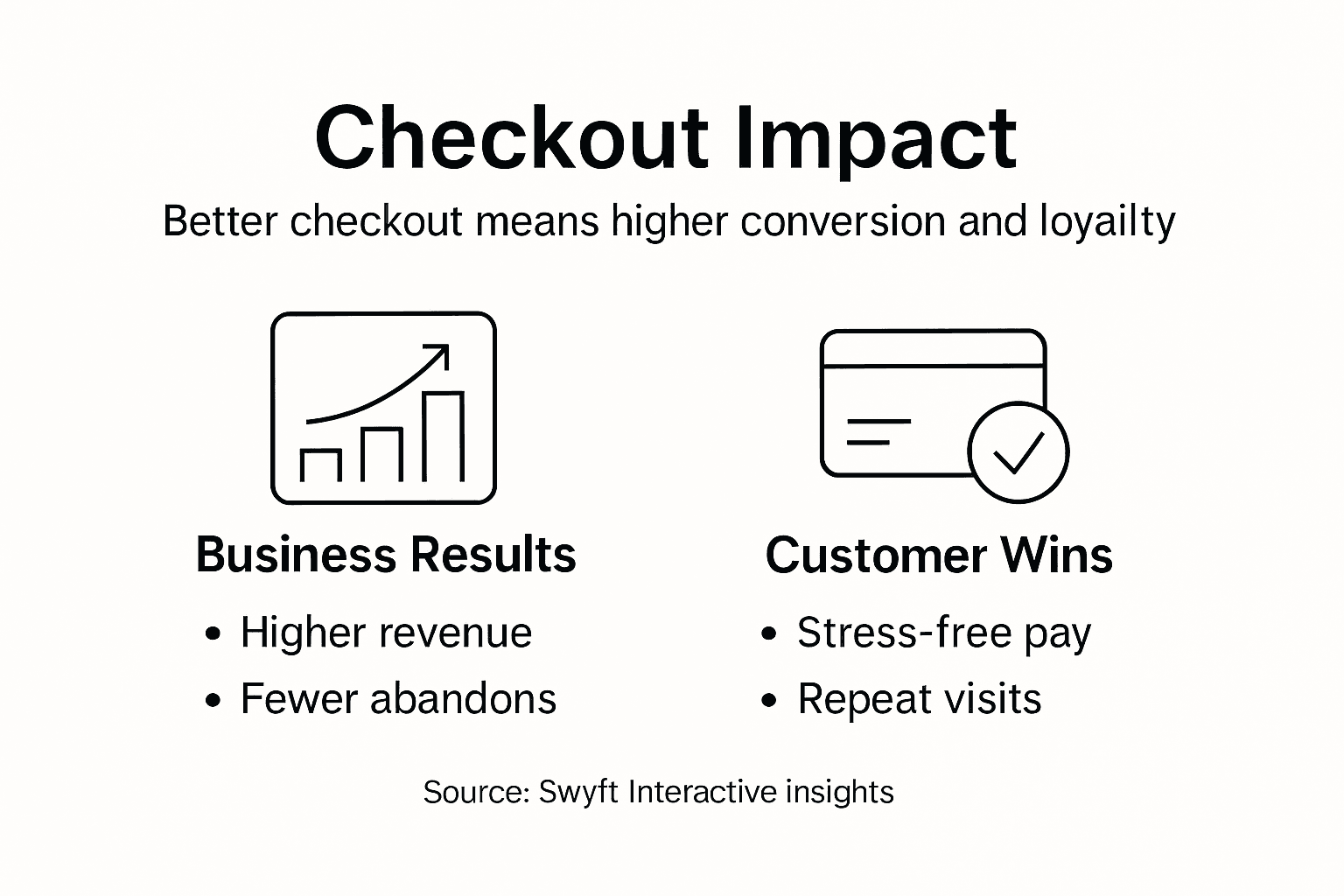
Checkout optimization directly influences revenue and customer retention, transforming how businesses approach online sales strategies. The checkout experience is no longer just a transactional endpoint, but a critical moment of customer engagement that can make or break future sales opportunities.
Key revenue and loyalty impacts include:
- Increased purchase frequency
- Higher average transaction value
- Reduced cart abandonment rates
- Enhanced customer trust
- Improved repeat purchase likelihood
- Extended customer lifetime value
- Greater brand perception
Quantifiable Impacts demonstrate the significant potential of an optimized checkout process. Research reveals remarkable improvements in key business metrics:
- 28.5% increase in customer spending
- 43% boost in purchase frequency
- 36% expansion in product variety per transaction
Seamless checkout experiences build substantial customer trust, enabling businesses to create more reliable and predictable revenue streams. By reducing friction and providing transparent, flexible payment options, companies can transform one-time buyers into loyal, long-term customers.
Pro tip: Implement comprehensive analytics to track checkout performance metrics and continuously refine your conversion strategy.
Avoiding Mistakes and Maximizing Results
Ecommerce checkout mistakes can dramatically undermine conversion potential, creating significant revenue barriers for online businesses. Understanding and systematically eliminating these friction points becomes crucial for sustained digital sales success.
Common checkout mistakes that significantly impact conversion rates include:
- Forced account creation
- Hidden or unexpected fees
- Complex, multi-step checkout processes
- Limited payment method options
- Poor mobile responsiveness
- Slow page loading times
- Insufficient security signals
- Lack of transparent pricing information
Businesses can recover substantial revenue by strategically addressing these challenges. Implementing user-friendly design principles can increase conversion rates by up to 35%, transforming potential abandoned carts into completed purchases.
Successful checkout optimization requires a holistic approach that combines technological solutions with intuitive user experience design. By prioritizing transparency, simplicity, and customer trust, ecommerce platforms can create checkout experiences that not only prevent sales loss but actively encourage repeat purchases.
Pro tip: Conduct regular user experience testing and analyze checkout funnel analytics to continuously identify and remove potential conversion barriers.
For quick reference, here’s a comparison of common checkout mistakes with their outcomes and solutions:
| Mistake Identified | Negative Outcome | Proven Solution |
|---|---|---|
| Forced Account Creation | Higher cart abandonment | Enable guest checkout |
| Hidden Fees | Lower customer trust | Show full costs upfront |
| Slow Page Loads | Reduced conversion | Optimize page performance |
| Limited Payment Options | Lost sales opportunities | Add more payment choices |
| Poor Mobile Experience | Drop in mobile sales | Ensure responsive design |
Unlock Higher Conversions with Expert Ecommerce Checkout Solutions
Struggling with cart abandonment and checkout friction is a common challenge for growing online stores. This article highlights how forced account creation, hidden fees, and complex multi-step processes can drive away customers before they complete their purchase. If your goal is to reduce these barriers and create a seamless, trustworthy checkout experience that maximizes revenue and loyalty, then optimizing your ecommerce funnel is essential. This means simplifying checkout flow, offering multiple payment options, and integrating transparent pricing along with mobile responsiveness.
At Swyft Interactive, we specialize in helping ecommerce brands transform their checkout experiences through tailored Digital Strategy and data-driven Email Marketing solutions powered by Klaviyo automation. Our approach combines fast-loading, customer-centric websites with powerful email sequences designed to recover abandoned carts and boost repeat purchases. Don’t let checkout mistakes undercut your growth. Visit Swyft Interactive today to start building a conversion-optimized checkout that turns visitors into loyal customers.
Frequently Asked Questions
What is ecommerce checkout optimization?
Ecommerce checkout optimization is a strategy focused on improving the final stage of online purchasing by reducing friction and complexity. This process enhances conversion rates and customer satisfaction by streamlining the transaction journey from selecting a product to completing payment.
What are common barriers to conversion during the checkout process?
Common barriers include forced account creation, unexpected fees, complex checkout flows, limited payment options, poor mobile experiences, slow page loading times, and lack of transparent pricing information. Addressing these issues is crucial to minimizing cart abandonment.
How can implementing multiple payment options benefit ecommerce sales?
Offering multiple secure payment options can expand market reach and provide customers with the flexibility to choose their preferred payment method, which ultimately enhances the customer experience and increases the likelihood of completing a purchase.
What are the impacts of optimizing the checkout experience on customer loyalty?
Optimizing the checkout experience can lead to increased purchase frequency, higher average transaction values, reduced cart abandonment rates, and improved customer trust. This can transform one-time buyers into long-term, loyal customers, ultimately boosting revenue and brand perception.