

TL;DR:
- Focusing on key KPIs clarifies decisions and drives ecommerce growth effectively.
- Regular real-time KPI monitoring helps detect and fix issues early.
- Start with a few core metrics aligned to business goals and review consistently.
Most ecommerce teams are drowning in data. You’ve got traffic reports, ad dashboards, email open rates, heatmaps, and a dozen other feeds competing for your attention every morning. Yet despite all that information, sales plateaus persist and decisions still feel like guesswork. The problem isn’t a lack of data. It’s a lack of focus. Tracking the right key performance indicators (KPIs) cuts through the noise and connects your daily numbers to your actual business goals. This guide breaks down exactly why KPI tracking matters, how to choose the metrics that move the needle, and how to build a system that drives sustainable ecommerce growth.
Table of Contents
- What are ecommerce KPIs and why do they matter?
- How tracking KPIs enables smarter, faster decisions
- Choosing the right KPIs for your ecommerce business
- KPI tracking in practice: Tools, cadence, and continuous improvement
- Our take: What most ecommerce brands get wrong about KPIs
- Scale your ecommerce business with expert KPI tracking
- Frequently asked questions
Key Takeaways
| Point | Details |
|---|---|
| Focus on key metrics | Tracking a handful of relevant KPIs delivers more actionable insight than measuring dozens of metrics. |
| KPIs drive business outcomes | Effective KPI tracking supports faster decisions, real-time problem detection, and ongoing optimization. |
| Avoid data overload | Align KPIs with business objectives to prevent overwhelm and keep teams focused. |
| Review and refine regularly | Consistent KPI review ensures your key indicators evolve with your ecommerce strategies. |
What are ecommerce KPIs and why do they matter?
A KPI, or key performance indicator, is a specific, goal-aligned metric that tells you whether your business is moving in the right direction. Not every number qualifies. Page views are a metric. Conversion rate is a KPI. The difference is intentionality. KPIs are chosen because they directly reflect progress toward a business objective, while general metrics simply describe what happened.
In ecommerce, this distinction is critical. Tracking ecommerce metrics without a framework leads to what analysts call “vanity metrics,” numbers that look impressive but don’t tell you what to do next. KPIs give your data a job.
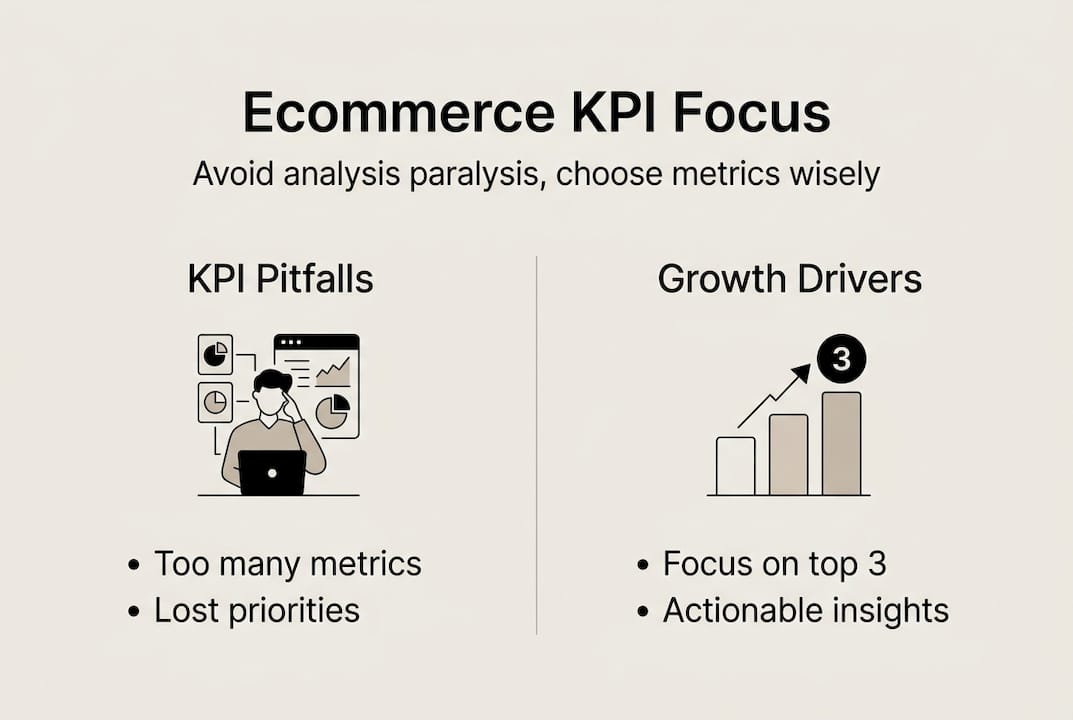
There are three core reasons KPIs drive growth. First, they create focus. When your team knows which five numbers matter most, everyone pulls in the same direction. Second, they enable benchmarking. You can’t improve what you don’t measure consistently over time. Third, they provide decision clarity. When a KPI drops, you have a clear signal to investigate and act, not just a vague sense that something is off.
Analytics for ecommerce growth becomes far more powerful when it’s organized around KPIs rather than raw data dumps. As research confirms, KPIs facilitate inventory optimization, marketing effectiveness evaluation, and customer behavior analysis for personalized strategies.
Here’s a quick reference for three foundational ecommerce KPIs:
| KPI | Definition | What it reveals |
|---|---|---|
| Conversion rate | Percentage of visitors who complete a purchase | Site effectiveness and UX quality |
| Average order value (AOV) | Average revenue per transaction | Upsell and bundling opportunities |
| Customer acquisition cost (CAC) | Total spend to acquire one new customer | Marketing efficiency and profitability |
“You can’t manage what you don’t measure. But you also can’t grow if you’re measuring everything at once.”
Start with these three and build outward as your strategy matures. Trying to track 30 KPIs from day one is a recipe for paralysis, not progress.
How tracking KPIs enables smarter, faster decisions
With a clear understanding of KPIs, the next question is: How does tracking them change everyday business decisions? The answer is speed and specificity.
When you monitor the right KPIs in real time, problems surface before they become expensive. A sudden spike in cart abandonment rate might signal a broken checkout flow. A drop in average session duration could point to a slow-loading product page. Without KPI tracking, these issues might go unnoticed for weeks while revenue quietly bleeds out. Real-time problem detection through KPIs like cart abandonment and page load speed prevents revenue loss from technical issues or poor UX.

Consider this comparison between two approaches to reporting:
| Approach | Response time | Business impact |
|---|---|---|
| Responsive KPI tracking | Hours to days | Issues caught early, minimal revenue loss |
| Ad-hoc reporting | Weeks to months | Problems compound, customer trust erodes |
The difference isn’t just speed. It’s the quality of decisions that follow. Responsive KPI tracking gives you ecommerce engagement metrics that tell a story, not just a snapshot.
Here’s how a typical ecommerce manager might use KPIs to solve a high cart abandonment problem:
- Spot the signal. Weekly KPI review shows cart abandonment jumped from 68% to 79% over seven days.
- Isolate the variable. Cross-reference with device type data. Mobile abandonment is disproportionately high.
- Investigate the cause. Session recordings reveal the mobile checkout button is partially hidden on smaller screens.
- Fix and measure. Development team corrects the layout. Abandonment rate returns to baseline within 48 hours.
- Document the pattern. Add mobile checkout rendering to the weekly QA checklist going forward.
This five-step loop only works if you’re watching the right KPI consistently. Without that weekly cart abandonment check, the broken button might have cost you thousands in lost sales before anyone noticed.
Choosing the right KPIs for your ecommerce business
Smart decisions depend on the right focus. But how do you choose which KPIs actually matter for your business? The answer starts with your goals, not your tools.
One of the most common mistakes ecommerce brands make is letting their analytics platform decide what to measure. You open Google Analytics, see 50 available reports, and start tracking all of them. The result is a dashboard full of numbers and a team with no clear direction. As one CFO-focused resource puts it, over-tracking leads to “data-rich, insight-poor”; start with business goals, select few KPIs, review consistently rather than adding tools.
The fix is to work backwards from your business objective. A brand in high-growth mode should prioritize KPIs like new customer acquisition rate and traffic-to-conversion ratio. A brand optimizing for profitability should focus on CAC, gross margin per order, and repeat purchase rate. These are very different dashboards, and that’s the point.
For conversion optimization KPIs, the goal is always to connect the metric directly to a lever you can pull. If you can’t act on a number, it probably doesn’t belong on your core KPI list.
Use these five questions to filter your KPI candidates:
- Does this metric connect directly to a business goal? If not, it’s context, not a KPI.
- Can we influence this number with our current resources? Vanity metrics often can’t be moved intentionally.
- Will a change in this metric tell us something actionable? If the answer is unclear, keep looking.
- Is this metric measurable on a consistent schedule? Irregular data creates unreliable trends.
- Does our team understand what this number means? Complexity kills adoption.
Pro Tip: Review your KPI list every quarter. As your business grows, the metrics that matter most will shift. A KPI that was critical during launch may become background noise once you’ve hit product-market fit.
Klaviyo KPI tracking is a strong example of platform-native measurement done right. Klaviyo surfaces email revenue attribution, flow performance, and list health in one place, making it easier to connect email activity to the KPIs that actually drive store revenue.
KPI tracking in practice: Tools, cadence, and continuous improvement
Once you’ve defined your key metrics, the next step is building a practical system to leverage this insight for ongoing growth. Having the right KPIs on paper means nothing if your team doesn’t review them regularly and act on what they find.
The tool landscape for ecommerce KPI tracking is broad. Most brands combine a few layers: a native analytics platform (like Google Analytics 4 or Shopify Analytics), a marketing automation tool with built-in reporting (like Klaviyo), and sometimes a third-party dashboard (like Looker Studio or Triple Whale) that pulls everything together. The goal isn’t to use the most tools. It’s to have one clear place where your core KPIs live.
As KPI-driven inventory and marketing analysis confirms, consistent measurement across these channels enables smarter personalization and more efficient spend allocation.
Cadence matters as much as tools. Here’s a practical routine for an ecommerce KPI review meeting:
- Weekly pulse check (15 minutes). Review conversion rate, cart abandonment, and revenue vs. target. Flag any anomalies.
- Monthly deep dive (60 minutes). Analyze AOV trends, CAC by channel, and email flow performance. Identify one area for improvement.
- Quarterly strategy review (half day). Reassess KPI selection, benchmark against industry standards, and update targets based on business evolution.
- Annual reset. Rebuild your KPI framework from scratch based on next year’s growth objectives.
This rhythm keeps your team focused without turning every meeting into a data marathon. Pair it with an automation checklist for ecommerce to ensure your systems are feeding accurate data into each review.
Pro Tip: Assign one team member as the KPI owner for each metric. When someone is personally accountable for a number, it gets watched more carefully and improved more consistently. Shared ownership often means no ownership.
For deeper guidance on building a measurement foundation, analytics for ecommerce success offers a practical framework for connecting your data stack to real revenue outcomes.
Our take: What most ecommerce brands get wrong about KPIs
After working with dozens of ecommerce brands, one pattern stands out above all others. Teams build dashboards before they define goals. They add tools, connect integrations, and generate beautiful reports, then wonder why nothing changes. The dashboard becomes a trophy, not a tool.
The brands that grow fastest treat KPIs as a living system. They start with two or three core metrics, review them obsessively, and only add new KPIs when the business question genuinely demands it. They resist the urge to measure everything and instead get very good at acting on a few key signals.
Here’s the uncomfortable truth: more data does not make you more decisive. It often makes you less decisive, because every new metric introduces another possible explanation for every problem. Simplicity is a competitive advantage.
If you want to build growth strategies for ecommerce that actually stick, start by cutting your KPI list in half. Then review what remains every single week without fail. That discipline, not the sophistication of your analytics stack, is what separates brands that scale from brands that stall.
Scale your ecommerce business with expert KPI tracking
Ready to turn your newfound KPI mastery into lasting revenue growth? Here’s how Swyft Interactive can help.
At Swyft Interactive, we build ecommerce growth systems that connect KPI tracking to real action. From customer journey mapping to Klaviyo automation and conversion-focused website development, every solution we build is designed around the metrics that matter most to your specific business goals.
Whether you’re starting fresh or optimizing an existing store, our ecommerce website checklist gives you a clear foundation for measurement and growth. And if you want to understand how data drives every decision we make for our clients, explore our perspective on the role of analytics in ecommerce. Let’s build a tracking system that actually moves your revenue forward.
Frequently asked questions
What are the most important KPIs for ecommerce stores?
The most critical KPIs often include conversion rate, average order value, customer acquisition cost, and cart abandonment rate. These four metrics cover inventory, marketing, and customer behavior in a way that directly informs growth decisions.
How often should ecommerce KPIs be tracked?
Most brands should review key KPIs weekly for operational decisions and monthly for strategic analysis. Daily monitoring is useful for high-traffic stores during peak seasons or major campaigns.
What’s the difference between a KPI and a metric?
A KPI is a strategic metric directly aligned with business goals, while other metrics may provide context but aren’t primary targets for improvement. Think of metrics as data and KPIs as the data that drives decisions.
How can KPIs help detect ecommerce problems early?
Real-time KPI tracking can quickly reveal issues like site speed slowdowns or rising cart abandonment, allowing immediate action before revenue impact compounds. Consistent monitoring is what makes early detection possible.