

Most eCommerce retailers are quietly hemorrhaging revenue. Cart abandonment sits at roughly 76%, meaning three out of every four shoppers who add something to their cart never complete the purchase. That’s not a traffic problem. It’s a funnel problem. A well-structured marketing funnel gives you a clear map of where customers drop off, what motivates them to stay, and exactly how to nudge them toward buying. This guide breaks down what a marketing funnel really is, what the numbers tell you, and how to apply funnel thinking to your store to recover lost sales and grow revenue.
Table of Contents
- Understanding the marketing funnel: Definition and key stages
- Breaking down funnel benchmarks: What do the numbers mean?
- How marketing funnels drive ecommerce growth
- Applying funnel strategies: Step-by-step optimization for your store
- Why most ecommerce brands misjudge the true value of funnel optimization
- Take the next step: Boost your ecommerce funnel results
- Frequently asked questions
Key Takeaways
| Point | Details |
|---|---|
| Funnels increase sales | A well-optimized marketing funnel guides more shoppers to complete purchases and return. |
| Benchmarks highlight gaps | Studying your funnel metrics shows where customers drop off so you can focus on fixes with the biggest payoff. |
| Email drives conversions | Strategic email campaigns recover lost carts and prompt more conversions than many other traffic sources. |
| Small tweaks, big results | Improving even one funnel stage can significantly boost overall store revenue and retention. |
Understanding the marketing funnel: Definition and key stages
A marketing funnel is a visual model that maps the journey a shopper takes from first hearing about your store all the way to becoming a loyal repeat customer. Think of it like a physical funnel: wide at the top where many people enter, and narrow at the bottom where only a fraction complete a purchase. The goal is to widen that bottom as much as possible by removing friction at every stage.
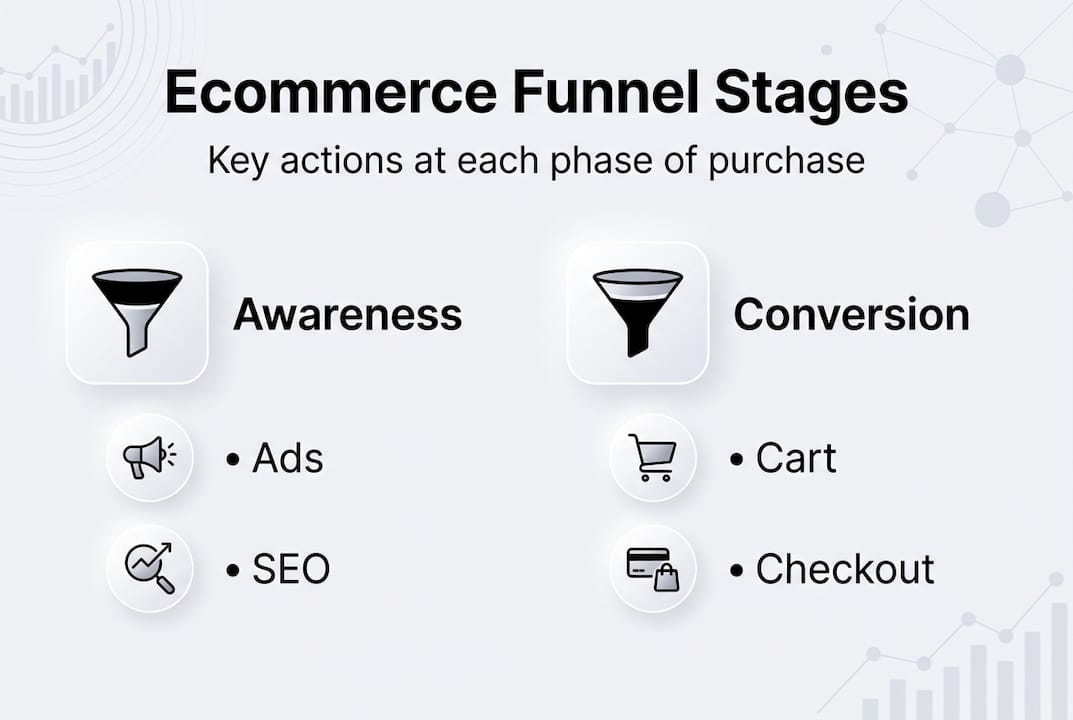
For eCommerce, the funnel typically breaks into four core stages:
- Awareness — The shopper discovers your brand through an ad, a search result, social media, or word of mouth. They don’t know you yet, so your job is to make a strong first impression.
- Consideration — The shopper is actively comparing options. They browse your product pages, read reviews, and weigh your offer against competitors. This is where trust is built or broken.
- Conversion — The shopper decides to buy. This stage covers everything from adding to cart through completing checkout. The global average eCommerce CVR sits at just 2.5 to 3%, which means most visitors still leave without purchasing.
- Retention — The customer returns, buys again, and ideally refers others. This stage is often the most profitable because acquiring a new customer costs far more than keeping an existing one.
Understanding the ecommerce funnel explained in full detail helps you see which stage needs the most attention in your specific store.
Pro Tip: Most eCommerce brands pour budget into awareness and ignore retention entirely. A 5% increase in customer retention can boost profits by 25 to 95%, making it one of the highest-return investments you can make.
Breaking down funnel benchmarks: What do the numbers mean?
Now that you understand the funnel’s structure, let’s look at actual numbers that shape strategy and what they reveal about where sales are often lost.
Benchmarks give you a baseline. Without them, you’re guessing whether your store is performing well or bleeding revenue. Here’s a snapshot of key funnel benchmark rates across common metrics:
| Metric | Benchmark range | Notes |
|---|---|---|
| Add-to-cart rate | 6.8% to 12% | Higher for fashion, lower for electronics |
| Cart abandonment rate | ~76% | Consistent across most verticals |
| Overall CVR (desktop) | 3 to 4% | Desktop consistently outperforms mobile |
| Overall CVR (mobile) | 1.5 to 2.5% | Mobile UX is a major drop-off point |
| Email channel CVR | 4 to 5% | Outperforms paid social and organic |
| Fashion vertical CVR | 3 to 4% | Impulse-driven purchases favor higher CVR |
| Electronics vertical CVR | 1 to 2% | Research-heavy buying lowers CVR |
Here’s what each metric tells you as a business owner:
- Add-to-cart rate reveals how compelling your product pages are. Low rates signal weak copy, poor images, or unclear value.
- Cart abandonment shows how many shoppers lose confidence or interest before checkout. Checkout friction is the usual culprit.
- CVR by device highlights whether your mobile experience is costing you sales. Most traffic is mobile, but most conversions still happen on desktop.
- Email CVR confirms that email remains the highest-converting channel when used correctly.
“Cart abandonment in eCommerce is about 76%.” That single number means the majority of your marketing spend is bringing people to the door who never walk through it.
Using these benchmarks, you can practice conversion rate optimization by identifying which stage of your funnel underperforms relative to industry norms and fixing it before throwing more ad spend at the top.
How marketing funnels drive ecommerce growth
With benchmarks in mind, we move from numbers to tactics. How does the funnel actually influence eCommerce business growth?
Each funnel stage responds to different tactics. Here’s a proven approach for each:
- Awareness — Run targeted paid ads and invest in SEO-driven content to reach new audiences. Influencer partnerships and social proof expand reach without requiring massive budgets.
- Consideration — Use retargeting ads, detailed product descriptions, customer reviews, and comparison content to help shoppers feel confident. Live chat and FAQ sections reduce hesitation.
- Conversion — Simplify checkout to as few steps as possible. Offer multiple payment options. Use urgency cues like low-stock alerts or limited-time offers. Deploy exit-intent popups with a small discount.
- Retention — Build post-purchase email sequences that thank customers, request reviews, and introduce complementary products. Loyalty programs and personalized recommendations keep buyers coming back.
Email automation is the engine that moves customers through the funnel automatically. A real example: an apparel brand sets up a three-email abandoned cart sequence. The first email goes out one hour after abandonment with a reminder. The second follows 24 hours later with social proof. The third offers a 10% discount at 72 hours. The result is a measurable lift in recovered revenue without any manual effort.

The email automation benefits go well beyond cart recovery. Segmented flows for welcome series, browse abandonment, and post-purchase upsells all push customers deeper into the funnel. Email traffic delivers 4 to 5% conversion rates, outperforming nearly every other channel.
Pro Tip: Personalized emails that reference a shopper’s browsing history or past purchases consistently outperform generic batch-and-blast campaigns. Segmentation is not optional if you want results. Check out abandoned cart email strategies to see exactly how to structure these sequences.
Applying funnel strategies: Step-by-step optimization for your store
Ready to take action? Here’s how to apply funnel thinking to your own eCommerce store, step by step.
Start with an audit before you change anything:
- Pull your add-to-cart rate, CVR, and cart abandonment rate from your analytics platform.
- Compare each metric to the benchmarks in the table above.
- Identify the one stage with the biggest gap between your numbers and the benchmark.
- Focus your first optimization effort there before moving to the next stage.
- Set a 30-day review cycle to measure whether changes are working.
Once you know where you’re losing customers, match the problem to the right fix:
| Funnel problem | Optimization technique |
|---|---|
| High cart abandonment | Abandoned cart email sequences, simplified checkout |
| Low add-to-cart rate | Improved product images, stronger copy, social proof |
| Low awareness | Paid traffic campaigns, SEO content, influencer outreach |
| Poor mobile CVR | Mobile-first UX redesign, faster page load speed |
| Low repeat purchase rate | Post-purchase email flows, loyalty program, upsell offers |
| Weak consideration stage | Retargeting ads, review collection, detailed FAQs |
Improving funnel steps and addressing abandonment directly increases conversion rates in a measurable way. The key is to treat each stage as its own mini-project with a clear goal and a defined metric for success.
For a deeper look at the full structure, the marketing funnel breakdown walks through each stage with more detail. Pair that with a review of ecommerce marketing strategies to build a complete plan. If you want to understand how customers actually move through your store, customer journey mapping is the tool that makes the invisible visible.
Why most ecommerce brands misjudge the true value of funnel optimization
Here’s a perspective that might shift how you think about your entire funnel strategy.
Most brands we work with arrive focused on traffic. They want more clicks, more reach, more impressions. And while top-of-funnel growth matters, it’s often the least efficient place to invest when your mid-funnel and retention stages are leaking. Pouring water into a bucket with holes doesn’t fill the bucket.
The brands that see the biggest ROI gains are the ones that invest in the quiet, unglamorous work: post-purchase sequences, personalized follow-up emails, loyalty touchpoints. These aren’t flashy. They don’t make for exciting ad creative. But they compound. A customer who buys twice is worth exponentially more than two one-time buyers, because the second purchase costs almost nothing to acquire.
The real edge in eCommerce right now is not bigger ad budgets. It’s nuanced funnel tweaks that most competitors aren’t making. The in-depth funnel breakdown shows you exactly where those opportunities live. Direct your attention there before you spend another dollar on traffic.
Take the next step: Boost your ecommerce funnel results
You now have a clear picture of how marketing funnels work, what the benchmarks mean, and where your store likely has room to grow. The next move is putting that knowledge into action with the right tools and support.
At Swyft Interactive, we help eCommerce brands build full-funnel growth systems that combine high-converting website design with Klaviyo email automation. Whether you want to learn about marketing funnels in more depth, follow a step-by-step email automation plan, or explore the full range of email automation benefits for your store, we have the resources and hands-on expertise to help you move faster. Explore our case studies or reach out to see how we can build a funnel that actually converts.
Frequently asked questions
What is a marketing funnel in ecommerce?
A marketing funnel is a model that outlines the steps shoppers take from discovering a brand to making a purchase and returning for more. It helps store owners identify where customers drop off and what to fix.
What is a good ecommerce conversion rate in 2026?
The global ecommerce CVR averages 2.5 to 3%, but top-performing stores often exceed this by systematically optimizing each funnel stage. Your vertical matters too, since fashion tends to convert higher than electronics.
How can I reduce cart abandonment in my funnel?
Use targeted abandoned cart emails, streamline your checkout process, and offer incentives like free shipping or a small discount. Cart abandonment rates around 76% are common, but smart funnel strategies can recover a meaningful portion of those lost sales.
Does email marketing really help move customers through the funnel?
Absolutely. Email traffic converts at 4 to 5%, outperforming paid social and organic search. Segmented, automated email flows re-engage shoppers at every stage of the funnel with minimal ongoing effort.
Recommended
- Ecommerce Funnel Explained: Boosting Conversions in 2026
- Marketing automation checklist for ecommerce success in 2026
- Proven ecommerce growth strategies to scale your brand in 2026
- 7 Essential Ecommerce Marketing Strategies for More Sales
- Hospitality Promotions Workflow: Cut Errors 40% & Boost Sales