
TL;DR:
- Building an ecommerce email list relies on a layered system of multiple capture points that target visitors at various stages of intent. Proper technical setup, GDPR-compliant consent, and segmented welcome flows are essential for sustainable growth and engagement. Most stores neglect this holistic approach, risking poor list quality and stagnant growth, while experts treat capture as a continuous system to maximize subscriber acquisition.
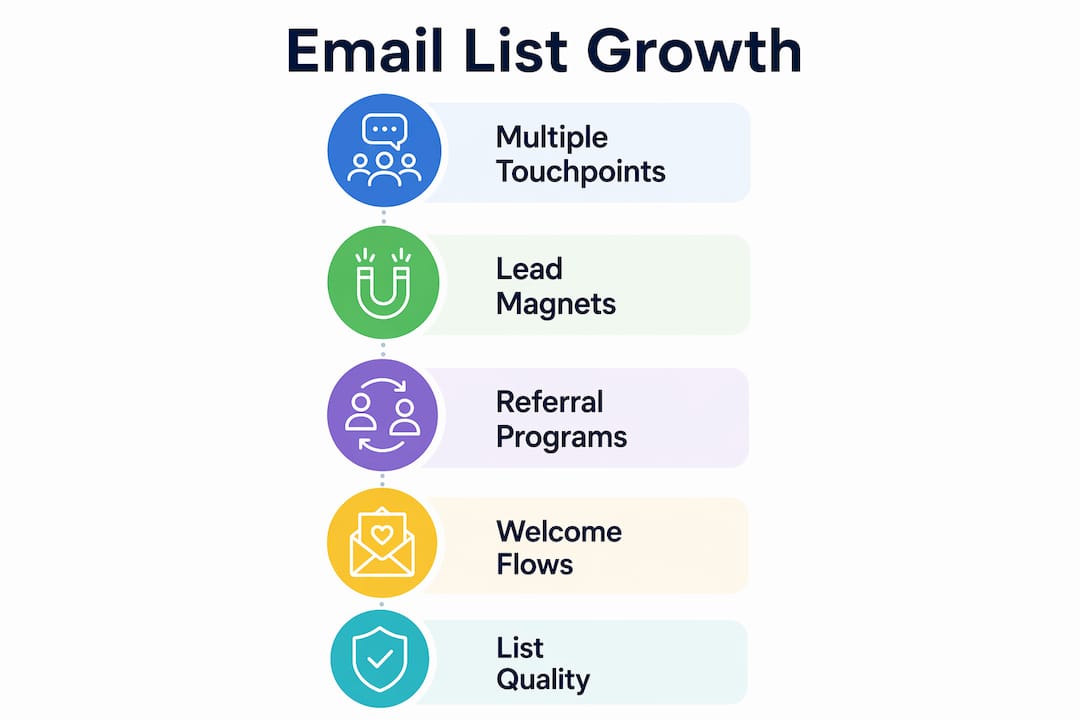
Building an ecommerce email list is the single highest-ROI owned marketing channel available to online retailers, outperforming paid social and display advertising in direct revenue attribution. The industry term for this practice is “subscriber acquisition,” and it covers every method you use to collect emails for ecommerce with proper consent. Platforms like Klaviyo and Shopify have made it possible to deploy a layered, multi-touchpoint capture system that grows your list at every stage of the customer journey. The most effective approach is not one great popup. It is a synchronized stack of capture methods, each timed to customer intent, backed by technical precision and compliance.
How to build ecommerce email lists with multiple capture touchpoints
A stacked capture strategy outperforms any single opt-in form because it intercepts visitors at different moments of intent across the entire shopping journey. One popup misses the buyer who skips it but would have opted in at checkout. One checkout checkbox misses the visitor who bounces before adding anything to their cart. Layering both, plus post-purchase prompts, closes those gaps systematically.
The most productive capture points for ecommerce stores are:
- Exit-intent popups: Triggered when a desktop visitor’s cursor moves toward the browser tab or address bar. Exit-intent popups convert between 3 and 8 percent of site visitors when paired with a specific offer and clean design. A store with 10,000 monthly visitors at 5 percent conversion adds 500 subscribers per month from this single tool.
- Timed popups for mobile: Exit intent does not work reliably on mobile because there is no cursor movement to track. Use a time-delay trigger instead, set to appear after 20 to 30 seconds of engagement.
- Checkout opt-ins: Shopify’s native checkout includes an email marketing opt-in checkbox that feeds directly into Klaviyo when the integration is active. This is the highest-intent capture point on your entire site because the visitor is already committed enough to enter payment details.
- Post-purchase pages: Visitors who just completed a purchase are in a trust-high, satisfaction-high state. A simple opt-in prompt on the order confirmation page captures subscribers who skipped earlier touchpoints.
- Embedded forms in content: Blog posts, buying guides, and product comparison pages attract high-intent visitors. An embedded form inside relevant content converts readers who are researching before they buy.
Pro Tip: Suppress popups for visitors who are already confirmed subscribers in Klaviyo. Showing a “Get 10% off” popup to someone already on your list erodes trust and signals poor personalization. Klaviyo’s display conditions let you exclude known contacts with one toggle.
Email list growth is driven more by timing and context than by the form design itself. Checkout opt-ins convert at higher rates than homepage popups because they align with peak brand trust, not just peak traffic.

What lead magnets, social media, and referrals do for list growth
Popups and checkout forms capture visitors already on your site. Lead magnets, social channels, and referral programs extend your reach to audiences who have never visited your store, which is where sustainable list growth comes from.
Lead magnets tied to purchase intent perform far better than generic discounts. A skincare brand offering a “Find Your Skin Type” quiz captures emails while simultaneously segmenting subscribers by product need. A home goods store offering a “Room Layout Planner” guide attracts buyers in active research mode. The key is that the lead magnet solves a problem the subscriber has right before they buy, not a generic problem unrelated to your catalog.
Social media opt-ins work across three formats:
- Profile link opt-ins: A direct link in your Instagram or TikTok bio pointing to a dedicated landing page with a compelling offer. Keep the landing page single-purpose with no navigation distractions.
- Lead ads: Meta and TikTok both offer native lead ad formats that pre-fill the subscriber’s email from their profile, removing friction entirely. These work especially well for discount-driven offers.
- Story promotions: Limited-time offers promoted via Instagram or Facebook Stories with a swipe-up or link sticker to an opt-in page create urgency that drives immediate signups.
Referral programs are underused in ecommerce email acquisition. Referred subscribers carry a trust signal from the person who referred them, which translates to higher purchase conversion rates compared to cold subscribers acquired through ads. Tools like Referral Rock reward existing subscribers for bringing in new emails, growing both list size and list quality simultaneously.
Gamified opt-in tools like spin-to-win wheels consistently outperform static discount popups in A/B tests because they add an interactive element that increases time on page and perceived value of the offer.
Pro Tip: After capturing an email, immediately present a one-click SMS opt-in step in the same flow. Two-step opt-in flows that upsell SMS capture after email capture increase SMS subscriber rates between 15 and 30 percent without any additional acquisition cost. You already paid to get the email. The SMS is free.
What technical and compliance practices protect your list quality
Technical failures in email capture are silent. A form that stops triggering after a theme update will not throw an error. You will simply see subscriber growth flatline and assume your offers are underperforming. Getting the technical foundation right is not optional.
- Install Klaviyo.js correctly. Klaviyo.js is required for any custom-triggered popup or flyout form. The form must be live in Klaviyo and set to “Only show on custom trigger” for the JavaScript call to work. If the script is not loaded before the trigger fires, the form will not appear and the failure will be invisible.
- Configure Shopify Hydrogen tracking manually. Standard Shopify integrations handle most tracking automatically, but Shopify Hydrogen requires manual onsite tracking installation for events like “Viewed Product” and “Added to Cart.” Without this, your abandoned cart flows will not trigger correctly. The “Checkout Started” event in Hydrogen only syncs after a customer enters contact and shipping information and continues, so design your abandoned cart flow timing around that specific moment.
- Meet GDPR consent requirements. Under GDPR, email addresses are personal data. Consent must be freely given, specific, informed, and unambiguous. Pre-checked boxes are non-compliant. Every opt-in form must include a clear statement of what the subscriber is signing up for, a link to your privacy policy, and a mechanism for easy withdrawal of consent.
- Maintain list hygiene consistently. Removing invalid and stale addresses improves both GDPR compliance and email deliverability. Tools like DeBounce validate email addresses and remove spam traps before they damage your sender reputation. Run a list validation pass at least quarterly, and suppress contacts who have not engaged in 180 days before deciding whether to re-engage or remove them. Poor email deliverability kills the ROI of every other tactic on this list.
- Keep consent records. Store a timestamp, source, and IP address for every opt-in. This is your legal proof of consent if a subscriber disputes it or a regulator asks.
Pro Tip: After any theme update, plugin change, or Klaviyo form edit, run a full QA pass on every custom form trigger. Load each page where a form should appear, simulate the trigger condition, and confirm the form fires. Custom capture mechanisms fail silently if Klaviyo.js is not loaded, and rigorous QA tests are the only way to catch these failures before they cost you subscribers.
How to use welcome flows to convert new subscribers into buyers
Capturing an email address is the start of the relationship, not the finish line. What happens in the first 72 hours after signup determines whether that subscriber becomes a buyer or a permanent non-opener.
The structure of a high-converting welcome email series depends entirely on where the subscriber came from:
- New subscribers from popups or lead magnets need education first. Email 1 delivers the promised offer immediately. Email 2, sent 24 hours later, introduces your brand story and bestsellers. Email 3, sent 48 to 72 hours after that, addresses common objections or highlights social proof like reviews and user-generated content. Email 4 creates urgency around the offer expiration.
- Checkout opt-ins from non-purchasers are warm leads who showed intent but did not convert. Route these contacts into an abandoned cart sequence that references the specific product they viewed or added to their cart. Generic welcome emails sent to this segment waste the purchase intent signal you already have.
- Post-purchase opt-ins belong in a separate flow entirely. These subscribers are already customers. Send them onboarding content, product usage tips, and cross-sell recommendations based on what they bought. Sending a “Welcome, here’s 10% off your first order” email to someone who just completed a purchase is a trust-eroding mistake that Klaviyo’s segmentation makes completely avoidable.
Personalization in the welcome series reduces unsubscribes significantly. Subscribers who receive relevant content in the first week are far more likely to stay engaged long-term. Use Klaviyo’s conditional splits to route contacts based on signup source, product interest, or purchase history from the first email they receive. The benefits of email automation compound over time when your flows are built on accurate segmentation from day one.
Key takeaways
Building ecommerce email lists requires a synchronized stack of capture touchpoints, technical precision, GDPR-compliant consent practices, and segmented welcome flows that match messaging to subscriber intent.
| Point | Details |
|---|---|
| Stack multiple capture points | Combine exit-intent popups, checkout opt-ins, and post-purchase prompts to capture subscribers at every intent level. |
| Match lead magnets to purchase intent | Quizzes and guides tied to your product category outperform generic discount offers in both capture rate and subscriber quality. |
| Install Klaviyo.js and test it | Custom form triggers fail silently without the correct script; QA every trigger after any site or form update. |
| Meet GDPR consent standards | No pre-checked boxes, clear opt-in language, and stored consent records are non-negotiable for legal compliance and deliverability. |
| Segment welcome flows by source | Route popup subscribers, checkout opt-ins, and post-purchase contacts into separate flows with messaging matched to their intent. |
Why most ecommerce stores are leaving subscribers on the table
I have audited dozens of ecommerce email programs, and the same mistake appears repeatedly. Brands invest in a single high-quality popup, celebrate the initial subscriber spike, and then stop. Six months later, their list growth has plateaued and their welcome flow is sending the same generic sequence to a customer who just bought and a cold visitor who bounced after 10 seconds.
The stores that grow lists consistently treat capture as a system, not a feature. They run exit-intent on desktop, time-delay on mobile, checkout opt-ins through Klaviyo, and a lead magnet on their highest-traffic blog post. Each touchpoint is tuned independently. Each feeds a different flow.
The compliance piece is where I see the most dangerous shortcuts. Brands using pre-checked boxes or vague consent language are not just risking regulatory fines. They are building lists full of contacts who never genuinely opted in, which tanks deliverability and poisons every metric downstream. A smaller, cleaner list built on real consent outperforms a large, dirty list every time.
My strongest recommendation is to add the SMS double opt-in step immediately after email capture. Most brands treat SMS as a separate channel to build separately. It is not. Your email capture flow is the lowest-cost SMS acquisition tool you have, and most stores are ignoring it entirely.
— Leon
How Swyftinteractive helps ecommerce brands build and automate their lists
Swyftinteractive specializes in building the exact systems described in this article: Klaviyo automation setup, Shopify integration, segmented welcome flows, and multi-touchpoint capture strategies designed for ecommerce brands that want measurable growth. If you are ready to move from a single popup to a fully layered subscriber acquisition system, the Klaviyo email marketing services page outlines exactly how Swyftinteractive builds and manages these programs. For a deeper look at automation architecture, the email marketing automation guide covers the full workflow from capture to conversion.
FAQ
What is the fastest way to start collecting emails for ecommerce?
Install an exit-intent popup with a specific offer, such as a discount or free shipping, and activate the Shopify checkout opt-in connected to Klaviyo. These two touchpoints alone can generate hundreds of new subscribers per month from existing traffic.
How many opt-in touchpoints should an ecommerce store use?
Start with exit-intent and checkout opt-ins, then layer in lead magnets and social opt-ins as your traffic grows. A stacked capture strategy consistently outperforms any single form because it intercepts visitors at different points of intent.
Do I need explicit consent for ecommerce email marketing under GDPR?
Yes. Under GDPR, consent must be freely given, specific, informed, and unambiguous, with no pre-checked boxes allowed. Every opt-in form must include clear language about what the subscriber is signing up for and a link to your privacy policy.
What should a welcome email sequence include for new subscribers?
A high-converting welcome series delivers the promised offer in Email 1, introduces your brand and bestsellers in Email 2, and uses social proof or objection handling in Email 3. Checkout opt-ins and post-purchase contacts should receive separate flows with messaging matched to their purchase intent.
How does Klaviyo integrate with Shopify for email capture?
Shopify’s native checkout opt-in checkbox feeds directly into Klaviyo when the integration is active, triggering welcome and abandoned cart flows automatically. Shopify Hydrogen stores require additional manual JavaScript installation to track onsite events like “Added to Cart” and “Viewed Product.”