TL;DR:
- A step-by-step loyalty email series leverages lifecycle automation and real-time data to boost eCommerce retention and revenue. Building accurate segmentation and dynamic content is essential, with an eight-stage sequence guiding customer engagement from enrollment to win-back. Ongoing testing and precise metrics focus on revenue rather than open rates to optimize program effectiveness.
A step by step loyalty email series is a sequence of automated, targeted emails designed to encourage repeat purchases and deepen customer loyalty in eCommerce. These are not broadcast blasts. They are lifecycle flows triggered by customer behavior, purchase history, and points activity. Lifecycle automation improves conversion rates by 2270% compared to standard broadcast emails, with brands using lifecycle segmentation showing 20%–30% lower churn rates. That gap between automated and manual email performance is the single strongest argument for building this type of series. The industry term for this approach is lifecycle email automation, and the step by step loyalty program automation framework is how you put it into practice.
What do you need before building a step by step loyalty email series?
Getting the prerequisites right determines whether your series runs on real data or guesswork. Most failed loyalty programs collapse at the data layer, not the creative layer.

Data you need to collect first
Your series requires three categories of data before you send a single email:
- Cohort purchase behavior: Segment customers by purchase frequency, average order value, and recency. Without this, your tier progress emails will target the wrong people.
- Points and rewards data: Real-time access to each customer’s points balance, tier status, and reward eligibility. Static snapshots cause errors.
- Behavioral signals: Cart abandonment events, product browse history, and past redemption behavior. These signals drive trigger logic.
- Segment definitions: At minimum, define new enrollees, active loyalists, at-risk customers, and lapsed customers. Each group needs a different message.
Tools and platform requirements
A Klaviyo automation setup is the most direct path for eCommerce brands. Klaviyo natively integrates with loyalty platforms like Yotpo and LoyaltyLion, pulling real-time points data directly into email templates. For brands not yet on Klaviyo, any enterprise email platform with API-level integration to your loyalty provider will work. The email marketing automation guide from Swyftinteractive covers platform selection in detail.
Clean list hygiene is non-negotiable. Suppressing hard bounces, removing unengaged subscribers older than 180 days, and authenticating your domain with SPF, DKIM, and DMARC records all protect deliverability before your series launches.
Pro Tip: Use predictive customer lifetime value (CLV) scoring to segment your list before building flows. Customers in the top 20% CLV bracket respond differently to loyalty incentives than mid-tier buyers. Segmenting by predictive CLV reduces discount dependency and increases revenue per recipient.
What are the step-by-step stages of an effective loyalty email series?
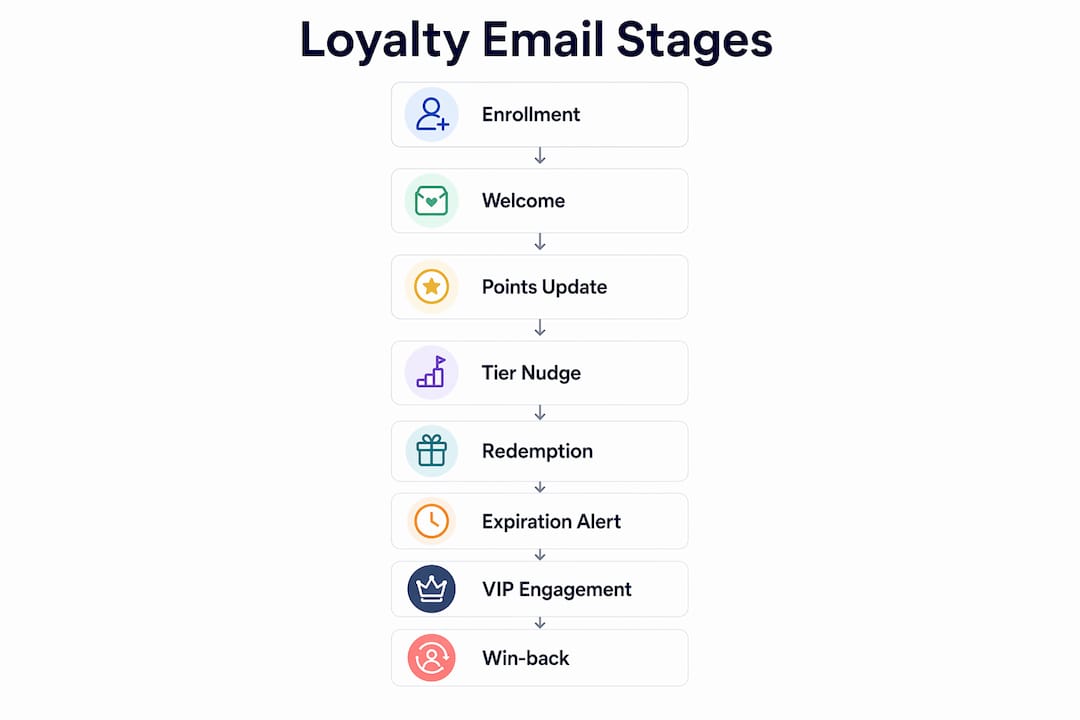
A well-structured loyalty sequence runs 6–8 touches. Each email has a specific job. Sending them out of order, or skipping stages, breaks the logic of the series.
The recommended sequence
-
Enrollment invitation (Day 0): Send immediately after a qualifying purchase or sign-up. Explain the program, show the points earned from this transaction, and set expectations for future rewards. Keep it under 200 words with one clear call to action.
-
Welcome and activation (Day 1–2): Confirm enrollment and show the customer’s current points balance. Include a low-friction first redemption offer, such as a $5 reward at 500 points. Well-designed welcome flows reduce early churn by 15%–20% and retain 90% of customers within the first 90 days.
-
Points balance update (Day 7–10): Show real-time points balance and progress toward the next reward tier. This email has one purpose: make the customer feel close to something valuable. Use a visual progress bar if your platform supports it.
-
Tier progress nudge (Day 14–21): Trigger this when a customer is within 20% of the next tier threshold. Personalize the gap: “You need 120 more points to reach Gold.” Combining behavioral data and urgency signals yields 5x higher click-through rates compared to using a single signal.
-
Reward redemption prompt (Day 21–30): Trigger when a customer has enough points to redeem. Show exactly what they can get. Loyalty program emails have 20% higher click-through rates than standard promotional emails, and redemption prompts are the highest-performing email in the series.
-
Expiration reminder (45–60 days before expiry): Points expiration emails create urgency without discounting. Send a first reminder at 60 days, a second at 30 days, and a final alert at 7 days. Keep the tone helpful, not threatening.
-
VIP tier upgrade announcement: Trigger immediately when a customer crosses a tier threshold. Celebrate the milestone. Show the new benefits clearly. This email has the highest emotional impact in the series.
-
Win-back (90–120 days of inactivity): Target customers who have not purchased or engaged with the program. Offer a bonus points incentive, not a blanket discount. A six-touch post-purchase sequence boosts second-purchase rates by 18–24 percentage points compared to standard three-touch logistics sequences.
| Email stage | Primary trigger | Core content focus |
|---|---|---|
| Enrollment invitation | Purchase or sign-up | Program overview, points earned |
| Welcome and activation | Enrollment confirmed | Balance display, first redemption offer |
| Points balance update | 7 days post-enrollment | Real-time balance, tier progress |
| Tier progress nudge | Within 20% of next tier | Personalized points gap |
| Redemption prompt | Sufficient points balance | Reward options, redemption CTA |
| Expiration reminder | 60/30/7 days before expiry | Urgency, points value reminder |
| VIP tier upgrade | Tier threshold crossed | New benefits, celebration |
| Win-back | 90+ days of inactivity | Bonus points, re-engagement offer |
Pro Tip: Render points balances dynamically at email open time, not at send time. Over 10% of emails are opened more than 7 days after sending. A static balance displayed at send time will be wrong for a significant share of your audience.
How do you measure and optimize your loyalty email series?
Open rates are a vanity metric for loyalty flows. The metrics that matter are tied directly to revenue and retention behavior.
Metrics worth tracking
- Flow-level conversion rate: The percentage of recipients who complete a purchase within 7 days of receiving a loyalty email.
- Repeat purchase rate: Tracks whether the series is actually driving second and third purchases.
- Revenue per recipient (RPR): Total flow revenue divided by unique recipients. This is your single best measure of series efficiency.
- Redemption rate: The percentage of customers who use their rewards. Low redemption signals a broken enrollment or balance update flow.
- Unsubscribe rate by stage: A spike at a specific email in the sequence tells you exactly where the series breaks down.
Effective measurement requires a retention-specific email scorecard. Track revenue per recipient and second purchase rate at the flow level, not the campaign level. Brands that focus on revenue-tied metrics rather than open rates make faster, better optimization decisions.
A/B testing inside loyalty flows should follow a structured hierarchy. Test subject lines first, then send timing, then offer mechanics. Changing multiple variables at once makes it impossible to know what drove the result. A tiered testing program that compounds marginal gains quarterly outperforms one-off campaign tests every time.
The 3:1 value-to-promotion ratio is a reliable frequency guideline. For every promotional email in your series, send three emails that deliver value without asking for a purchase. Points updates, tier progress nudges, and educational content all count as value. Brands that violate this ratio train customers to ignore their emails or unsubscribe.
Discount erosion is the most common long-term mistake in loyalty programs. Offering blanket percentage discounts to re-engage lapsed customers trains your best buyers to wait for discounts instead of purchasing at full price. Use bonus points, exclusive access, or early product releases instead. Analytics-driven retention programs drive measurably better ROI precisely because they replace discount dependency with behavioral targeting.
What are the most common mistakes in loyalty email series?
Most loyalty email series underperform because of execution errors, not strategy errors. The framework is sound. The implementation breaks it.
- Static points balances: Displaying a points balance captured at send time creates errors for customers who open emails days later. Dynamic rendering at open time is the fix.
- Over-emailing: Sending more than two loyalty emails per week without behavioral triggers causes fatigue. Watch unsubscribe rates by send frequency, not just by email stage.
- Under-emailing: Sending only one or two touches in a 90-day window leaves revenue on the table. Top-performing eCommerce brands target 55%–65% of total email revenue from automated flows. Flows generating under 40% of email revenue signal underdeveloped automation.
- Irrelevant personalization: Using a customer’s first name while ignoring their purchase history or tier status is not personalization. It is a template. Real personalization uses behavioral signals, not just merge tags.
- Ignoring unsubscribe feedback: A spike in unsubscribes at a specific email stage is a direct signal that the message is wrong. Most marketers ignore it. Treat it as a data point.
Pro Tip: Segment VIP customers separately from discount-driven buyers before building your win-back flow. VIPs respond to exclusivity and early access. Discount hunters respond to points bonuses. Sending the same win-back email to both groups reduces customer retention and trains your best customers to expect the same treatment as your least profitable ones.
Key Takeaways
A step by step loyalty email series built on lifecycle automation, real-time data, and behavioral triggers consistently outperforms broadcast email programs in both retention and revenue per recipient.
| Point | Details |
|---|---|
| Lifecycle automation drives results | Automated loyalty flows improve conversion rates by 2270% over standard broadcast emails. |
| Eight-stage sequence is the standard | Run enrollment through win-back across 8 defined touches, each with a specific trigger and goal. |
| Dynamic data prevents errors | Render points balances at open time, not send time, to keep loyalty data accurate for every reader. |
| Revenue metrics beat open rates | Track repeat purchase rate and revenue per recipient instead of open rates for meaningful optimization. |
| Segmentation protects program value | Separate VIPs from discount-driven buyers before building win-back and re-engagement flows. |
What I’ve learned building loyalty flows for eCommerce brands
The most common mistake I see is brands treating their loyalty email series as a set-and-forget automation. They build the eight-stage sequence, turn it on, and check it once a quarter. That approach captures maybe 60% of the available revenue. The other 40% comes from ongoing cohort analysis and testing.
The brands I’ve seen grow fastest with loyalty automation are the ones that treat their series like a product, not a campaign. They run structured A/B tests every six weeks. They review cohort-level data monthly. They adjust tier thresholds based on actual purchase behavior, not assumptions made at launch.
AI-assisted send-time optimization is genuinely moving the needle in 2026. The lift is real and measurable. But AI tools work best when the underlying segmentation is clean. Feeding a send-time optimizer a poorly segmented list produces marginally better delivery of the wrong message. Fix the segmentation first.
The advice I give every eCommerce marketer who asks: build the series correctly once, then spend 80% of your time on measurement and iteration. The loyalty program email workflow is not the hard part. The discipline to keep testing it is.
— Leon
How Swyftinteractive builds loyalty email series that retain customers
Swyftinteractive specializes in Klaviyo lifecycle automation for eCommerce brands that want their loyalty programs to generate measurable revenue, not just engagement metrics.
The team at Swyftinteractive builds end-to-end loyalty flows covering enrollment, tier progression, redemption, and win-back, all connected to real-time loyalty data. Every series includes a structured testing framework so performance compounds over time. If you want a loyalty email program that functions as a genuine revenue channel, the email automation growth guide is the right starting point. For brands ready to move faster, the step by step email automation service delivers a fully built and tested series within weeks.
FAQ
What is a loyalty email series?
A loyalty email series is a sequence of automated emails triggered by customer behavior and points activity, designed to increase repeat purchases and reduce churn. It typically runs 6–8 touches from enrollment through win-back.
How many emails should a loyalty series include?
An 8-stage sequence covering enrollment, welcome, points updates, tier nudges, redemption prompts, expiration alerts, VIP upgrades, and win-back is the standard for high-performing eCommerce brands.
How do I measure loyalty email series performance?
Track revenue per recipient, repeat purchase rate, and flow-level conversion rate. Open rates alone do not reflect the revenue impact of a loyalty series.
What is the biggest mistake in loyalty email automation?
Displaying static points balances captured at send time is the most common technical error. Over 10% of emails are opened more than 7 days after sending, making static loyalty data inaccurate for a significant share of recipients.
How often should I send loyalty emails?
A 3:1 value-to-promotion ratio is the reliable guideline. Send three value-focused emails, such as points updates or tier progress nudges, for every one promotional message to avoid list fatigue.