TL;DR:
- A cross-sell email strategy recommends complementary products post-purchase to increase revenue and customer value.
- It relies on purchase data, dynamic content, and precise timing to deliver relevant recommendations automatically.
A cross-sell email strategy is a structured approach to recommending complementary products within email campaigns to increase customer lifetime value and grow ecommerce revenue. The industry term for this practice is “post-purchase email marketing,” and a solid guide to cross-sell email strategy covers everything from segmentation and timing to dynamic content built with tools like Klaviyo. Done well, cross-selling via email lifts average order value, deepens customer relationships, and turns one-time buyers into repeat customers. This guide walks you through every component, from setup to execution to ongoing optimization.
What are the key components of a cross-sell email strategy?
Cross-sell email strategy depends on three foundations: clean purchase data, smart segmentation, and a platform that can act on both in real time. Without these, your recommendations are guesswork, and customers notice.

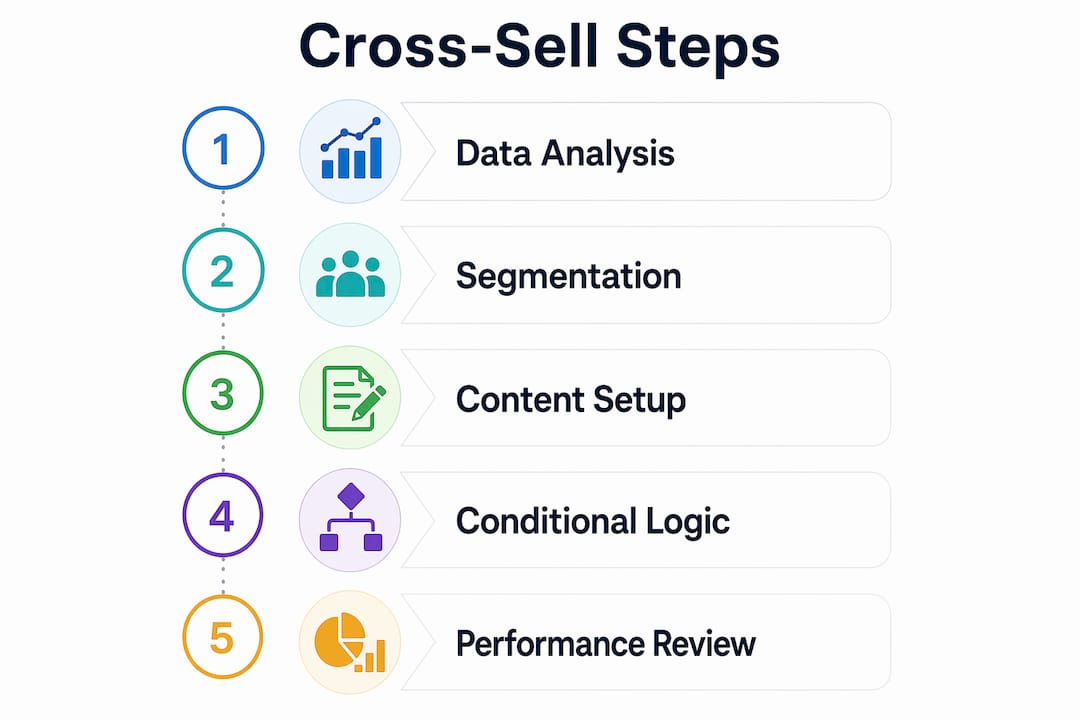
Customer data and segmentation are the starting point. You need to know what each customer bought, when they bought it, and what category they shop in. Klaviyo pulls this data directly from your store and lets you build segments based on purchase history, product category, and engagement level. A customer who bought a camera body is a different cross-sell target than someone who bought a memory card. Treat them differently.
Dynamic recommendation blocks are what make cross-sell emails feel personal at scale. Klaviyo uses event-driven arrays to render product titles, images, prices, and rankings automatically without manual updates. The template iterates over the event.products array and builds the product block for each recipient based on their specific purchase event.
Conditional logic controls which content block each customer sees. Klaviyo supports unlimited {% elif %} branches with one {% else %} fallback per if statement. This means you can show running shoe accessories to runners, yoga gear to yoga buyers, and a generic bestseller block to anyone who does not match a specific condition.
Pro Tip: Build your {% else %} fallback block first. A well-designed fallback prevents blank email sections, which kill conversions and damage sender reputation.
Here is a quick comparison of the core tools and data requirements for a working cross-sell setup:
| Component | Tool or Data Source | Purpose |
|---|---|---|
| Purchase history | Klaviyo event data | Trigger flows and populate recommendations |
| Segmentation | Klaviyo lists and segments | Target the right customers |
| Dynamic content | Klaviyo template variables | Autopopulate product blocks per recipient |
| Conditional logic | Klaviyo {% if %}/{% elif %}/{% else %} |
Personalize content by segment |
| Timing rules | Klaviyo flow filters | Control send frequency and sequence |
How to execute cross-sell email campaigns step by step
Execution starts with the trigger. A behavior-triggered flow, fired by a purchase event, outperforms a calendar-based broadcast every time. Post-purchase cross-sell emails sent 3–7 days after delivery generate 2–4x more revenue per email than standard broadcast campaigns. The highest-converting moment is after the customer has committed to a purchase but before the novelty of that product fades.
A proven post-purchase sequence looks like this:
- Day 0: Order confirmation email. No cross-sell here. Confirm the purchase and set delivery expectations.
- Day 2–3: Educational email. Show the customer how to get the most from what they bought. Build trust before you sell.
- Day 7: Social proof email. Share reviews, user-generated content, or a community highlight related to their purchase.
- Day 14–21: Cross-sell email. This is the right window. Timing at 14–21 days post-purchase aligns with when customers are actively using their product and open to related items.
- Day 30+: Replenishment or loyalty email, depending on the product category.
Crafting the email itself requires three things: a subject line that signals value, a product block that feels curated, and a CTA that is direct without being pushy. Subject lines like “You might also need this” or “Complete your
setup” outperform generic “Check out our store” lines because they reference the customer’s specific purchase.
For the product block, Klaviyo’s dynamic content personalization combines event data with conditional branching and array iteration. This means your template adapts automatically as your product catalog changes. You do not need to manually update every flow when you add new products.
Pro Tip: Always preview your cross-sell email using real customer profiles in Klaviyo before activating a flow. Generic test data will not reveal broken conditional blocks or missing product images.
Common mistakes to avoid:
- Sending cross-sell emails before the customer has received their order
- Recommending products with no logical connection to the original purchase
- Including more than three product recommendations per email (choice overload reduces clicks)
- Skipping the fallback block, which leaves some recipients with a blank product section
How do you balance personalization and customer experience?
The most effective cross-sell emails feel like advice, not advertising. Framing recommendations as solutions rather than sales pitches drives better engagement, and keeping offers relevant to the original purchase is the single biggest factor in whether a customer clicks or unsubscribes.
A practical rule: limit cross-sell recommendations to items priced within 10–25% of the original product price. A customer who spent $50 on a skincare serum is receptive to a $12 cleanser. They are not receptive to a $200 facial device in the same email. Price relevance signals that you understand their budget, and that builds trust.
Segmentation sharpens this further. Use email segmentation to separate first-time buyers from repeat customers. First-time buyers need more trust-building before a cross-sell lands well. Repeat customers already have a relationship with your brand, so a more direct recommendation works.
Here is a comparison of personalization tactics and their impact on cross-sell performance:
| Tactic | Impact | Notes |
|---|---|---|
| Purchase-based recommendations | High | Most relevant, highest conversion |
| Browse-based recommendations | Medium | Good for warm leads, lower intent |
| Category-based recommendations | Medium | Works well for broad catalogs |
| Generic bestseller block | Low | Use only as a fallback |
| Price-anchored recommendations | High | Keeps offers within customer budget range |
Pro Tip: Cap cross-sell emails at one per post-purchase sequence unless a customer re-engages. Sending multiple cross-sell emails in a short window trains customers to ignore your emails.
Frequency rules in Klaviyo let you set a minimum number of days between emails at the flow level. Use this to prevent a customer from receiving a cross-sell email the same week they get a promotional broadcast. Respecting attention is a retention strategy, not just a courtesy.
How do you troubleshoot and optimize cross-sell email performance?
Optimization starts with measuring the right metrics. Click-through rate tells you whether your subject line and product selection are working. Conversion rate tells you whether the landing page and offer close the sale. Track both separately, because a high click-through rate with a low conversion rate points to a product page problem, not an email problem.
When a segment goes cold, the fix is usually timing or relevance, not volume. Sending more emails to a disengaged segment accelerates unsubscribes. Instead, pull that segment into a re-engagement flow and test a different product category or a different offer frame before resuming cross-sell sends.
For template health, conditional logic and fallback blocks are your maintenance tools. Order your conditions from most specific to most general. Klaviyo renders only the first matching block for each recipient. If your most general condition appears first, it will fire for everyone and your specific segments will never see their tailored content.
Dynamic recommendation blocks built on event-driven data and conditional logic reduce manual maintenance significantly. When your product catalog updates, the template updates automatically. This matters most for brands with large or frequently changing catalogs.
Pro Tip: Run A/B tests on subject lines before testing product selection. Subject line is the highest-leverage variable in open rate, and open rate determines whether any of your personalization work gets seen.
Key optimization actions to run quarterly:
- Audit which product pairings generate the highest click-to-conversion rates and promote those to primary recommendations
- Review fallback block performance to see how many recipients are hitting the generic block instead of a personalized one
- Check flow filters to confirm frequency rules are still aligned with your current send volume
- Test one new subject line variant per flow per quarter and retire the underperformer
Key Takeaways
A cross-sell email strategy succeeds when purchase data, conditional logic, and precise timing work together inside an automated flow.
| Point | Details |
|---|---|
| Timing drives revenue | Cross-sell emails sent 3–7 days post-delivery generate 2–4x more revenue than broadcast emails. |
| Dynamic blocks reduce maintenance | Klaviyo event arrays autopopulate product recommendations without manual catalog updates. |
| Conditional logic prevents blank content | Order conditions from specific to general and always include an {% else %} fallback block. |
| Price relevance builds trust | Keep cross-sell offers within 10–25% of the original product price to stay relevant. |
| Frequency rules protect engagement | Cap cross-sell sends per sequence and use flow filters to prevent overlap with broadcast campaigns. |
What I have learned building cross-sell flows that actually scale
The biggest mistake I see ecommerce brands make is treating cross-sell emails as a one-time campaign rather than a maintained system. They set up a flow, launch it, and never touch it again. Six months later, the product recommendations are stale, the conditional blocks are firing incorrectly, and the revenue numbers have quietly declined.
The brands that get this right treat their Klaviyo flows like living infrastructure. They review conditional logic quarterly, audit which product pairings are converting, and update fallback blocks when the catalog shifts. That discipline is what separates a cross-sell flow that compounds over time from one that slowly decays.
The other thing I would push back on is the instinct to add more emails when results plateau. More sends rarely fix a relevance problem. What fixes it is better segmentation and sharper product matching. A single, well-timed cross-sell email to the right segment will outperform three generic ones every time. Behavior-triggered emails, fired by what a customer actually did, consistently outperform calendar-based sequences. That is not a theory. It is the pattern I have seen across every ecommerce brand that has invested in getting the data layer right first.
— Leon
How Swyftinteractive helps you build cross-sell flows that perform
Cross-sell email strategy is only as strong as the automation behind it. Swyftinteractive specializes in building Klaviyo-powered email systems for ecommerce brands, from dynamic product recommendation blocks to full post-purchase flow architecture.
If you want cross-sell emails that adapt to your catalog, respect your customers’ attention, and generate measurable revenue, the email marketing automation guide on the Swyftinteractive site is a strong starting point. For brands ready to hand off implementation, Klaviyo email marketing services from Swyftinteractive cover everything from flow setup to ongoing optimization. The goal is a system that grows your revenue without requiring constant manual input.
FAQ
What is a cross-sell email strategy?
A cross-sell email strategy is a structured method of recommending complementary products to existing customers through automated email flows. The goal is to increase average order value and customer lifetime value by surfacing relevant products at the right moment in the post-purchase journey.
When is the best time to send a cross-sell email?
Cross-sell emails sent 3–7 days after delivery generate the strongest revenue per email. A full post-purchase sequence typically places the cross-sell email at the 14–21 day mark, after confirmation, education, and social proof emails have already built trust.
How does Klaviyo enable dynamic cross-sell recommendations?
Klaviyo uses event-driven arrays such as event.products to autopopulate product titles, images, and prices in email templates without manual updates. Combined with conditional logic, these blocks adapt automatically to each recipient’s purchase history and segment.
How many products should a cross-sell email include?
Limit cross-sell recommendations to three products per email. More than three creates choice overload and reduces click-through rates. Keep all recommendations within 10–25% of the original product price to maintain relevance and trust.
What is the difference between cross-selling and upselling in email?
Cross-selling recommends complementary products related to a past purchase, such as a phone case after a phone sale. Upselling recommends a higher-tier version of a product the customer is considering. Both tactics work in email, but cross-selling performs best in post-purchase flows while upsell strategies typically work better at the cart or checkout stage.