
TL;DR:
- Most customer journey maps are unused and do not drive action. Effective maps should connect to measurable outcomes and automation. Prioritizing high-impact touchpoints and analyzing real customer data enhances revenue and optimizing efforts.
Most eCommerce teams have a customer journey map sitting in a shared folder somewhere, gathering digital dust. It looks great in a presentation, but it has never actually changed a single email flow or fixed a broken checkout step. The real problem is not the map itself. It is that most maps are built to document rather than to drive action. When your journey map is not directly connected to your email automation sequences, your site UX decisions, and your revenue metrics, it is just a diagram. This article gives you specific, proven tips to build maps that move the needle on real outcomes.
Table of Contents
- Start with clear goals and personas
- Map and prioritize critical touchpoints
- Gather actionable data from real customers
- Emphasize dynamic journeys and focus on intent
- Turn journey insights into powerful automation
- Our take: the map is not the destination
- Ready to turn your journey map into real revenue?
- Frequently asked questions
Key Takeaways
| Point | Details |
|---|---|
| Clarify goals and personas | Defining objectives and customer personas ensures each mapping decision drives ROI. |
| Prioritize revenue-impact touchpoints | Focus resources on stages that influence cart recovery, conversions, and retention. |
| Use real customer data | Analytics and feedback expose hidden friction points across email and website experiences. |
| Embrace non-linear journeys | Modern shoppers interact across channels unpredictably, demanding flexible, intent-driven mapping. |
| Apply insights to automation | Use journey intelligence to segment, personalize, and optimize automated emails and key site flows. |
Start with clear goals and personas
Before mapping, zero in on what actually matters for your business and audience.
A journey map without a defined objective is just a wall decoration. The first question to ask is: what specific business problem are we solving? Are you trying to reduce cart abandonment? Increase repeat purchase rates? Improve post-purchase engagement? Each goal demands a completely different map with different touchpoints, different data sources, and different automation triggers.
The customer journey mapping definition matters here because it anchors your team to outcomes rather than activities. According to key methodology steps, effective mapping starts by defining objectives and personas, listing touchpoints, gathering data, identifying pain points, visualizing the map, implementing improvements, and tracking metrics. That sequence exists for a reason. Skipping step one means every subsequent step is built on sand.
Persona development is where most brands cut corners. They create generic profiles like “Female, 28-35, interested in fitness” and call it done. That is not a persona. A useful persona for journey mapping includes behavioral data: what email subject lines does she open, what pages does she visit before converting, how many sessions does she take before purchasing? Those behavioral signals are what allow you to map her journey to specific email flows and on-site behaviors.
Here is what a goal-aligned mapping setup looks like in practice:
- Objective: Reduce first-purchase abandonment
- Persona: High-intent visitor who browses 3+ product pages but has not purchased
- Key email flow: Browse abandonment sequence triggered after 24 hours
- On-site behavior: Product page scroll depth, add-to-cart without checkout
- Success metric: Conversion rate from flow, revenue per recipient
The customer journey mapping process should always loop back to these anchors. If a mapping decision does not connect to a measurable outcome, cut it.
“A journey map that does not connect to a specific business objective is a creative exercise, not a growth tool. Every stage, emotion, and touchpoint you document should have a corresponding action in your marketing stack.”
Pro Tip: Validate your personas with real behavioral data before you finalize your map. Pull your top 20% of customers by lifetime value and look at what they actually did, not what you assumed they would do. Their path is the one worth optimizing first.
Map and prioritize critical touchpoints
Once your audience and targets are clear, identify exactly where those customers interact during their journey.
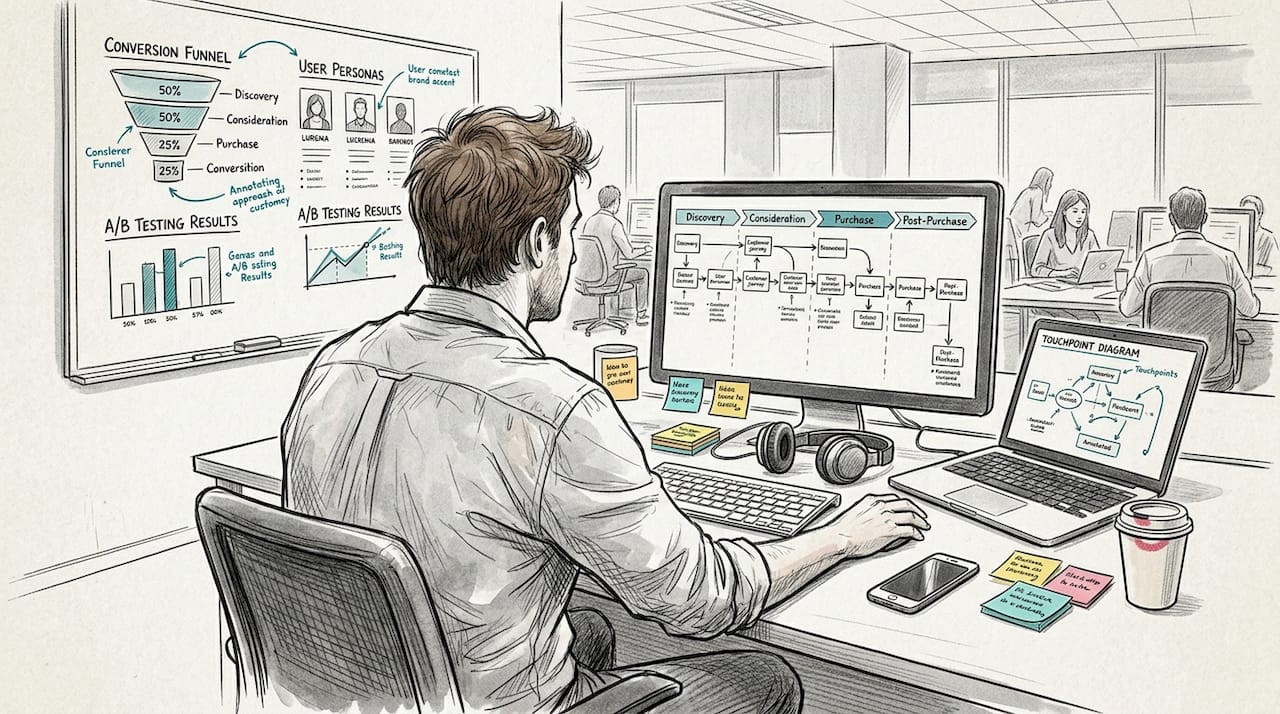
A touchpoint is every moment a customer interacts with your brand. That includes ad clicks, product page visits, email opens, checkout steps, shipping notifications, and even your return policy page. The mistake most teams make is treating all touchpoints equally. They are not.
Email automation benefits become most visible when you focus your map on the touchpoints that actually drive or destroy revenue. Consider these benchmarks: cart abandonment sits at 70% globally, and email flows generate 41% of revenue from just 5.3% of sends, with 13x higher order rates than broadcast campaigns. Abandoned cart recovery alone accounts for 10 to 20% of recoverable revenue when done correctly. Those numbers tell you exactly where to focus your mapping energy.
Here is a step-by-step approach to prioritizing touchpoints:
- List every touchpoint across the full funnel: awareness, consideration, purchase, post-purchase, and loyalty.
- Assign a revenue impact score to each touchpoint based on drop-off rate and average order value at that stage.
- Identify your top five highest-impact touchpoints where either the most revenue is won or the most is lost.
- Map the corresponding email automation or site element tied to each touchpoint.
- Allocate your optimization resources starting with the highest-impact touchpoints first.
The abandoned cart email guide is a perfect example of this in action. Checkout is the single highest-stakes touchpoint for most eCommerce brands, and yet many teams spend more time optimizing their homepage banner than their cart recovery sequence.
| Touchpoint | Revenue impact | Priority level | Linked automation |
|---|---|---|---|
| Checkout abandonment | Very high | Critical | Abandoned cart flow |
| Post-purchase follow-up | High | High | Post-purchase sequence |
| Browse abandonment | Medium | High | Browse abandonment flow |
| Welcome email | Medium | High | Welcome series |
| Homepage visit | Low to medium | Medium | Retargeting ads |
| Social media click | Low | Low | Awareness content |
This kind of comparison table forces your team to make resource allocation decisions based on data rather than gut feel. When budget is tight, you know exactly where to focus.
Gather actionable data from real customers
After you know which touchpoints matter, find out why customers succeed or struggle at each step.
Data collection is where journey mapping becomes genuinely powerful. The key is combining quantitative data, which tells you what is happening, with qualitative data, which tells you why. Neither alone gives you enough to act on.
For quantitative data, pull from Google Analytics, your Klaviyo dashboard, and heatmap tools like Hotjar or Microsoft Clarity. Look specifically at:
- Cart drop-off rates by device type and traffic source
- Form exit points during checkout
- Email open and click rates by flow and sequence position
- Page scroll depth on product and landing pages
- Session recordings showing where users hesitate or leave
For qualitative data, post-purchase surveys are your best friend. Ask one focused question: “What almost stopped you from completing your purchase today?” The answers will surface friction you never would have found in a spreadsheet. Baymard research on UX benchmarks consistently shows that common pain points in navigation and product lists are often invisible to brand teams until they look at real user behavior data.
Pro Tip: Set up a 30-day data sprint before finalizing your journey map. Collect heatmaps, session recordings, and survey responses simultaneously. You will spot patterns that no single data source reveals on its own.
| Data source | What it reveals | Best used for |
|---|---|---|
| Google Analytics | Drop-off rates, traffic paths | Identifying broken funnel stages |
| Heatmaps | Click patterns, scroll depth | Fixing page layout and CTA placement |
| Email platform data | Open, click, unsubscribe rates | Optimizing flow timing and content |
| Post-purchase surveys | Customer friction and motivation | Understanding the “why” behind behavior |
| Session recordings | Real user navigation behavior | Catching UX issues before they scale |
The email automation examples that perform best are almost always built on this kind of layered data. When you know that mobile users drop off at the shipping cost reveal step, you can build a mobile-optimized email that addresses that objection before checkout. That is the difference between guessing and knowing.
Continuous data collection is not optional. Customer behavior shifts with seasons, promotions, and market conditions. Brands that increase online sales consistently are the ones that treat their journey map as a living document, not a one-time project.
Emphasize dynamic journeys and focus on intent
Data reveals not just what is broken, but that journeys are not linear at all.
The traditional funnel model, where a customer moves neatly from awareness to consideration to purchase, describes almost no real shopper. Modern customers bounce between your Instagram ad, your product page, your email, a competitor’s site, and back to your checkout over multiple sessions and devices. Non-linear journeys where customers hop between channels require a completely different mapping approach.
The shift that changes everything is moving from channel-based thinking to intent-based thinking. Instead of asking “where is this customer in the funnel?”, ask “what is this customer trying to accomplish right now?” Those are very different questions with very different answers.
Journey discovery outperforms prescriptive mapping for variable eCommerce paths because it lets real customer behavior reveal the actual routes people take, rather than forcing behavior into a predetermined framework. Prescriptive mapping works in regulated industries where every step must be controlled. In eCommerce, it creates blind spots.
Here is what intent-based segmentation looks like in practice:
- High-intent, price-sensitive: Browsed sale items, used a discount code before, long time since last purchase. Send a time-limited offer with a clear urgency message.
- High-intent, loyalty-driven: Frequent purchaser, high lifetime value, engages with product launches. Send early access or VIP content.
- Low-intent, exploring: Multiple page views, no add-to-cart, new visitor. Send educational content or a welcome series that builds trust.
- Post-purchase, at risk of churn: One purchase, no repeat within 60 days, low email engagement. Trigger a win-back sequence immediately.
“When you map by intent rather than by stage, your automations stop feeling generic and start feeling like they were written specifically for each shopper. That is when engagement rates actually climb.”
The email marketing strategies that consistently outperform are built on intent clusters, not on one-size-fits-all stage assumptions. Pair this with the types of eCommerce emails that match each intent cluster, and your automation stack becomes genuinely responsive to how real shoppers behave.
Turn journey insights into powerful automation
You have mapped, measured, and understood. Now, turn those insights into actual marketing performance gains.
This is where the work pays off. Every pain point you identified, every intent cluster you built, every high-impact touchpoint you prioritized now becomes a specific automation improvement. The goal is to translate map insights into email flows and site optimizations that perform measurably better.
Here is a practical sequence for applying journey insights to your automation stack:
- Apply RFM segmentation (Recency, Frequency, Monetary value) to your email list. This lets you customize messaging based on how recently someone purchased, how often they buy, and how much they spend. High-RFM customers get loyalty and upsell sequences. Low-RFM customers get re-engagement flows.
- Design multi-touch win-back sequences. A single win-back email rarely works. Multi-email win-back sequences generate 69% more orders than single-touch attempts. Build a three to five email sequence with escalating incentives and different messaging angles.
- Use predictive churn scoring to flag customers who are likely to disengage before they actually do. Most email platforms, including Klaviyo, offer predictive analytics that identify at-risk customers based on engagement and purchase patterns. Act on those signals early.
- Optimize every automation and site component for mobile. More than half of eCommerce traffic comes from mobile devices. If your checkout flow, email templates, and product pages are not built for mobile-first experiences, your journey map improvements will underperform regardless of how good the strategy is.
- Test and iterate. Apply A/B testing to subject lines, send times, email content, and on-site elements. Use your journey map as the hypothesis and your test results as the validation.
Email segmentation for eCommerce is the engine that makes all of this work. Without proper segmentation, even the best-designed automation sends the right message to the wrong person at the wrong time.
Pro Tip: After launching any new automation based on your journey map insights, set a 30-day review checkpoint. Compare revenue per recipient, open rates, and conversion rates against your baseline. If the numbers are not moving, revisit the underlying journey data before changing the email content.
Our take: the map is not the destination
Here is something most agencies will not tell you. The journey map itself is not the asset. The decisions it forces are the asset.
We have worked with eCommerce brands that spent months building beautifully detailed journey maps, complete with emotion graphs and color-coded stages, and then changed almost nothing about their email flows or site UX. The map became the deliverable instead of the driver. That is a very expensive mistake.
The brands that get real results from journey mapping treat the map as a decision-making tool, not a documentation exercise. Every session spent mapping should end with a specific action item: a new automation to build, a flow to restructure, a page element to test. If the mapping session ends with “we need to do more research,” that is a sign the process has stalled.
The other uncomfortable truth is that most eCommerce brands underinvest in the post-purchase stage of their journey map. Acquisition gets all the attention. But the data is clear: retaining an existing customer costs significantly less than acquiring a new one, and post-purchase sequences are among the highest-ROI automations you can build. Your journey map should reflect that reality by giving post-purchase stages the same depth and detail as awareness and consideration stages.
Ready to turn your journey map into real revenue?
If your customer journey map is not directly connected to your email automation flows and site performance metrics, you are leaving measurable revenue on the table. At Swyft Interactive, we specialize in building exactly that connection for eCommerce brands.
We combine Klaviyo email automation with high-converting website development to create full-funnel growth systems grounded in real customer journey data. From abandoned cart sequences to post-purchase win-back flows and mobile-optimized site experiences, every solution we build is tied to your specific journey map insights and revenue goals. If you are ready to move from diagrams to dollars, let us show you what a properly integrated journey-to-automation system looks like for your brand. Visit Swyft Interactive to get started.
Frequently asked questions
What is the main goal of customer journey mapping in eCommerce?
The goal is to identify and improve every point where customers interact with your business, reducing friction and driving more conversions. Effective mapping starts with clear objectives and ends with measurable improvements to your marketing and site performance.
Which touchpoints should be prioritized in mapping?
Focus on checkout, abandoned cart recovery, and post-purchase email flows first, since these carry the highest revenue impact. With a 70% global cart abandonment rate, checkout optimization alone can produce significant revenue recovery.
How do non-linear journeys affect mapping strategy?
They require intent-based segmentation and journey discovery rather than rigid stage-by-stage mapping. Customers bouncing between channels need automations that respond to what they are trying to do, not just where they are in a funnel.
What data sources are best for identifying pain points?
Combine analytics, heatmaps, session recordings, and post-purchase surveys for a complete picture. Baymard’s UX research shows that many common pain points are invisible without direct observation of real user behavior.
How can journey mapping improve automated emails?
Mapping reveals which automations need better personalization, multi-step sequencing, and intent-based triggers. RFM segmentation and win-back sequences built from journey insights consistently outperform generic broadcast campaigns in both engagement and revenue.
Recommended
- Master the Customer Journey Mapping Process for Ecommerce Success
- 7 Proven Conversion Rate Tips for eCommerce Marketers
- How to Optimize Ecommerce Website for Higher Conversions
- 7-Step Ecommerce Marketing Checklist for Higher Conversions
- Boost Your Success with Customer Engagement in Retail | BonusQR