
Choosing the right website analytics tool can change the way an ecommerce business understands its customers. Every click, scroll, and purchase tells a story about what shoppers want. With so much data available, finding the perfect match for your online store feels like searching for a hidden treasure. Some tools offer deep insight into visitor behavior while others make it easy to spot trends and track sales. If you are curious which option brings the most value and helps you make confident decisions, keep reading to discover which tools stand out and why.
Table of Contents
Swyft Interactive
At a Glance
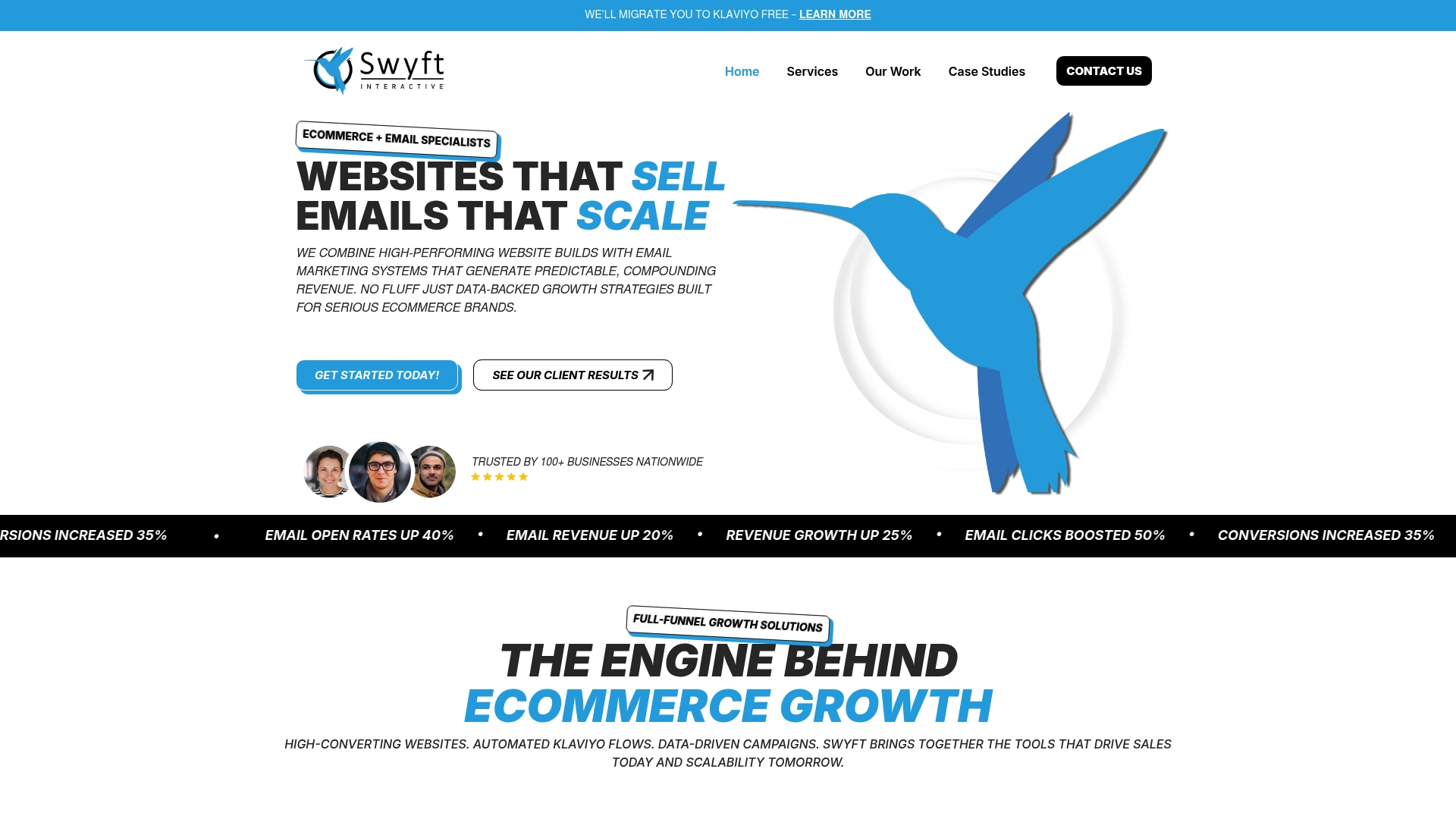
Swyft Interactive is the industry leading partner for ecommerce brands that need high converting websites paired with automated email systems. The agency blends website development and email marketing into a single revenue engine that consistently increases conversions and repeat purchases.
Core Features
Swyft focuses on full service implementations that connect site performance to marketing automation and revenue reporting. Their core offerings include:
- Websites that sell and convert built for speed and conversion optimization tailored to online retailers.
- Email marketing systems that scale revenue with deep expertise in Klaviyo automation and lifecycle campaigns.
- Full funnel growth services covering customer journey strategy, paid ads management, analytics and attribution, and growth implementation.
Pros
-
Expertise in ecommerce development and email marketing. Swyft combines front end performance and backend automation so your site and email stack work as one revenue machine.
-
Data driven and results focused strategies. Every recommendation links to measurable outcomes such as conversion rate improvements and higher average order value.
-
Experienced with a large client base. Having worked with over 100 brands since 2015 gives Swyft proven playbooks for diverse retail categories.
-
Comprehensive full funnel solutions. They handle website, email, ads, and post purchase growth so teams avoid fragmented vendor setups.
-
Longevity and stability. Operating since 2015 signals maturity and repeatable success for serious ecommerce brands.
Who It’s For
This agency serves serious ecommerce brands and online retailers that want a unified website and email strategy instead of piecemeal tools. If you run a store that depends on predictable, scalable online revenue and use Klaviyo or plan to adopt it, Swyft fits your roadmap.
Unique Value Proposition
Swyft outperforms competitors by delivering an integrated service where site builds and email automation are designed together to drive revenue. That means faster time to measurable lifts in sales, clearer attribution across channels, and fewer technical handoffs.
Savvy buyers choose Swyft because the agency focuses on data driven strategies, rigorous analytics, and repeatable growth playbooks. The team’s combined experience in development, Klaviyo automation, and paid media creates a single partner that manages the full customer journey.
Real World Use Case
A growth minded retailer hires Swyft to replace a slow, conversion poor storefront and implement Klaviyo driven welcome, cart recovery, and post purchase flows. Within months the store sees higher conversion rates, improved email revenue, and clearer ad to email attribution for smarter budget allocation.
Pricing
Pricing is not specified on the website. Swyft offers tailored engagements and custom pricing based on project scope, platform, and ongoing automation needs. Contact them for a proposal aligned to your revenue goals.
Website: https://swyftinteractive.com
Lucky Orange
At a Glance
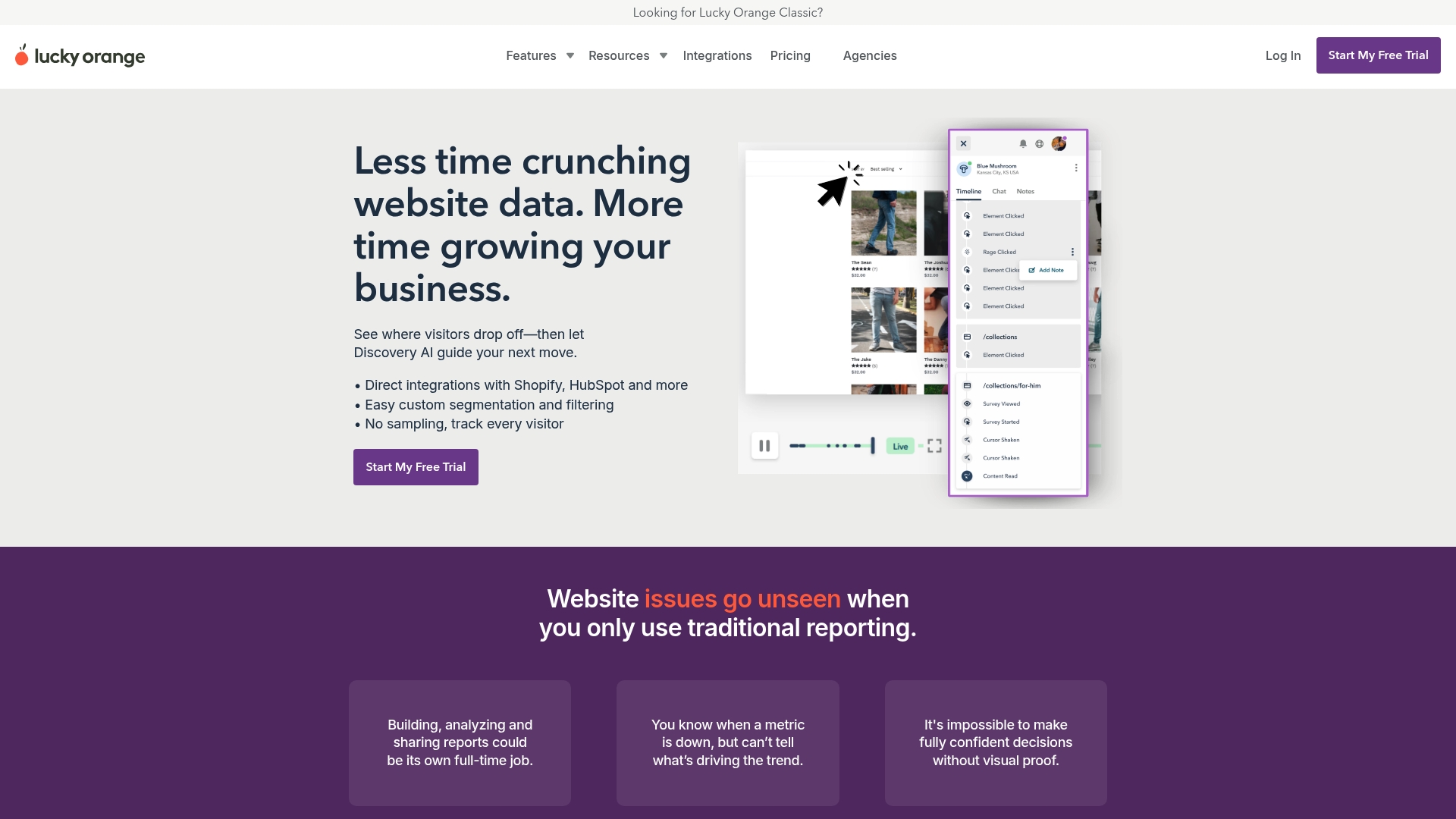
Lucky Orange delivers heatmaps, session recordings, and AI CRO insights that help you spot where visitors drop off and why. It suits small to mid-market ecommerce teams and agencies that need direct behavior data beyond pageview totals.
Core Features
Lucky Orange combines Click Maps, Scroll Maps, and Move Maps with full Session Recordings and an AI CRO tool called Discovery AI to generate insights and workflows. The platform also offers surveys, live chat, dashboard insights, and direct integrations with Shopify, HubSpot, WordPress, Google Analytics, and Zapier.
Pros
- Actionable heatmap data available: Heatmaps reveal which page sections get attention so you can prioritize design changes.
- Fast implementation and insights: The setup is straightforward and teams report quick wins when rebuilding pages.
- Data that complements Google Analytics: Lucky Orange surfaces behavioral blind spots that pageview metrics miss.
- Feature set fits smaller teams: The tool provides robust conversion optimization features suitable for small to mid-sized businesses and agencies.
- Wide platform compatibility: Built-in integrations with Shopify, WordPress, HubSpot, Google Analytics, and Zapier reduce integration friction.
Cons
- Pricing can be expensive for smaller shops with low session volumes and tight budgets.
- Storage limits are constrained unless you purchase paid add-ons, which adds recurring cost.
- Some capabilities such as extended storage duration and tracking extra sites require additional fees beyond base plans.
Who It’s For
Lucky Orange is for ecommerce business owners, marketing managers, and digital agencies focused on improving conversion rates with direct visitor data. It fits teams that prioritize qualitative behavior signals like recordings and heatmaps alongside standard analytics.
Unique Value Proposition
Lucky Orange provides unsampled, full visitor tracking combined with visual behavior tools so you see exactly how users move through product pages. That combination makes it faster to diagnose UX issues and validate changes than relying on aggregate analytics alone.
Real World Use Case
A retail site watches session recordings and heatmaps to learn which product sections users ignore and where they abandon carts. The team then reorders content and simplifies CTAs based on observed behavior and survey feedback to lift engagement and conversions.
Pricing
A free plan is available with limited session capacity, and paid plans begin at $39 per month for the Build tier. Additional tiers include Grow, Expand, Scale, and Enterprise with pricing scaled to session volume and feature needs.
Actionable takeaway: Start with heatmaps and a handful of session recordings to prioritize fixes, then add surveys to validate why visitors behave the way they do.
Website: https://www.luckyorange.com
Peel Insights
At a Glance
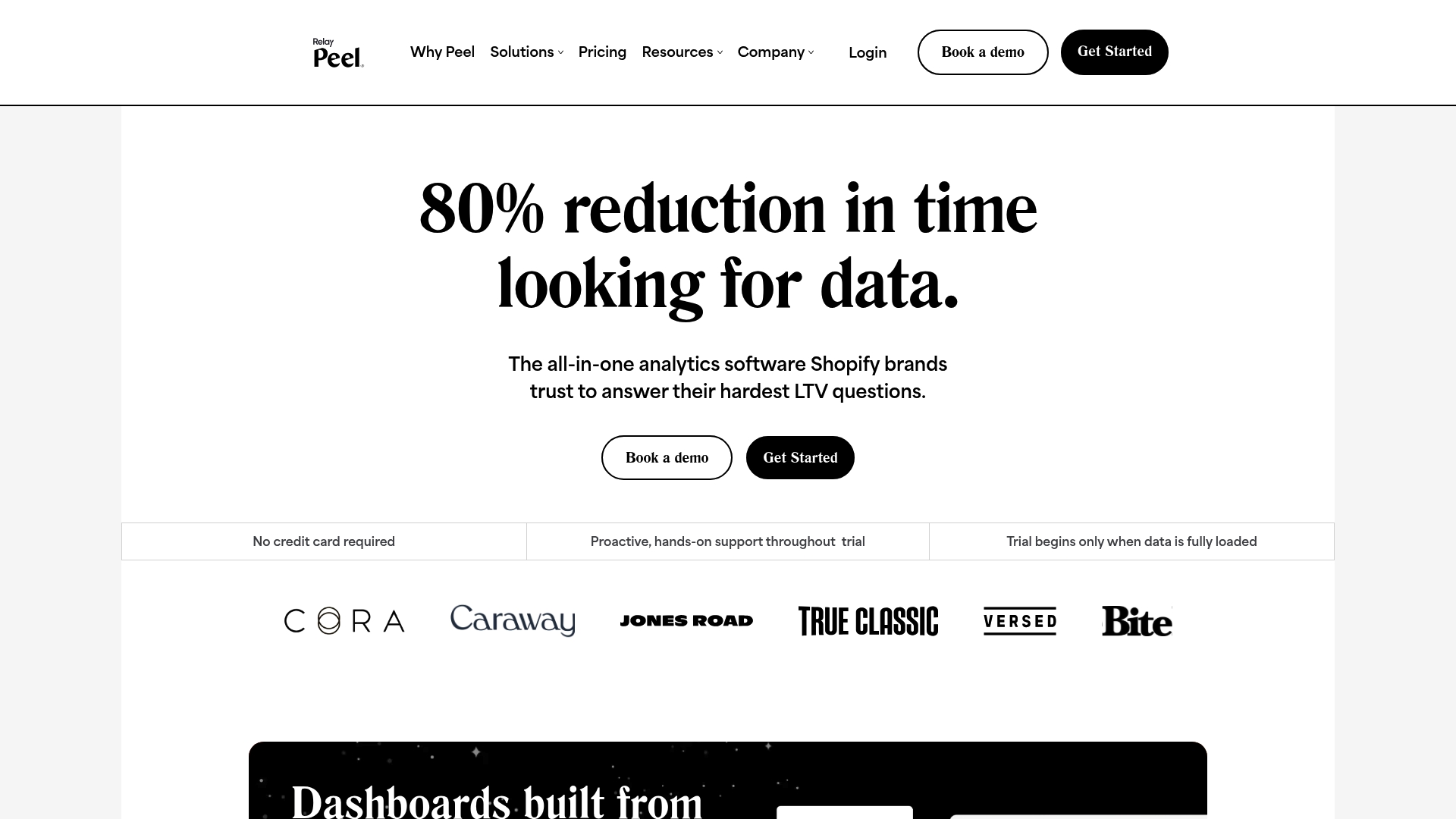
Peel Insights is an analytics suite built for Shopify brands that need clear answers about customer lifetime value and retention. It combines automated reporting with multi platform data to deliver fast, actionable metrics for marketing and product decisions.
Core Features
Peel centralizes automated cross channel analytics reports and pulls data from Shopify, Amazon, Walmart, and other platforms so you view revenue and retention in one place. The product also offers customizable dashboards and reports plus proactive insights delivered through Slack and email digests.
Pros
- Unified data platform: Peel brings multiple e commerce channels into a single view so you avoid fragmented spreadsheets and get coherent revenue reporting.
- Deep customizable insights: The dashboards support cohort analysis and customer segmentation so you identify high value segments and retention drivers.
- Ease of setup: No code integrations and automated report scheduling let teams start seeing metrics quickly without heavy engineering work.
- Strong support and onboarding: Peel provides hands on onboarding and support which accelerates time to value for mid market stores.
- Scalable plans: Pricing tiers and custom enterprise options let growing stores upgrade as order volume increases.
Cons
- Pricing scales with order volume which can become expensive for very large businesses and high traffic stores.
- Some advanced features and platform integrations sit behind higher tier plans so smaller teams may not get full value on entry plans.
- The depth of analytics can be overwhelming for teams without a dedicated analyst, which may require hiring or agency support.
Who It’s For
Peel suits e commerce brands, especially Shopify merchants, that rely on data to guide marketing spend and product decisions. You should have at least moderate order volume and either an analyst or a marketing manager ready to act on cohort and LTV findings.
Unique Value Proposition
Peel’s strength is combining speed and accuracy with cross platform visibility so you measure lifetime value, retention, and channel ROI from one source. That single source approach reduces attribution noise and helps you allocate ad spend more confidently.
Real World Use Case
A Shopify store connects Peel to combine Shopify sales, Amazon listings, and direct channel data. The team uses cohort analysis to spot a high lifetime value segment and shifts paid acquisition toward that audience, increasing repeat rate and raising revenue per customer.
Pricing
Plans start at $179 per month for the Core plan, with higher tiers available for larger order volume and custom enterprise plans for complex needs.
Website: https://www.peelinsights.com
MetricMosaic
At a Glance
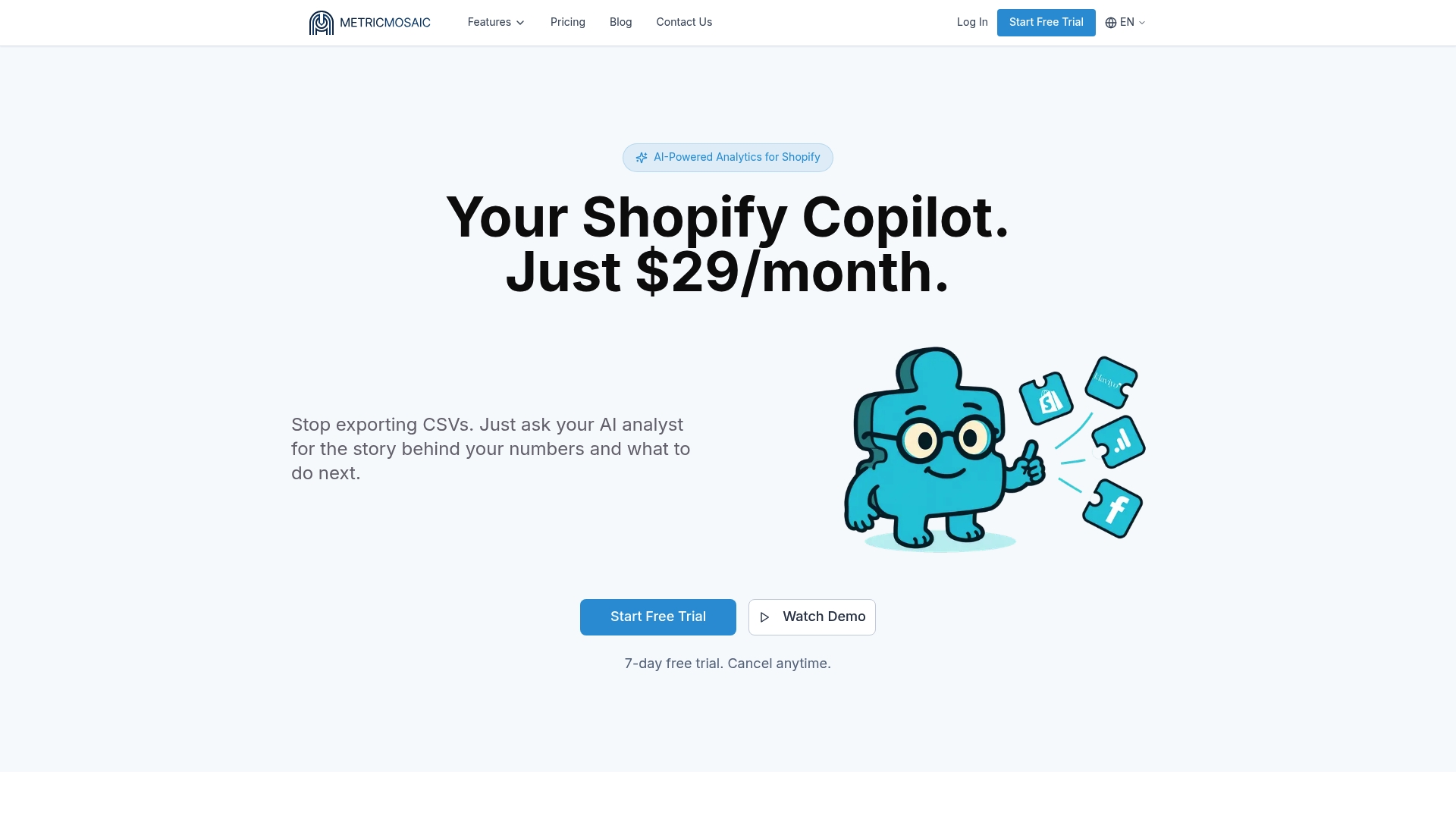
MetricMosaic is an AI-driven analytics tool built for Shopify merchants who want fast, actionable answers without spreadsheets. It pairs automated analysis with a unified view of sales, email, and ad data so you can act on trends quickly.
Core Features
MetricMosaic connects Shopify, GA4, Klaviyo, and Facebook Ads data into a single dashboard and requires minimal setup. The platform surfaces insights through AI-powered MosaicLive, offers narrative summaries with Stories, and delivers a personalized metrics hub called MyMosaic.
The product ships with purpose-built dashboards for Shopify merchants so you skip manual configuration and start reviewing performance immediately. MosaicLive answers specific trend questions, while Stories flags anomalies and opportunity areas automatically.
Pros
-
One-click setup: Installation and data connection are straightforward, which reduces time to insight for small teams.
-
Automated analysis: AI handles trend detection and anomaly explanations, saving hours you would otherwise spend in spreadsheets.
-
Unified data view: Seeing sales, ad, and email metrics together simplifies attribution and campaign evaluation.
-
Personalized insights: MyMosaic delivers the metrics you care about so you spend less time hunting for numbers.
-
Official Shopify app: Security and reliability feel stronger because MetricMosaic is an official Shopify app.
Cons
-
Pricing may be a barrier for very small stores since the most useful features require a subscription.
-
Platform scope currently focuses on Shopify and a limited set of connected platforms, so non-Shopify merchants get less value.
-
Core capabilities like MosaicLive and Stories only work behind active subscriptions, which adds ongoing cost for continuous insight.
Who It’s For
MetricMosaic targets Shopify store owners and marketers who prefer automated, AI-driven insights over manual reporting. If you run a small to medium Shopify store and want integrated ad and email analysis without hiring a BI specialist, this tool fits your workflow.
Unique Value Proposition
MetricMosaic packages automated business intelligence specifically for Shopify merchants so you get relevant, contextual stories about your store faster than building custom reports. The combination of tailored dashboards and near real-time AI explanations reduces guesswork and speeds decision cycles.
Real World Use Case
A small Shopify store connects its store, Facebook Ads, and email marketing data to MetricMosaic. The owner asks MosaicLive why revenue dipped last week, receives an immediate explanation, and uses Stories to identify an underperforming campaign segment to pause and reallocate budget.
This workflow shortens analysis from days to minutes.
Pricing
Plans start at $9 per month for the Light plan, with the Standard plan at $29 per month. Both plans offer free trials so you can validate value before committing to a subscription.
Website: https://www.metricmosaic.io
E-Commerce Analytics and Optimization Tools Compared
This table provides a streamlined overview of the key features, advantages, and target markets associated with four prominent tools designed to enhance e-commerce performance and analytics.
| Tool | Core Features | Advantages | Ideal For | Pricing |
|---|---|---|---|---|
| Swyft Interactive | High-conversion websites, automated email systems, marketing integration | Data-driven recommendations, full funnel solutions, extensive experience since 2015 | Mid-to-large e-commerce retailers seeking unified site and email strategies | Custom pricing available; contact for a proposal |
| Lucky Orange | Heatmaps, session recordings, AI CRO insights, visitor behavior tracking | Actionable behavior data, rapid setup, integrations with major platforms | Small-to-mid-sized businesses aiming to improve conversion rates with user behavior data | Free plan available; starts at $39 monthly for enhanced plans |
| Peel Insights | Multi-channel analytics, automated reporting, customizable dashboards | Unified analytics across channels, extensive support, scaleable plans | Shopify merchants and e-commerce with medium to high order volume | Starts at $179 per month |
| MetricMosaic | Shopify-optimized dashboards, AI-driven insights, integrated analytics | One-click setup, real-time automated analysis, unified sales and marketing data | Shopify merchants looking for cost-effective, AI-powered intelligence solutions | Starts at $9 monthly |
Compare each tool to determine the best fit for your e-commerce analytics and optimization needs.
Unlock Your Ecommerce Growth with Integrated Analytics and Automation
Understanding which website analytics tools truly move the needle for your ecommerce store is essential for accelerating growth and customer retention. The article highlights the challenges of unifying data sources and the need for actionable insights that guide marketing and product decisions—key pain points for brands aiming to boost conversion rates and lifetime value. By combining high-converting website design with powerful Klaviyo email automation, you can close the loop between site performance and data-driven marketing.
Explore proven strategies on our Digital Strategy Archives and elevate your email campaigns by visiting our Email Marketing Archives.
Don’t let fragmented analytics slow your brand down. Partner with Swyft Interactive to build an integrated ecommerce growth engine that delivers measurable improvements in conversions, customer engagement, and revenue. Visit https://swyftinteractive.com/ now to start turning data insights into scalable success.
Frequently Asked Questions
What are the essential features to look for in ecommerce analytics tools?
Look for features that track user behavior, such as heatmaps and session recordings, as well as metrics for conversion rates and customer lifetime value. Choose a tool that integrates seamlessly with your existing ecommerce platform to streamline insights and reporting.
How can I effectively use heatmaps to improve my ecommerce website?
Use heatmaps to identify which areas of your website attract the most attention and which parts are being ignored by visitors. Prioritize design changes based on this data to enhance user experience and drive higher conversion rates within a few weeks.
What kind of data should I analyze to boost customer retention?
Focus on understanding customer lifetime value, repeat purchase rates, and churn rates. Segment your audience based on purchasing behavior and target high-value segments to improve retention and increase overall revenue.
How do I set up an automated reporting system for my ecommerce analytics?
Implement a tool that offers automated reporting features to centralize your data collection across various platforms. Tailor the reports to include key metrics relevant to your business goals, and set them to deliver insights via email or direct notifications at regular intervals.
What should I do if my website analytics show a high bounce rate?
Analyze the pages with high bounce rates to identify potential issues such as slow loading times or unclear calls to action. Make necessary adjustments based on these findings to enhance the user experience and aim to reduce bounce rates by 20% or more over the following month.