

TL;DR:
- Agentic AI in ecommerce is autonomous and handles complex customer journeys independently.
- Back-office automation offers the highest ROI, especially in inventory, segmentation, and omnichannel workflows.
- Brands should focus on strategic implementation, build flexible systems, and prioritize human judgment over AI hype.
The idea that automation means setting up a workflow and walking away is one of the most expensive misconceptions in ecommerce marketing right now. In 2026, the shift toward agentic AI is rewriting how brands attract, convert, and retain customers at scale. But with that shift comes a new set of trade-offs that most marketing managers aren’t fully prepared for. This article breaks down what agentic AI actually means for your growth strategy, where automation genuinely pays off, where the hype outpaces reality, and how to build a roadmap that keeps you competitive without exposing your brand to unnecessary risk.
Table of Contents
- How agentic AI is transforming ecommerce marketing in 2026
- Key opportunities: Where automation delivers ROI in 2026
- Hype vs. reality: Risks and limitations of agentic ecommerce
- Practical roadmap: How to future-proof your ecommerce marketing strategy
- Beyond the AI buzz: What most ecommerce brands miss in 2026
- Unlock your ecommerce growth with proven automation strategies
- Frequently asked questions
Key Takeaways
| Point | Details |
|---|---|
| Agentic AI redefines automation | Autonomous AI agents are transforming ecommerce from rule-based systems to smarter, self-driven processes in 2026. |
| Focus on back-office for ROI | Automation in back-office operations yields the best returns and fewest risks for ecommerce marketing managers. |
| Balance opportunity with caution | Embrace automation, but stay vigilant about privacy, regulations, and over-reliance on consumer-facing AI. |
| Build a future-proof plan | A flexible, data-driven automation strategy positions your brand for lasting growth amid rapid change. |
How agentic AI is transforming ecommerce marketing in 2026
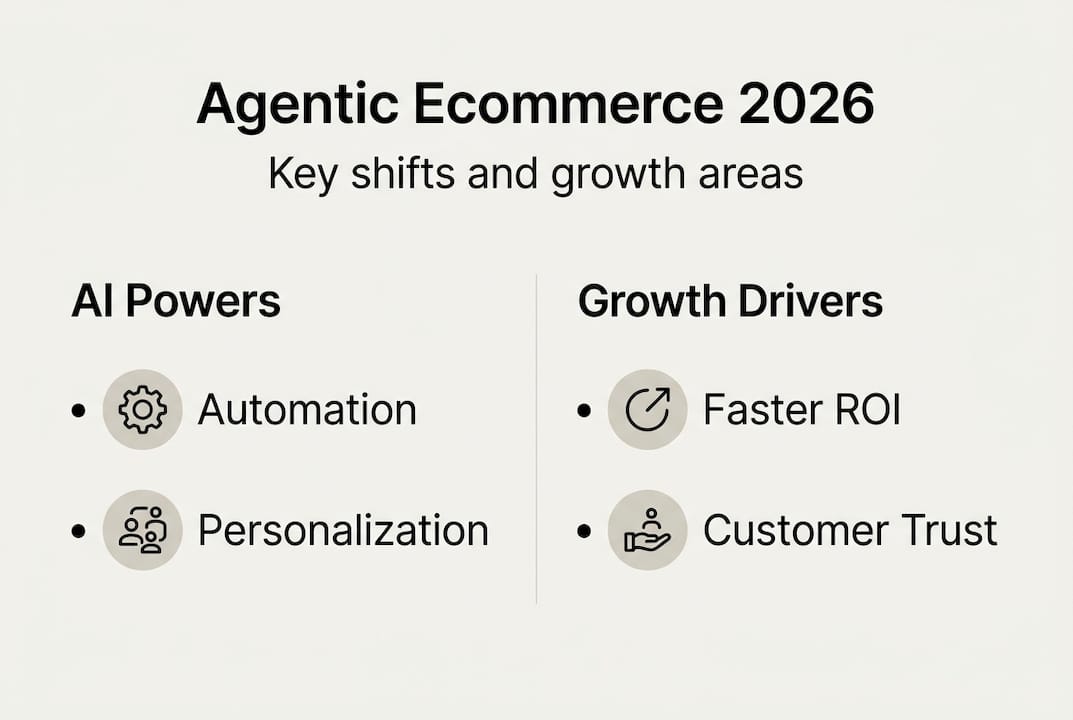
Most automation tools you’ve used until now follow rules. If a customer abandons a cart, send an email. If they browse a category twice, trigger a retargeting ad. These are conditional workflows, and they work well within defined boundaries. Agentic AI is fundamentally different. It doesn’t wait for a trigger. It observes, reasons, and acts on its own to complete multi-step goals, like finding the best product match for a shopper, negotiating a price, or managing a reorder cycle without any human input.
According to Forrester’s 2026 predictions, agentic commerce is emerging as the dominant trend, marking a clear shift from rule-based systems to autonomous AI agents that can execute complex tasks across the customer journey. That’s a significant leap from the automation playbooks most brands are running today.
Here’s a quick comparison of where the two approaches differ:
| Feature | Rule-based automation | Agentic AI |
|---|---|---|
| Decision logic | Predefined triggers | Autonomous reasoning |
| Adaptability | Static | Dynamic, self-adjusting |
| Human oversight needed | Moderate | High for consumer-facing tasks |
| Best use case | Email flows, retargeting | Inventory, pricing, back-office ops |
| Risk level | Low to medium | Medium to high (consumer-facing) |
The areas where agentic AI already delivers strong results for marketing teams include:
- Personalization at scale: AI agents can adjust product recommendations in real time based on browsing behavior, purchase history, and even external signals like weather or trending topics.
- 24/7 customer responsiveness: Agents handle inquiries, process returns, and guide shoppers through decisions without waiting for a human to log in.
- Dynamic pricing and inventory signals: AI monitors stock levels and competitive pricing, then adjusts your catalog automatically.
- Back-office workflow management: From supplier communications to fulfillment coordination, agents reduce the manual load on your operations team.
Human input still matters most when brand voice, ethical judgment, or creative strategy is involved. AI can execute, but it can’t replace the thinking behind a campaign that resonates emotionally. You can explore how AI automation growth in ecommerce is reshaping marketing priorities for brands at every scale.
Pro Tip: Start with back-office agentic AI before deploying it in customer-facing contexts. The ROI is faster, the risk is lower, and you’ll build the internal confidence to scale responsibly.
Key opportunities: Where automation delivers ROI in 2026
Not all automation investments are equal. The brands seeing the strongest returns right now are the ones that matched their automation tools to specific, measurable outcomes rather than adopting technology for its own sake. Forrester’s retail outlook confirms that back-office AI focus yields the most reliable ROI, particularly in areas where speed and accuracy matter more than emotional nuance.

Here’s where automation is producing real results across ecommerce marketing functions:
| Automation area | Primary benefit | Measurable outcome |
|---|---|---|
| Email segmentation | Precision targeting | Higher open and click rates |
| Lifecycle marketing | Timely, relevant touchpoints | Improved LTV and retention |
| Inventory management | Reduced stockouts and overstock | Lower carrying costs |
| Omnichannel workflows | Consistent cross-channel experience | Increased conversion rates |
| Post-purchase flows | Upsell and loyalty activation | Higher average order value |
The strongest ROI cases we see consistently involve:
- Behavioral segmentation: Using purchase and browse data to create micro-segments that receive hyper-relevant messaging, not just broad demographic groups.
- Abandoned cart and browse abandonment flows: These remain among the highest-converting automations in ecommerce, especially when personalized with dynamic product blocks.
- Replenishment and subscription triggers: For consumable products, automated replenishment reminders recover revenue that would otherwise be lost to competitors.
- Omnichannel coordination: Syncing email, SMS, and paid retargeting so that each channel reinforces the others without redundancy or fatigue.
Measuring ROI on automation requires more than tracking revenue per email. You need to factor in time saved, reduction in manual errors, and the compounding effect of consistent customer engagement over time. The proven growth strategies for 2026 that work best are built on clean data pipelines and clear attribution models. And the role of analytics in 2026 is central to making those models work accurately.
Pro Tip: Run a quarterly automation audit. Pull performance data for every active flow, identify underperforming sequences, and test one variable at a time to improve results systematically.
Hype vs. reality: Risks and limitations of agentic ecommerce
The excitement around agentic AI is real, but so are the risks. Before you commit significant budget to consumer-facing AI agents, it’s worth understanding where the technology is still catching up to the marketing pitch.
One of the most underreported risks is traffic cannibalization. As answer engines like AI-powered search tools become more capable, shoppers are getting product recommendations and completing purchases without ever visiting your website. Consumer-facing risks include direct traffic loss to answer engines and the gradual abandonment of traditional marketplace channels. That’s a structural shift in how discovery works, and it affects every brand that relies on organic search or platform traffic.
Here are the key risks marketing managers need to evaluate:
- Regulatory uncertainty: AI-driven personalization and autonomous purchasing agents are under increasing scrutiny from regulators in the US and EU. Compliance requirements are still evolving.
- Privacy concerns: Consumers are more aware of how their data is used. Aggressive AI personalization can trigger distrust if it feels intrusive.
- Brand voice erosion: When AI generates customer communications at scale, maintaining a consistent, authentic tone becomes harder without strong governance.
- Over-reliance on platforms: Deploying agents that depend on third-party AI platforms creates vendor lock-in and exposure to sudden policy changes.
- Misaligned expectations: Teams that expect agentic AI to replace human strategy often end up with expensive tools that underdeliver.
“AI excels in back-office automation, but consumer agentic risks include traffic cannibalization and slow adoption driven by regulatory and privacy concerns.” — Forrester, 2026
The brands that navigate this well are the ones building flexibility into their tech stack. Rather than betting everything on one AI platform, they maintain modular systems that can adapt as regulations shift and new tools emerge. Understanding how marketing funnels work in ecommerce helps you identify where AI adds leverage and where human-led strategy is irreplaceable.
Practical roadmap: How to future-proof your ecommerce marketing strategy
Knowing the risks and opportunities is only useful if you have a clear plan for acting on them. Here’s a practical framework for evaluating and adopting automation in a way that builds long-term competitiveness without unnecessary exposure.
Forrester notes that agentic AI demands thoughtful implementation to deliver maximum value, and that framing is exactly right. Speed matters, but so does strategic fit.
- Audit your current automation stack. Map every active workflow, identify gaps in your customer journey, and flag redundancies. Use this as your baseline before adding new tools.
- Define success metrics before you deploy. Every automation investment should have a clear KPI tied to revenue, retention, or efficiency. Vague goals produce vague results.
- Start with back-office automation. Inventory management, order routing, and supplier communications are low-risk, high-reward starting points for agentic AI.
- Build a data governance policy. Before expanding AI personalization, document how customer data is collected, stored, and used. This protects you from regulatory risk and builds consumer trust.
- Test consumer-facing AI in controlled environments. Pilot AI-driven chat or product discovery tools with a small segment before full rollout. Measure satisfaction and conversion impact carefully.
- Plan for interoperability. Choose tools that integrate cleanly with your existing CRM, email platform, and analytics stack. Siloed systems kill ROI.
- Review and adapt quarterly. The AI landscape is moving fast. Build a review cadence into your marketing calendar so your strategy stays current.
The automation checklist for ecommerce is a practical starting point for teams working through this process. Pair it with a data-driven marketing approach to ensure every decision is grounded in real performance signals.
Pro Tip: Prioritize interoperability and compliance from day one. Retrofitting a privacy-aware data strategy after the fact is far more expensive than building it in at the start.
Beyond the AI buzz: What most ecommerce brands miss in 2026
Here’s the uncomfortable truth we see repeatedly: brands that chase every new AI capability often end up with fragmented customer experiences and eroded brand loyalty. The ones that grow sustainably are the ones that use AI to scale what already works, not to replace the thinking that made it work in the first place.
Brand voice, ethical data practices, and genuinely creative campaigns matter more now, not less. When every competitor is running similar AI-driven flows, the differentiator becomes how your brand feels to a customer. That’s a human judgment call, and no agent can make it for you.
We’ve watched brands pour budget into agentic tools while cutting the creative and strategy teams that gave their marketing its edge. The result is technically sophisticated but emotionally flat campaigns that perform below expectations. Analytics for smarter growth can tell you what’s happening, but it takes human interpretation to understand why and to act on it with creativity and conviction.
Use AI for scale. Use your team for soul.
Unlock your ecommerce growth with proven automation strategies
If this article made one thing clear, it’s that the brands winning in 2026 aren’t the ones with the most automation. They’re the ones with the right automation, deployed strategically, measured rigorously, and adjusted continuously.
At Swyft Interactive, we help ecommerce brands build exactly that kind of system. Whether you’re ready to overhaul your automation for ecommerce growth, build out step-by-step email automation that converts at every stage of the customer journey, or evaluate the top automation tools for 2026, we bring the strategy and execution to make it measurable. Let’s build a growth engine that scales with your brand.
Frequently asked questions
What is agentic AI in ecommerce marketing?
Agentic AI refers to autonomous systems that handle tasks like product discovery, comparison, and purchasing without human intervention. Unlike rule-based automation, agentic commerce operates independently across multi-step workflows.
What are the main risks of AI-driven ecommerce marketing?
The primary risks include regulatory uncertainty, privacy concerns, and traffic loss to answer engines as AI-powered search tools intercept shoppers before they reach your site.
Which ecommerce marketing areas benefit most from automation in 2026?
Back-office operations deliver the most reliable returns. Back-office AI focus in areas like segmentation, inventory management, and omnichannel coordination consistently outperforms consumer-facing AI in measurable ROI.
How can ecommerce brands prepare for future AI regulations?
Brands should build flexible, privacy-centric data strategies now and monitor regulatory developments closely. Consumer agentic risks tied to privacy and compliance are expected to slow adoption, so early preparation creates a meaningful competitive advantage.