
Most eCommerce brands see up to 38 percent higher revenue when they master advanced email automation strategies. For marketing managers, understanding core terminology can unlock smarter campaign decisions with Klaviyo and deepen customer relationships. This guide delivers practical explanations for vital email concepts, helping you speak the language that drives engagement and increases sales across your American business.
Table of Contents
- Defining Core Email Marketing Terms
- Key Metrics Shaping Campaign Success
- Automation Terms Powering Klaviyo Workflows
- Segmentation and List Management Vocabulary
- Common Mistakes With Industry Jargon
Key Takeaways
| Point | Details |
| Understand Core Terms | Familiarize yourself with key email marketing terminology to enhance communication strategies and campaign management. |
| Track Key Metrics | Focus on essential performance metrics like Open Rate and Conversion Rate to gauge the success of your campaigns and optimize future efforts. |
| Utilize Automation Wisely | Leverage automation tools to create responsive email workflows that engage customers based on their behaviors and preferences. |
| Avoid Jargon Overload | Simplify communication by avoiding complex terminology, ensuring your messages are clear and accessible to your audience. |
Defining Core Email Marketing Terms
Understanding the core terminology in email marketing is fundamental for eCommerce brands seeking to optimize their digital communication strategies. From marketing communication basics to advanced automation techniques, these definitions create a shared language for marketing professionals navigating complex digital landscapes.
Key email marketing terms cover critical areas of campaign management and performance tracking. Deliverability represents the ability of an email to successfully reach a recipient’s inbox, while engagement measures how recipients interact with email content through metrics like opens, clicks, and conversions. Automation enables marketers to create sophisticated, triggered email sequences that respond dynamically to customer behaviors, such as abandoned cart reminders or post-purchase follow-ups.
Specific technical terms provide deeper insights into campaign optimization. A/B Testing allows marketers to compare two versions of an email to determine which performs better, helping refine messaging and design. Dynamic Content enables personalization by automatically adjusting email content based on individual subscriber attributes like purchase history or demographic information. Call to Action (CTA) represents the critical element that encourages recipients to take a specific action, whether purchasing a product, downloading a resource, or exploring a new collection.
Pro tip: Create a personal glossary of these terms and review it monthly to stay current with evolving email marketing technologies and strategies.
Key Metrics Shaping Campaign Success
Email marketing success hinges on understanding and tracking critical performance indicators that reveal the true impact of digital campaigns. Campaign performance metrics provide eCommerce brands with actionable insights into customer engagement, conversion potential, and overall marketing effectiveness.
Several key metrics stand out as essential indicators of email campaign performance. Open Rate measures the percentage of recipients who actually open an email, reflecting the effectiveness of subject lines and sender reputation. Click-Through Rate (CTR) tracks the number of recipients who click on links within an email, indicating content relevance and audience interest. Conversion Rate represents the ultimate measure of success, showing the percentage of email recipients who complete a desired action like making a purchase or signing up for a promotion.

Additional metrics offer nuanced insights into campaign health and audience behavior. Bounce Rate identifies problematic email addresses and list quality, while Unsubscribe Rate signals potential issues with content frequency or relevance. List Growth Rate helps marketers understand audience expansion, and ROI Tracking connects email marketing efforts directly to revenue generation. Understanding these metrics allows eCommerce brands to continuously refine their email strategies, optimize targeting, and improve overall marketing performance.
Here’s a summary of key email marketing metrics and their roles in campaign assessment:
| Metric | What It Measures | Business Value |
| Open Rate | Percentage of recipients opening emails | Indicates subject line effectiveness |
| Click-Through Rate | Percentage clicking links in emails | Reveals content relevance and interest |
| Conversion Rate | Recipients completing desired actions | Quantifies campaign ROI and success |
| Bounce Rate | Rate of failed email deliveries | Signals list quality issues |
| Unsubscribe Rate | Contacts opting out of list | Flags content frequency or relevance problems |
| List Growth Rate | Change in subscriber count | Shows audience expansion or decline |
| ROI Tracking | Revenue from email marketing | Connects campaign to financial results |
Pro tip: Create a monthly dashboard tracking these key metrics to identify trends, benchmark performance, and make data-driven improvements to your email marketing strategy.
Automation Terms Powering Klaviyo Workflows
Email marketing automation transforms how eCommerce brands engage with customers through sophisticated workflow management technologies. These powerful systems enable businesses to create intelligent, responsive communication strategies that adapt to individual customer behaviors and preferences.
Trigger Workflows represent the foundational mechanism of marketing automation, allowing brands to design sequences that automatically respond to specific customer actions. For instance, when a customer abandons a shopping cart, a predefined workflow can instantly dispatch a reminder email, potentially recovering lost sales. Segmentation plays a critical role in these workflows, enabling marketers to categorize customers based on detailed attributes like purchase history, browsing behavior, or demographic information, ensuring highly targeted and personalized communication.
Advanced automation terms reveal the depth of strategic communication possible in modern email marketing. Dynamic Content allows for real-time customization of email elements, displaying different product recommendations or messaging based on individual user profiles. Behavioral Tracking enables precise monitoring of customer interactions, helping brands understand engagement patterns and optimize future communications. Predictive Sending represents a sophisticated technique that determines the optimal time to send emails for maximum open and conversion rates, leveraging machine learning algorithms to analyze individual recipient behaviors.
Pro tip: Map out your customer journey and identify key interaction points where automated workflows can provide personalized, timely communications to enhance engagement and drive conversions.
Segmentation and List Management Vocabulary
Effective email marketing requires sophisticated understanding of audience classification techniques. Segmentation and list management represent critical strategies that transform generic email campaigns into precision-targeted communications tailored to specific customer groups.
Segments are defined subgroups within an email list, categorized by specific attributes like purchase history, demographic information, engagement levels, or behavioral patterns. Dynamic Segmentation takes this concept further by automatically updating customer groups based on real-time interactions, ensuring marketing communications remain relevant and responsive. Static Lists represent fixed collections of contacts that do not automatically change, providing a stable subset of customers for targeted campaigns that require consistent messaging.
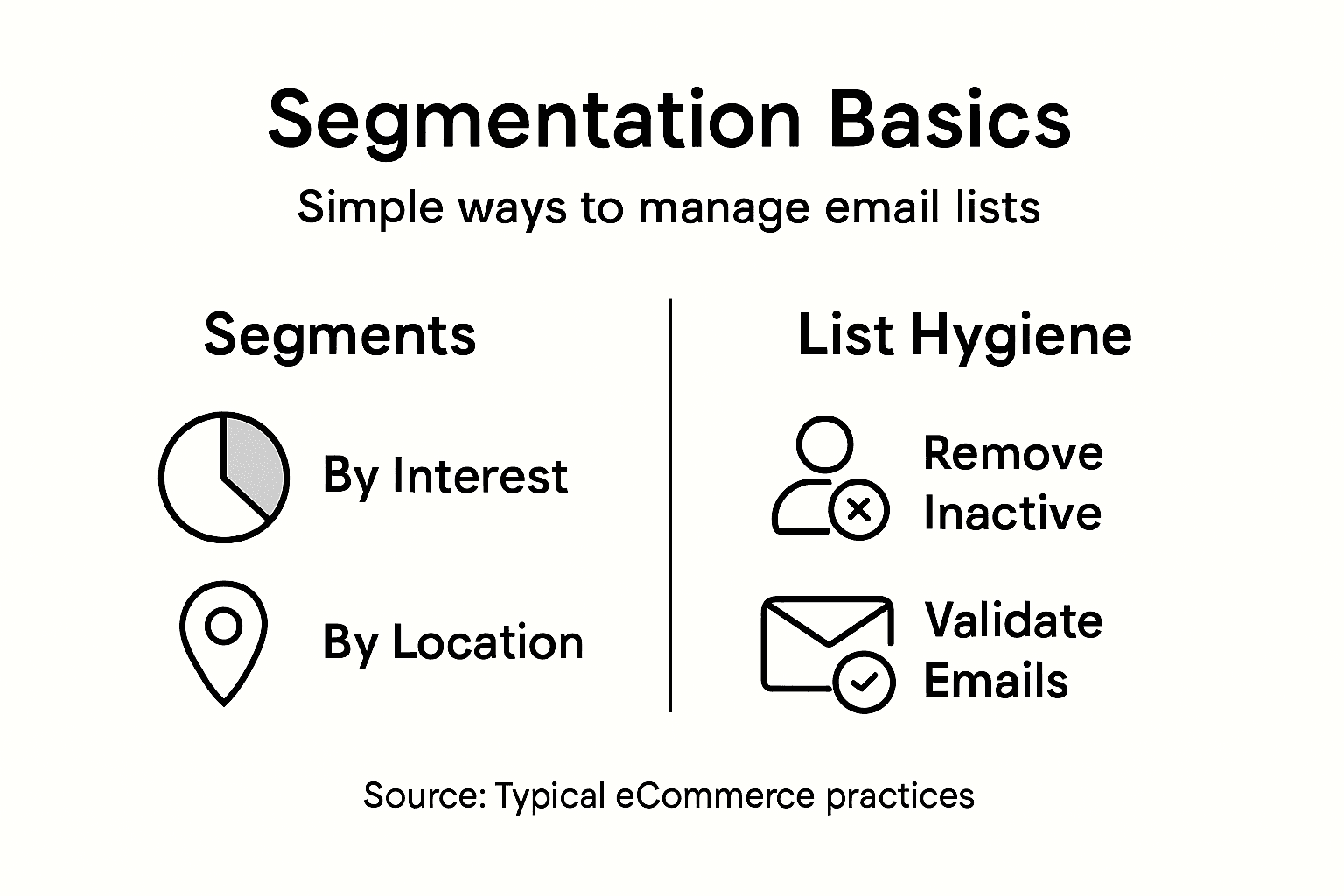
Advanced list management involves several nuanced techniques for maintaining email list quality and compliance. List Hygiene describes the process of regularly cleaning email databases by removing inactive subscribers, incorrect email addresses, and potential spam traps. Suppression Lists are specialized collections of email addresses that should never receive communications, including unsubscribed contacts, hard bounces, and customers who have explicitly opted out of marketing messages. Lookalike Audiences represent a sophisticated segmentation technique that identifies new potential customers with characteristics similar to existing high-value customer groups.
Compare static lists, dynamic segmentation, and lookalike audiences for effective list management:
| Method | How It Works | Best Use Case |
| Static List | Fixed group, does not auto-update | Announcements to consistent audience |
| Dynamic Segmentation | Updates automatically by user behavior | Personalized, targeted sends |
| Lookalike Audience | Finds users like your best subscribers | Growing list with high-potential leads |
Pro tip: Conduct a quarterly audit of your email lists to remove inactive subscribers, validate email addresses, and ensure your segmentation strategy reflects current customer behaviors and preferences.
Common Mistakes With Industry Jargon
Email marketing professionals often undermine their communication effectiveness by overusing complex technical language and jargon. Understanding how to communicate clearly can dramatically improve audience engagement and campaign performance.
Overcomplication represents the most common mistake in email marketing terminology. Marketers frequently use unnecessarily complex terms like “conversion optimization” when simpler phrases like “improving sales” would resonate more effectively with audiences. Technical Overwhelm occurs when emails become saturated with industry-specific language that alienates readers, particularly those less familiar with marketing terminology. For instance, replacing “implement dynamic segmentation strategies” with “create targeted email groups” makes communication more accessible and understandable.
Some industry terms can create genuine confusion and potentially damage brand credibility. Vague Metrics like “engagement rate” without clear context can mislead readers, while Misleading Descriptors such as “revolutionary” or “groundbreaking” without substantive evidence can erode trust. Successful email marketers translate technical concepts into straightforward, meaningful language that connects directly with their audience’s needs and understanding, focusing on clear value propositions rather than impressive-sounding but ultimately empty terminology.
Pro tip: Before sending any marketing email, read your content aloud and replace any term that makes you stumble or sounds overly complicated with a simpler, more direct alternative.
Master Email Marketing Terms to Elevate Your eCommerce Growth
Understanding industry terms like deliverability, segmentation, and automation is just the start. The real challenge is turning that knowledge into measurable revenue increases and stronger customer engagement. If you are struggling with managing complex workflows or optimizing your email campaigns for maximum ROI this article highlights key concepts that you cannot overlook.
At Swyft Interactive we specialize in transforming email marketing jargon into actionable strategies that drive your eCommerce brand forward. By combining expert Klaviyo automation with high-converting, fast-loading website design we help you build a scalable sales engine that boosts engagement and conversions. Explore insights on creating efficient email automations and dynamic segmentation in our Email Marketing Archives – Swyft Interactive or sharpen your full-funnel digital approach through our Digital Strategy Archives – Swyft Interactive.
Ready to stop guessing and start growing? Visit Swyft Interactive now to unlock proven, data-driven email marketing solutions tailored specifically for eCommerce success. Achieve better metrics faster and automate smarter with our expert guidance.
Frequently Asked Questions
What are the key metrics that determine the success of an email marketing campaign?
Understanding key metrics such as Open Rate, Click-Through Rate (CTR), Conversion Rate, Bounce Rate, Unsubscribe Rate, List Growth Rate, and ROI Tracking is essential for assessing campaign performance and optimizing email strategies.
How can automation improve email marketing for eCommerce brands?
Automation allows eCommerce brands to create responsive email workflows that engage customers based on their actions, like abandoned cart reminders or personalized follow-ups, enhancing customer experience and increasing conversion potential.
What is segmentation in email marketing, and why is it important?
Segmentation involves categorizing your email list into specific subgroups based on characteristics like purchase history or engagement levels, enabling more targeted communications that resonate with your audience and improve open and click rates.
What common mistakes should marketers avoid when using industry jargon in email marketing?
Marketers should avoid overcomplication and technical overwhelm in their language, ensuring clear communication by minimizing jargon and using straightforward phrases that enhance audience understanding and engagement.